While working on my current knitting project I’ve been squeezing in time to practice spinning merino. Eventually I’ll get good enough at it and find enough courage to start spinning the fiber from the Spin-Off sweater kit.

This week I’ve been concentrating on “wraps per inch” (wpi). In order to get consistent yarn in the spinning world, spinners measure the average width of their yarn by wrapping it around a ruler many times and then counting how many wraps there are per inch. This merino practice yarn is yielding between 13 and 14 wpi. Now I just need to figure out if this will translate into the correct knitted gauge for the project.
Yesterday I received the new summer issue of Interweave Knits and finally took a closer look at the “sources for supplies” section in the back. Not only do they show each yarn used in the projects but they also list the ply and wip of each one. It occurred to me that perhaps I could use this information to compare my handspun yarn to a store bought yarn that is close to the weight I need. Last night I pulled out my old issues and came up with a list of comparison yarns. A couple of the yarns are already in my “stash” so I should be able to find one that will work as a good comparison yarn.
If you’re not a spinner, you might still find wpi interesting since it seems like a good way to compare yarns when trying to find a substitute.
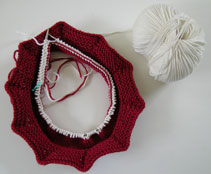 The pattern says to start out with a 16″ circular needle. Of course I didn’t have a 16″ needle so I attempted to use a 40″ and reduce the circumference using the magic loop method. With 160 stitches to manage, I twisted the stitches to form a
  Purlwise