
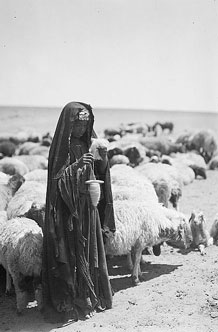
In 1790 John Greenwood, George Washington’s dentist, adapted his mother’s spinning wheel to power an early version of a dental drill.
Library of Congress, Prints & Photographs Division
In 1790 John Greenwood, George Washington’s dentist, adapted his mother’s spinning wheel to power an early version of a dental drill.
Library of Congress, Prints & Photographs Division
Library of Congress, Prints & Photographs Division
Emma suggested that I might try putting my unruly yarn through the wheel once more to see if that would help. Well I’ve been respinning some of it on my hand spindle and it seems to be working. I also marched over to the new library and checked out The Alden Amos Big Book of Handspinning. He takes up the subject of plying in a much more detail fashion any of the other spinning books.
I never thought that plying on a wheel would be so difficult.
(a) waistcoat, N Am: vest; (b) g. de sauvetage, life jacket; g. d’armes, fenching jacket; (c) g. (de corps, de peau de dessous), vest, singlet, N Am: undershirt; (d) (woman’s) cardigan. – Harrap’s New Collegiate French and English Dictionary
Oh, so that’s what gilet means in English. I translated the instructions but neglected to translate the title.
 Yep, this one is turning out to be a quick one. The most challenging aspects have been acquiring the yarn, translating the pattern and dealing with the messy half used yarn balls.
Figuring out how to cross two stitches was a bit tricky. While I understood the word-for-word translation of this stitch, I wasn’t familiar with the technique. Here’s how I ended up working these stitches after referring to several English knitting books.
Crossing Stitches
(enlarge any photo by clicking on it)
2 maille croisées à droite / cross 2 stitches right –
Knit into the second stitch on the left needle but don’t slip it off the left needle.
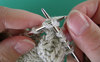

Knit into the first stitch on the left needle and then let both stitches slip off the left needle. In the photo on the bottom right, the two stitches on the left needle will be dropped off.


2 maille croisées à gauche / cross 2 stitches left –
Knit into the back loop of the second stitch on the left needle but don’t slip it off the left needle.


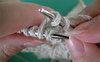
Knit into the back loop of the first stitch on the left needle and then let both stitches slip off the left needle. In the photo on the bottom right, the two stitches on the left needle will be dropped off.


 After a couple of attempts to ply the merino using a wheel, I think I’ve got it. The singles were spun with 15 twists per inch and plied with 10 twists per inch. This time I took more care when plying although the skein does have a slight “S” twist. According to The Spinner’s Companion, I’ll need to add more twist during plying. At least it doesn’t look as bad as my first attempt (the red skein). Maybe Patternworks could sell my first attempt as scarf & novelty yarn. It would fit right in with Cool Stuff for $50.00/skein.
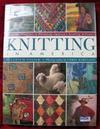 While browsing books at the library yesterday, I came across Knitting In America by Melanie Falick. Wow, what a beautiful and inspiring book. It profiles 38 knitting designers, authors and fiber related places in America. I’m enjoying reading about Priscilla Gibson-Roberts, Nancy Bush, Lizbeth Upitis, Sarah Swett and others.
I was especially interested in the profile on Sarah Swett who designed the Spin-Off sweater that I’m making. Check out her web site. Her all tapestries are truly amazing, but I especially like Hands. Her Kestrals Alight Cropped Kimono is now on my list of future projects. The pattern is in Knitting In America.
Another pattern added to my sock list is the Pretty Comfy Socks pattern that Emma is currently knitting. Emma thanks for sharing this pattern by Debbie Young. Your socks are coming out beautifully and look quite comfy. I just happen to have several balls of Fixation that needed a pattern.
When I knit in public, I never know what will come from it.
Last summer while on a short hiking trip in the Methow with folks from PBI, I whipped out a mitten project during our lunch break. As I worked a few rows, my fellow hikers mentioned that knitting and spinning was a popular activity when they moved there among a wave of hippies. One hiker mentioned that she happened to have a fleece given to her by a friend who had raised sheep and spun wool. It had been used as part of a Halloween costume but was no longer needed. Since I was so enthusiastic about knitting, she graciously offered me the fleece. I gladly accepted not fully understanding the ramifications.
After the fleece sat in the box for a couple of weeks while I research what to do with it, I finally got enough courage to dive in and clean it. I’ve read that a fleece can be soaked in a top loading washing machine as long as there is no agitation. After the fleece is clean through soaking, the water can be spun out of the wool by putting the washer in spin mode. Although this sounded like a fast way to get the job done, this method wasn’t an option for me since I converted to a front loader a couple of years ago.
 Here are the steps that I took to manually clean the fleece. It’s a long process but keeps the lock intact which is important when spinning worsted yarn.
1. Separate a bunch of the wool locks from the fleece and put them in a mesh laundry bag, keeping the cut ends together so as not to mix up the ends of the wool.
2. Fill the buckets with very hot tap water and then add lots of Dawn dishwashing soap.
3. Place the mesh bag of wool into one bucket and let it soak for 10 minutes. Be sure not to agitate the wool or it might felt.
4. Repeat soaking with another bucket of new water until the water starts to look clean. Each bucket of water must be at the same temperature as the last, otherwise the wool might start to felt.
5. When the wool is fairly clean, rinse it in fresh hot water.
6. Gently take the wool out of mesh bags and put on a drying rack. It takes about one to two days to dry.
The mesh laundry bags help keep the locks together and allow the wool to be delicately removed from the water. Keep in mind that wool will felt if there is too much agitation or a drastic change in the water temperature.
Don’t be surprised if the wool changes color when cleaned. This one turned from brown to gray with white highlights.

 Here’s what I accomplished over the weekend while on a car trip to the other side of the mountains. Hopefully it will get more interesting when I start the sleeves. The main body pieces are simple rectangles, minus a small triangle on the upper edges. The sleeves are a little more complicated since they extend over the shoulders to form the collar and upper back.
The curled edges in the photo got me thinking about blocking. To be honest, I’m not serious about blocking. I usually just lightly steam any curled edges and move straight to sewing. However, this time I’m going to try using a set of blocking wires that I learned about a couple of months ago while reading Marilyn’s blog.

Bergereine is unlike any yarn that I’ve used.
Of course, being a new spinner, I took apart a piece to see how it was made. It’s constructed with 4-ply strands of 3-ply yarn. Each 3-ply yarn is made of two strands of cotton thread and one strand of wool.
It knits nicely but is not so easy to rip out since the small strands of cotton tend to get easily snagged by the needle. The fabric has the feel of soft cotton and the stretch of wool, so it should make a comfortable summer sweater.
I’ll be casting on a piece this week – probably a sleeve. Yep, I’m knitting this one in pieces instead of adjusting it to knit in the round. It will be so much easier to take along with me if I knit in pieces.
Friday, I plyed some singles on my wheel for the first time and ended up with a twisted mess that couldn’t be straightened through washing. It was all very sad. Plying on a spindle never produced such horrible results, so I was a little depressed about the whole ordeal.
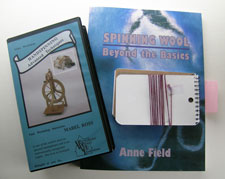
While at the sale on Saturday, I finally caved in and bought Spinning Wool Beyond the Basics by Anne Field. Although I’ve only flipped through the book, I’ve learned how to regulate twists per inch (tpi) by counting treadle cycles. Only an inch of fiber is feed into the orifice for every revolution of the wheel. Monitoring twist in this way should result in a single with consistent twist through out the thread.
The book mentions keeping track of the wheel revolution by counting on the down pedal but I’ve come up with my own technique. I put a bright sticky note on the top edge of the wheel and watch for it as I spin. Every time I see the sticky note at the top, I feed in an inch of fiber.
The singles are look pretty good but the real test will happen when I attempt to ply. Before my next attempt, I’ll follow the handy 2-ply twist comparison chart in Beyond the Basics to determine the correct plied twist per inch. This chart lists desired tpi for singles along with corresponding tpi for plied yarn. Singles are generally plied with 2/3 of the amount of twist used to spin the singles.
This weekend I also received my Paradise Fiber order which contained a copy of Handspinning Advanced Techniques. It promises to teach me how to “make a plied yarn of any exact thickness with just the amount of twist …” Sounds promising. I started watching it but dozed off after the hand carding segment.
 The Weaving Works is having a Mother’s Day sale this weekend and knowing how much my mother loves socks, I picked up a skein of Mountain Colors Bearfoot sock yarn.
Mom, this yarn will eventually become the “fall” socks that you requested. Happy Mother’s day.
The fool doth think he is wise, but the wise man knows himself to be a fool.
– Shakespeare
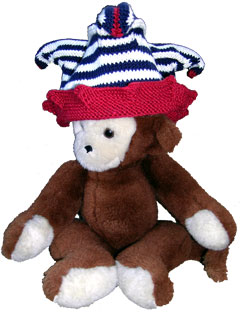
Yep, I didn’t add the bells but I’m considering adding medium size pompoms.
The model was made from a kit that I put together in a Junior High Home Economics class. I can’t believe he’s hung around all these years.
 Purlwise
You must be logged in to post a comment.