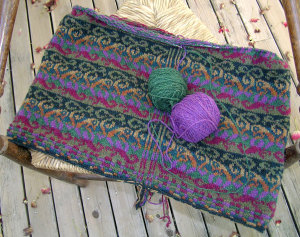
Found!

Woollyboard

I guess if you have patience and look hard enough you’ll eventually find what you’ve been seeking.

I was very lucky to find this Woolly Board II for the bargain basement price of $10. However, shipping from the East coast was another $35.

It’s made of finished poplar wood. All the pieces come apart and are stored in a handy cloth bag. It came with instructions but didn’t include any indication of who made it. My guess would be that it was made in the early or mid 90’s when Ms. Starmore’s books were still in circulation. The instructions refer to the woolly board shown in Stillwater.

Knitter ISO jumper board

Last week I must have run across some bad karma because my tension didn’t seem to be up to snuff so mid week I rip out a whole lengthwise repeat. So, even though I anticipated finishing the neck shaping this week, it didn’t happen. Today, I’m just now at that point.

body

Traditionally, knitted items such as this one are dressed on some type of frame. I did a bit of searching and came up with these pictures.

  • Here’s a Japanese website called Shaela that shows the two most common frames,  “Woollie Horse” and Jumper board. I can just make out from one photo that the Woollie Horse is from Tulloch of Shetland.
  • The Shetland Museum’s website had several old photos of jumper boards.
  • Knitting Beyond the Hebrides has instructions to make one.
  • There’s a website with the URL www.jumperboard.com that appears to be located in Shetland that is selling them.

There’s several online yarn suppliers that are offering some version of this frame with the cheapest around $90. That seems like a lot of money to plunk down on a knitting device that can only be used for sweaters with drop shoulders. Generally, I don’t like sweaters with drop shoulders but overlooked that fact when choosing Firebirds. The colors and pattern was just irresistible.

Hold it a minute

When knitting with only one color I hold the yarn in my right hand between my thumb and forefinger, with no extra yarn wrapped around any fingers. I probably came across this method when I first started teaching myself how to knit from books but didn’t bother learning the details of how to tension the yarn around other fingers. I’ve tried the proper way of holding yarn in the right hand but always go back to my own way. I love how it gives me total control over the tension, even if it is a little slower method of knitting.

Holding two yarns

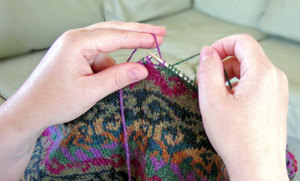
Learning to work with two colors was quite a challenge. I tried knitting with both colors in my left hand, both in my right and one in each hand. As you can see in the picture, I finally settled on holding one color in each hand. Of course,I don’t hold the yarns as shown in most books.

The yarn in my right hand is held as I do when knitting with one color. The yarn in my left hand is held between the first and second finger. To give more tension to the yarn in this hand, the working yarn is always placed in front of the object being knitted and held in place with my thumb.

While I can put lots of tension on the yarn with this method, I don’t. I always make sure that tension in both yarns is very even and not too tight or too loose. When switching between yarns I “fan out” the stitches on the right needle to make sure the yarn carried along the back isn’t too tight.

My advice on holding yarn is to practice until you find a way that achieves the best results.

Progress report:
Next week the body of Firebirds should be nearly completed. This week I started the arm steeks.

Giving new life to an old planner

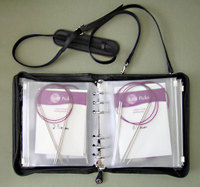
Needlebinderinside_1I did a little more rummaging around at the thrift store and found a decent looking binder for my needles. It’s amazing what one can find in that store. I’m recycling this old Franklin Covey planner cover into a binder for my needles. A little scrub down with leather cleaner and it looks almost new. The detachable shoulder strap is a bonus.

For any of you out there that are also looking at various binder alternatives, I noticed that these binder pages from Knit Picks can fit into  8.5″ X 5.5″ binder. Just stagger them until the holes line up into the rings. I also tried this with a normal sized 3 ring binder and voila, the pages can also be made to fit one of those.

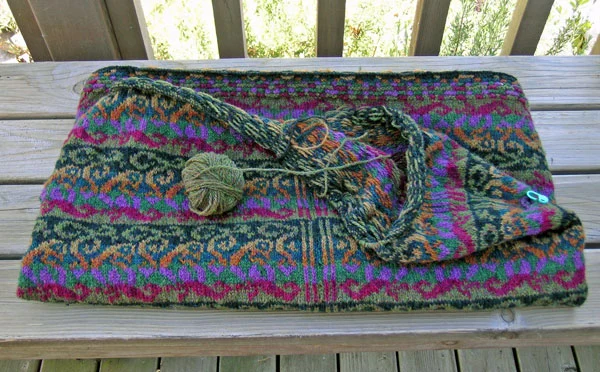
I did make steady progress on Firebirds this week. Here’s a photo of the back. Notice how that birds on the left face left and the ones on the right face right? I love this detail of the design. For now I’ve stuck with the pattern hoping all will work out well when I dress the sweater on a woolly board. On the next row the steeks for the armholes will be started.

Ss_socks_yarnEven though it’s hard to put Firbirds down, yesterday I started winding yarn for another sock project. Although I generally knit one item at a time, I’m itching to take on another more portable one.

Working with two hand painted yarn colors on my last sock project was so enjoyable that I want to explore similar possibilities. So my next little project will be the Sunrise-Sunset Socks from Big Girl Knits.

A few changes

Body3repeatsKnitting on Firebirds continues as usual, with a pace of about one lengthwise repeat per week.

Previously I mentioned that I was going to shorten the sweater by one repeat. Well, plans have changed after taking a moment to check my tension.

While my stitch tension seems to be fine (~7 sts per inch), I found that my row tensions is off a bit. I’m knitting 8.43 rows per inch while the pattern calls for 8 rows per inch. Yikes! that’s going to make the sweater about one inch shorter.

I’ve gotten squeamish about shortening the sweater one whole repeat. That would be 3.5 inches, which seems too much. At the same time I’m also concerned about the width. As I’ve been contemplating this dilemma, I remembered hearing the teacher in a beginning knitting class say that you can always block a sweater so it’s wider or longer but not both. With that in mind, I’ll go ahead and knit all seven lengthwise repeats and try to stretch the sweater out an inch with a woolly board.

Besides worrying about the overall length, I also started thinking about how my row tension could affect other parts of the sweater; specifically the armholes and neckline. The difference in row gauge means that I’ll need to start the armhole steeks a few rows sooner so that the length of the armhole matches the length specified in the pattern. However, no adjustments for the neck opening will be needed. After doing a bit of math, I found that the tension differences won’t make enough of a difference to merit adjustments.
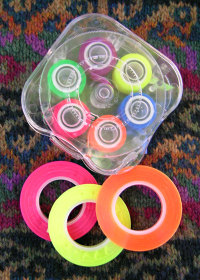
Chart_marking_tapeOn another note, I was at the fabric store yesterday checking out fabrics to cover my needle binder and found these tapes near the  rulers used by quilters. Apparently, quilters use them to mark off frequently used measurements on their rulers. When I saw them I though, wow I could use those for marking my knitting chart for my current project.

My first attempt started with a piece of blue tape from “Tape Go Round”; the funny tape dispenser with six little tape rolls. It didn’t take long before I found out this tape wasn’t going to work. When I tried to move it to another row it didn’t come off very easily and started tearing my paper chart.

Next I used one of the tapes called “Glow-Line Tape”. This tape was about $1 cheaper with couple more yards of tape. This one worked much better but oddly isn’t quite tacky enough to last more than a couple of rows.

I ‘m considering going back to good old Post-it notes.