Splicing

Sleeve_yarn_ends

Monday night I caught up with the Feral Knitters and brought Firebirds along.

They’re a subset of knitters from the Seattle Knitters Guild who focus on traditional projects such as Fair Isle and Aran knitting.

I was whole heartily welcomed and everyone was very friendly. They all seemed eager to allow one more Fair Isle knitter into the group.  As soon as I found a place I pulled out Firebirds to show to everyone. All were so kind with their comments and loved seeing this Jade Starmore design in person.

As I was showing it to Janine, she noticed the many dangling yarn ends on the sleeve. She suggested that I splice color changes instead of leaving ends. I’m glad she said something because I was wondering how I should handle color changes before I started the sleeve. It’s not that I didn’t know about splicing but thought it wouldn’t look right if each yarn was a different color. Janine said that if the values are close enough than it’s not really noticeable, especially if the color change is under the arm. With this new advice I started splicing most of the color changes.

When I spliced in the past, I would unravel each yarn end, discard one ply from each yarn, put the remaining ones together in the palm of my hand, spit into my hand and rub the plies together until they felted. This method seemed to work OK but didn’t always seem too sturdy. In fact I did it a few times on Firebirds and had to rip out some rows to fix a splice that started falling apart.  So when that happened, I knew there had to be a better way that would result in a stronger splice. I put a little more thought into the process and revamped how I splice. Here it is.

How to splice yarn
Splice1

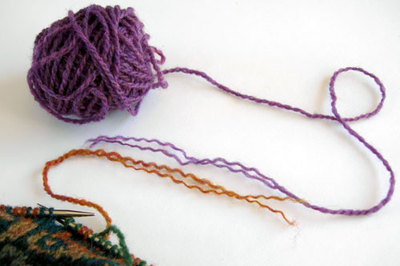
1. Unravel the plys of the two yarn ends that need to be spliced. Look at the two yarns as they lay side by side and figure out which ply
from one yarn would easily twist around a ply from the other yarn. I
find one ply that easily fits into the “kinks” of the other and twist
these two plys together with the same amount of twist while leaving the
other two plies dangling.
Splice2

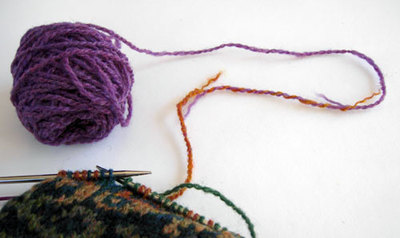
2. When the two opposite plies are neatly twisted together, I break off the extra plies but leave a tiny overlap.  Here’s a closer view of the two plies after they’ve been twisted together and the extra ends are broken off.
Splice5_1

3. Now make the extra ends stick together by spitting into one palm. Place the yarn into the wet palm and  rub with the other palm. This should felt the ends into the yarn.

Here’s a closer view of the finished splice.

Now I won’t have so many ends to weave!
Public and private side of the sleeve

sleeve: public side
sleeve: private side

I found enough courage to finally cut one of the arm steeks and pickup the sleeve stitches.

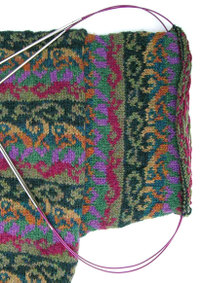
In the picture on the right, you’ll see the inside (private side) of the sweater and I’ve pointed out where I picked up stitches from the cut steek. So far the edge hasn’t unraveled much despite several attempts at picking up stitches before getting it right. When the sleeves are finished I’ll trim the steek stitches if necessary and tack down the remaining stitches as described in A. Starmore’s book.

In the picture on the left you’ll see the outside (public side) of the same sleeve. Notice how it starts in the middle of a lengthwise repeat. I’ve read that traditional Fair Isle sweaters are usually designed so that there are no partial lengthwise repeats. With that being said, I think the long single lengthwise repeat in this non-traditional sweater makes it impossible to avoid a partial repeat on the sleeves, especially the adult versions. I did however notice that the child’s version shown on the Virtual Yarn website, has sleeves with three full lengthwise repeats.

One thing leads to another

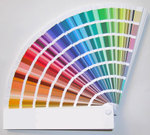
Color_fan

I haven’t knitted much this week but have found lots of eye candy on the web.

I like color.

Last week I popped over to the Interweave website to see when the next issue of Spin Off was coming out. While looking at the blurb about the next issue I noticed a picture of a very colorful felted bag. When I went back to their website a few days later, the photo had been replaced with the cover of the Fall 2006 issue. I wasn’t sure if I would ever see that bag again since it wasn’t on the cover.

Yesterday, my copy of arrived and I found the bag on  page 60 with an article by Nancy Roberts called “Machine Knitting to Dye For”. This morning I got a chance to read through the article and it amazed me. She describes how she knits plain white yarn on a knitting machine creating “blank” fabric, dies this fabric and then unravels the yarn to use it for a totally different object that is knitted by hand.

I did a bit of searching and found a picture of Nancy’s work including that bag. It’s is the one in this picture with wooden handles. The article says that it was knit with two colorways in a stranded pattern (a.k.a. Fair Isle Knitting?). I’ve been thinking about this concept of knitting with two colorways ever since knitting my Fair Isle socks.

Check out this shawl by Anni. Isn’t it amazing. Looks like she used the same multi-colored yarn but started each strand at a different color. Doesn’t the yarn she uses look very similar to the type Nancy dyes?

And if that’s not enough eye candy, look at these socks by Sara Lamb. I found her blog while looking for more information about Nancy’s technique. I’ve seen her work in Spin Off and admired it. It tempts me to take up weaving.

Front and back

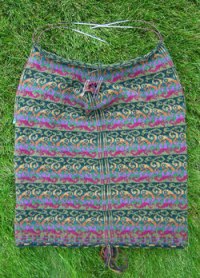
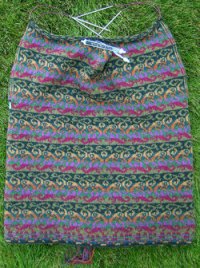
frontback

Almost looks like a skirt rather than a sweater. I promise it will start looking more like a sweater soon.

Notice the stitch holders. Just after casting off the extra stitches some stitches are put on hold just before starting decreases for the neck line.

On the front neck line, several inches of stitches in the center of the body are put on hold and the knitting continues in the round with decreases on either side of the extra stitches. Thanks to Anne Feitelson’s book, I learned that the decreases should slant towards the extra stitches – totally opposite of what I would have thought.

On the back neck line, about 1/3 of the stitches at center back are put on hold just a few rows before the body is complete. This small dip in the back will help the collar sit comfortably around the neck; or so I’ve read in various knitting books.

Although not shown in these photos, the shoulders were grafter together earlier this week.

Next step is to cut the extra stitches at the sides  and to pick up stitches for the sleeves. What a difficult thing to do since once done, there’s no turning back.

By the way,  this photo wasn’t taken in my yard. We tend not to water the little grass that we do have. This large lawn was well nurtured by my father for the past year.