I’ve made nearly a dozen pairs of socks since I took up knitting in earnest a few years ago, but have never tried making knee-high socks. I didn’t think much about making some until I attended Judith’s class on spinning for socks last year. During a discussion on fit, I showed her a pair of my hand knit socks that bulged at the ankles and asked her how I could avoid it. The solution was simple, add some strategic shaping to the leg. She recommended getting a copy of The Complete Book of Progressive Knitting by Ida Riley Duncan to help figure out the details. I got a copy of the book soon after the class but let the idea linger in my knitting thoughts until now.
While my foot tends to fit any medium sized sock pattern, I usually end up shortening the length of the leg about one inch so it will “fit” below the meaty part of my drumstick shaped leg. It’s a trick that works well for most patterns, especially ones with ribbing, but last month after knitting a few inches of the Fair Isle socks from Blue Moon Fiber Arts , I realized that such a colorful sock would look great with a much longer leg. At this point I wasn’t able to ignore reality, if the leg was to be longer, I’d have to figure out how to shape the sock so it fit properly. I ripped out what I had done and set the yarn aside so I could worked out the details on a simple sock, without any motifs. A couple of skeins of Mountain Colors 4/8 wool (Northern Lights & Yellowstone) have been lingering in my yarn reserve so I pulled them out and started knitting away after checking various references on the subject*.
One of the most helpful sources of information came from Holly Shaltz’s tutorial called Shaping Knee Socks. I printed out the worksheets, entered my measurements, did the calculations and started knitting. Her instructions start with knitting the socks from the top to toe so, against my better judgment, that’s how I started.
It’s easy to plug in all the numbers and calculate figures but it’s hard to know how much ease to allow. I started out casting on 104 stitches and ended up revising that to 88. After knitting the ribbing, I worked several alternating rows of increases to reach a total of 96 stitches for the widest part of the calf. This part of the leg is knit straight for a couple of inches before starting decreases which continue until several inches short of the ankle.
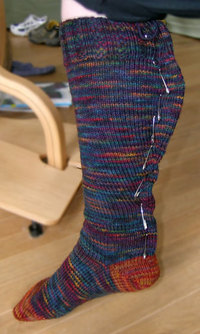
As my knitting progressed, I tried on the sock every few inches or so and thought all was going well after a few initial adjustments. Once off the needles, I immediately tried on the sock and walked around the house. It didn’t take long for the top to droop and the ankle to sag. There was no doubt that this sock needed more adjustments so I pulled out my safety pins and carefully pinched out the extra fabric. I retested the droop factor by walking around but also added a short trip down the stairs. Turns out that walking down stairs seems to be the ultimate test of whether a sock will stay up.
During the next week, I’ll start working on the second sock making adjustments after considering the amount of ease that I was able to pinch out of the leg of the first. This time I change knitting directioon and start the toe so that adjustments to the width of the leg will be easier to manage and test as I knit.
* References:
– The Complete Book of Progressive Knitting by Ida Riley Duncan
– Hand-Knitting Techniques from Threads
– Knitting Around the World from Threads
– Socks: A Spin-Off Special Publication for Knitters and Spinners

 Purlwise