 Here’s my latest skein of wheel spun merino yarn. Notice how nicely balanced it is. It hangs in a nice round circle. My plying skills have definitely improved after lots of practice, reading several spinning books and watching two videos.
Last night I picked up a copy High Whorling by Priscilla Gibson-Roberts (PGR) that’s been sitting on my book shelf for a year. I guess I didn’t really think much about it when I purchased the wheel since it “only” covered handspindles. Oh, that was an oversight. Yes, it doesn’t discuss spinning wheels, but it does cover all other aspects of spinning. In many respects, I think it’s probably the best of all the books and videos that I’ve used.
Here are some tips that I’ve picked up from PGR’s book and other sources.
1. Make a “self” ply sample that can be used as a reference during plying.
Most sources mention this by saying that a sample can be made by letting a freshly spun single strand fold back on it self. PGR takes it a logical step further by mentioning that a sample should actually be made under tension to get a much more accurate sample.
Incidentally, I came to this conclusion before reading PGR’s book. I make all my samples under tension using my hand spindle by pulling out a long section of the freshly spun single, placing the hook of the handspindle in the middle of the strand and putting the two ends of the strand together, letting the single ply itself with the weight of the spindle. Don’t add any extra twist.
2. Frequently refer to the ply sample while plying.
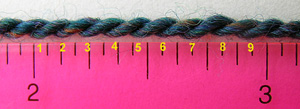
It might not be easy to see differences between the ply sample and the plied yarn on the wheel. A good way to check differences is to count the number of bumps per inch in the sample and compare that number with bumps per inch in the yarn being plied.
3. Don’t bother measuring whether a yarn is balanced during plying.
Many sources say that you can determine whether your yarn is balanced by hanging a long piece of freshly plied yarn between the orifice and your hand or a similar test from the spindle. If the piece twists then it isn’t balanced.
Well, there’s no need to do this test. PGR and Alden Amos mention that the twist in a single will set almost immediately, so such ply tests with “old” singles don’t give accurate results. It’s best to just refer to the plied sample that was done from freshly spun singles. Wool has memory of the original twist once it is washed.
4. Don’t over twist when plying.
PGR mentions that the stitches in knitted fabric with over-twisted yarn will look odd. One side of the stitch will be fat and the other thin. I’ve noticed this effect with commercial yarns such as Cashmerino. To minimize this effect, make sure the angle of the ply is appropriate for the diameter of the single.
5. Finish the yarn by simmering it in a pot on a stove.
I finished the skein, shown in the picture above, by following PGR’s instructions. I put the yarn in a large enameled pot with warn water, placed the pot on the burner and then set it to medium heat. I monitored the heat with a thermometer so that the water didn’t get hotter then 180 degrees Fahernheit. Once it reached 180, I turned off the burner and let the water cool before I removed the yarn. I gently squeeze much of the water out of the skein with a towel and then hung it to dry. PGR mentions that she doesn’t put any weight on the yarn while it dries since this tends to take elasticity out of it.
You might be wondering why I’m so obsessed with getting a balanced yarn. Well, if the yarn isn’t balanced then it will knit up in a skewed fabric that slants on a bias.
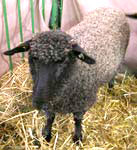 I continued to browse the various wool and equipment vendors but had a hard time deciding on what to buy so I took a break from shopping to check out wool on the hoof. This Wensleydale cross from Carlson Farm has the most beautiful curly wool. It didn’t take much imagine to visual how pleasant it would be to spinning straight from the locks.
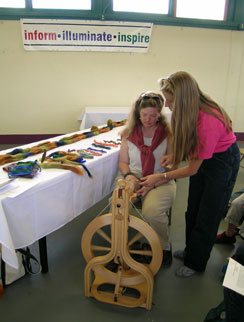 At noon I attended Annie Dachnal’s demonstration on spinning multicolored roving which was based on a workshop taught by Lynne Vogel at SOAR last year.
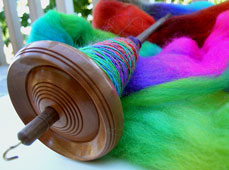 Here’s a bit of one roving that I spun on my new Tabachek spindle. I’m always on the look out for a well balanced and long spinning spindle. This one has quickly become my favorite.
 I was starting to feel smug about the consistency and twist of my handspun merino until I knitted a swatch. Despite producing a beautify skein, the first swatch knitted with this yarn came out less then satisfying (click the photo for a closer view). Although it’s a perfectly balanced yarn, the twist angle produces oddly formed stitches and a stiffly knitted fabric.
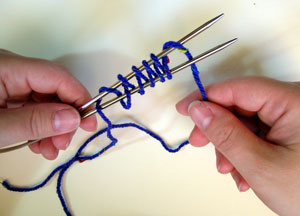

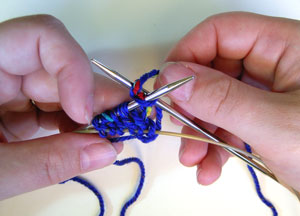


 For a few weeks now, I’ve been patiently waiting for Knitting on the Edge to show up at a local yarn shop or bookstore so I could flip through it to see if it’s a keeper. Last week my patient wore out and I ended up ordering a copy, sight unseen.
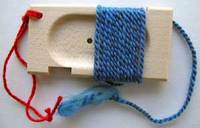 Singles:
 Purlwise