Another organizer

Gadget boxLike many knitters I’m always on the lookout for the perfect gadget holder. Here’s my latest find. Small enough to fit in my knitting bag but big enough to hold all my stitch markers, darning needles and a pair of folding scissors. Everything is safely stored in its individually covered  compartment. No more worries about spilling all those tiny pieces!

I got mine at Restoration Hardware (with fishing tackle included) but did an Internet search and found them at Cabela’s, minus the fishing stuff.

Over the past week I focused on getting the green top-down pullover finished.

When I last worked on it only the neck was left to do. I planned on a simple roll-neck version which in my mine should have only taken a hour at the most. However, without going into much detail, it wasn’t so simple. I have a knack for making such things way more difficult than they should be. Of course after  knitting several different versions I put the thing aside and swore I was going to leave it as is and not change a thing. It was time to move on.

A few weeks have passed and I started getting curious about those tight sleeves. I tried on the sweater again and the sleeves seemed even tighter than before. There was no question in my mind. The sleeves had to be rip out reknit with 2cm added to the width. That’s what I’m doing now.
 

Loose ends

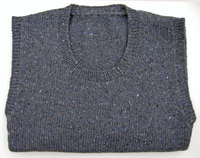
Vest done - folded

One down and 7 more to go.

A word of caution – Rowan Felted Tweed yarn makes 1×1 tubular bind off a tedious job since the tweedy bits and alpaca hair that have a tendency to cling while sewing. Whenever I wasn’t careful pulling the yarn from the darning needle through the first knit stitch it would inevitably stick to the near by purl stitch and leave an ugly blob. Practice make perfect, right? Here’s a closer view
after much practice.

Jean’s formula for picking up stitches is actually very simple and looks great. Strategically pickup one stitch for every row/stitch and then decrease 10% of the stitches on the next round. At least that’s my interpretation of the instructions. Also, I’m not sure if she mentioned this in class, but I noticed that her DVD mentions picking up stitches with a needle .5mm or 1.0mm smaller than the one used for the body. I used one that was 1.0mm smaller and didn’t switch to a larger size to finish the rib.

Kate asked about my supple rib swatch. It’s for one of my class sweaters yet to be created so I don’t have a pattern. In fact I might never create one because this stitch probably won’t work so well for my class project. I tried adding ribbing and it look odd. This stitch really doesn’t need any. I’d suggest checking out Jo Sharp’s Knitted Sweater Style for a V-neck and cardigan that use this stitch pattern. Also her first booklet has a pullover called Tundra that uses it as well.

V-neck swatch

V-neck swatchAt  the end of class last week Jean walked around the room  checking swatches for the next project, a V-neck  pullover. I didn’t have mine out so I off handedly mentioned, “oh, I’m doing stockinette again.” I can’t remember what her exact response was but I remember her firm encouragement to find a stitch pattern.
It’s not that I don’t want to do one, it’s just been difficult to pair one with 1×1 or 2×2 ribbing.

Here what I came up. It’s a stitch pattern from one of my Jo Sharp pattern books that she used on a V-neck  with no ribbing. I’ve seen it named supple rib in some books.

The yarn is Louet Gems in eggplant.

I’m crossing my fingers hoping I have enough.

Zoey asked about the ribbing on my green top-down pullover. Well, I’m sorry to say that I haven’t blocked it yet. In fact I’m considering redoing the sleeves yet again. Several other students had the same problem as I, the lower part of the arm is too tight. I did, however, show my ribbing to Jean and asked if there’s any way to avoid that flaring of the knit stitch. She had no handy tip on that but remarked that some yarns do that.

This weekend I blocked the vest and sewed the side seams. Shouldn’t be long before I finish the ribbing on the neck and armholes.

Madrona Fiber Arts Winter Retreat registration start tomorrow, 8am (PST) sharp!

Dye lot caution

With all my homework finished last weekend, I was finally free to swatch Arabesque.

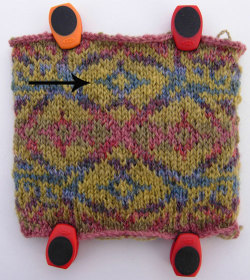
Arabesque swatch

It’s hard to tell but there are actually three colors of green in the background; chartreuse, pistachio and marjoram. The arrow is pointing to a band of chartreuse. Pistachio is just below chartreuse and marjoram is in the center (with the pink).

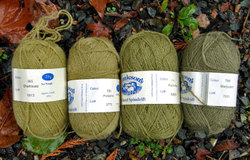
Jamieson's pistachio

Here are the skeins laid out from light to dark (left to right) with two skeins of pistachio in the middle. The one on the left was purchased at the mill (and used in the swatch) while the other was purchased at a local yarn store. Can you see the difference between the two skeins of pistachio?

Ever since my problem with “Irish Moss” I’ve know that dye lots of the same color can vary significantly but I never stopped to think of the ramifications for a Fair Isle garment. These two skeins are so different that it’s hard for me to tell what pistachio should look like.

Karen was kind enough to indulge my curiosity this weekend and brought skeins from her stock for comparisons. It looks like my lighter skein of pistachio is similar to hers but my skein of chartreuse is a bit darker.

Gosh, this type of problem sure makes Fair Isle knitting even more tricky than I ever imagined. The right colors can be rather elusive.