Time to start thinking of the next project

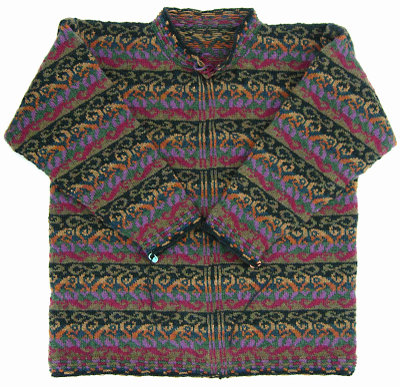
Firebirds: almost done

The pattern says to cut extra stitches on the front of the body and the collar before starting the collar. Every time I anticipate cutting my work, I feel a bit queasy about the idea. So, I decide to only cut the extra stitches around the collar and finish it before cutting into the extra stitches on the front. After the fact, I’m thinking I should just get over my fear of stitches unraveling. It’s really no big deal when working with Shetland yarn. Working the collar with the front open would have been much easier.


Time to start thinking about the next project

I’ve been engrossed in this project for so long that it’s odd to even think about starting another one. Several months back I was going to start a sock project  but never manage to get it started. I’ve been promising to make fingerless gloves, so I guess that will be next.

Read the entire pattern before starting

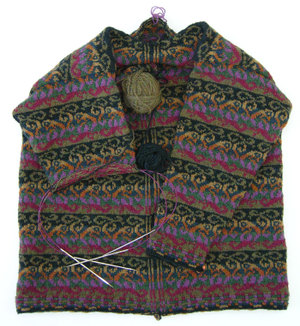
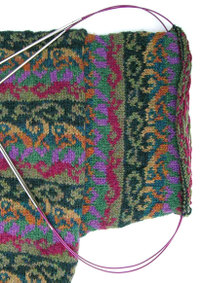
Second_sleeve_almost

That’s now my number one advice to any knitter.

Earlier this week I was looking at the pattern for “Lindsay” in Starmore’s A Scottish Garland and was surprised to see a section called “Stitches” that described exactly how the chart, steeks, edge stitch and cross stitch should be done. Right there in black and white, were answers a couple of burning questions that I had wondered about when first starting Firebirds. These were things that most patterns leave to the knitter to figure out on their own.

After finding this, I grabbed my Firebirds pattern to see if that pattern also had a similar section. It turns out that the amendment  send with the pattern card refers to the pattern card for that part of the pattern.  I seemed to have skipped reading the pattern card.

Here are the questions that I had.

Q: There are some long stretches of one color in this pattern. How often should I weave in between color changes?

A: When there are more than 7 stitches of one color then weave in the yarn being carried half way between color changes.

Q:  How long should my yarn ends be when I change colors at the front?

A: Leave a 5 cm tail.

Starmore patterns are very detailed, easy to understand and mostly error free. I did however find one small error on my version of the Firebirds amendment when starting the cuff. It says to start the cuff on round 8 of the chart and then list the first row of the cuff as round 12.  I started at round 12.

Splicing

Sleeve_yarn_ends

Monday night I caught up with the Feral Knitters and brought Firebirds along.

They’re a subset of knitters from the Seattle Knitters Guild who focus on traditional projects such as Fair Isle and Aran knitting.

I was whole heartily welcomed and everyone was very friendly. They all seemed eager to allow one more Fair Isle knitter into the group.  As soon as I found a place I pulled out Firebirds to show to everyone. All were so kind with their comments and loved seeing this Jade Starmore design in person.

As I was showing it to Janine, she noticed the many dangling yarn ends on the sleeve. She suggested that I splice color changes instead of leaving ends. I’m glad she said something because I was wondering how I should handle color changes before I started the sleeve. It’s not that I didn’t know about splicing but thought it wouldn’t look right if each yarn was a different color. Janine said that if the values are close enough than it’s not really noticeable, especially if the color change is under the arm. With this new advice I started splicing most of the color changes.

When I spliced in the past, I would unravel each yarn end, discard one ply from each yarn, put the remaining ones together in the palm of my hand, spit into my hand and rub the plies together until they felted. This method seemed to work OK but didn’t always seem too sturdy. In fact I did it a few times on Firebirds and had to rip out some rows to fix a splice that started falling apart.  So when that happened, I knew there had to be a better way that would result in a stronger splice. I put a little more thought into the process and revamped how I splice. Here it is.

How to splice yarn
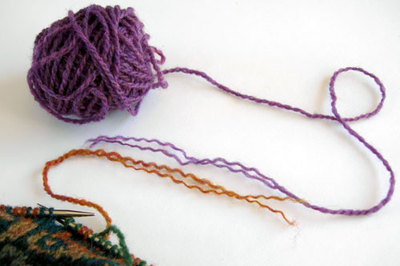
Splice1

1. Unravel the plys of the two yarn ends that need to be spliced. Look at the two yarns as they lay side by side and figure out which ply
from one yarn would easily twist around a ply from the other yarn. I
find one ply that easily fits into the “kinks” of the other and twist
these two plys together with the same amount of twist while leaving the
other two plies dangling.
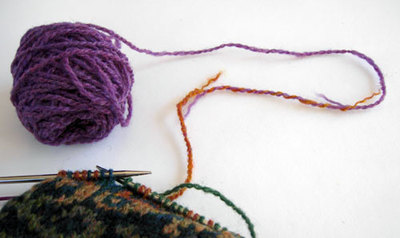
Splice2

2. When the two opposite plies are neatly twisted together, I break off the extra plies but leave a tiny overlap.  Here’s a closer view of the two plies after they’ve been twisted together and the extra ends are broken off.
Splice5_1

3. Now make the extra ends stick together by spitting into one palm. Place the yarn into the wet palm and  rub with the other palm. This should felt the ends into the yarn.

Here’s a closer view of the finished splice.

Now I won’t have so many ends to weave!
Public and private side of the sleeve

sleeve: public side
sleeve: private side

I found enough courage to finally cut one of the arm steeks and pickup the sleeve stitches.

In the picture on the right, you’ll see the inside (private side) of the sweater and I’ve pointed out where I picked up stitches from the cut steek. So far the edge hasn’t unraveled much despite several attempts at picking up stitches before getting it right. When the sleeves are finished I’ll trim the steek stitches if necessary and tack down the remaining stitches as described in A. Starmore’s book.

In the picture on the left you’ll see the outside (public side) of the same sleeve. Notice how it starts in the middle of a lengthwise repeat. I’ve read that traditional Fair Isle sweaters are usually designed so that there are no partial lengthwise repeats. With that being said, I think the long single lengthwise repeat in this non-traditional sweater makes it impossible to avoid a partial repeat on the sleeves, especially the adult versions. I did however notice that the child’s version shown on the Virtual Yarn website, has sleeves with three full lengthwise repeats.

One thing leads to another

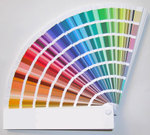
Color_fan

I haven’t knitted much this week but have found lots of eye candy on the web.

I like color.

Last week I popped over to the Interweave website to see when the next issue of Spin Off was coming out. While looking at the blurb about the next issue I noticed a picture of a very colorful felted bag. When I went back to their website a few days later, the photo had been replaced with the cover of the Fall 2006 issue. I wasn’t sure if I would ever see that bag again since it wasn’t on the cover.

Yesterday, my copy of arrived and I found the bag on  page 60 with an article by Nancy Roberts called “Machine Knitting to Dye For”. This morning I got a chance to read through the article and it amazed me. She describes how she knits plain white yarn on a knitting machine creating “blank” fabric, dies this fabric and then unravels the yarn to use it for a totally different object that is knitted by hand.

I did a bit of searching and found a picture of Nancy’s work including that bag. It’s is the one in this picture with wooden handles. The article says that it was knit with two colorways in a stranded pattern (a.k.a. Fair Isle Knitting?). I’ve been thinking about this concept of knitting with two colorways ever since knitting my Fair Isle socks.

Check out this shawl by Anni. Isn’t it amazing. Looks like she used the same multi-colored yarn but started each strand at a different color. Doesn’t the yarn she uses look very similar to the type Nancy dyes?

And if that’s not enough eye candy, look at these socks by Sara Lamb. I found her blog while looking for more information about Nancy’s technique. I’ve seen her work in Spin Off and admired it. It tempts me to take up weaving.

Front and back

frontback

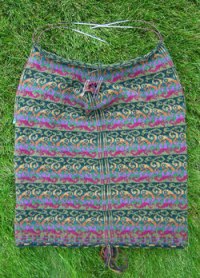
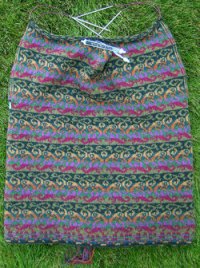
Almost looks like a skirt rather than a sweater. I promise it will start looking more like a sweater soon.

Notice the stitch holders. Just after casting off the extra stitches some stitches are put on hold just before starting decreases for the neck line.

On the front neck line, several inches of stitches in the center of the body are put on hold and the knitting continues in the round with decreases on either side of the extra stitches. Thanks to Anne Feitelson’s book, I learned that the decreases should slant towards the extra stitches – totally opposite of what I would have thought.

On the back neck line, about 1/3 of the stitches at center back are put on hold just a few rows before the body is complete. This small dip in the back will help the collar sit comfortably around the neck; or so I’ve read in various knitting books.

Although not shown in these photos, the shoulders were grafter together earlier this week.

Next step is to cut the extra stitches at the sides  and to pick up stitches for the sleeves. What a difficult thing to do since once done, there’s no turning back.

By the way,  this photo wasn’t taken in my yard. We tend not to water the little grass that we do have. This large lawn was well nurtured by my father for the past year.

Found!

Woollyboard

I guess if you have patience and look hard enough you’ll eventually find what you’ve been seeking.

I was very lucky to find this Woolly Board II for the bargain basement price of $10. However, shipping from the East coast was another $35.

It’s made of finished poplar wood. All the pieces come apart and are stored in a handy cloth bag. It came with instructions but didn’t include any indication of who made it. My guess would be that it was made in the early or mid 90’s when Ms. Starmore’s books were still in circulation. The instructions refer to the woolly board shown in Stillwater.

Knitter ISO jumper board

Last week I must have run across some bad karma because my tension didn’t seem to be up to snuff so mid week I rip out a whole lengthwise repeat. So, even though I anticipated finishing the neck shaping this week, it didn’t happen. Today, I’m just now at that point.

body

Traditionally, knitted items such as this one are dressed on some type of frame. I did a bit of searching and came up with these pictures.

  • Here’s a Japanese website called Shaela that shows the two most common frames,  “Woollie Horse” and Jumper board. I can just make out from one photo that the Woollie Horse is from Tulloch of Shetland.
  • The Shetland Museum’s website had several old photos of jumper boards.
  • Knitting Beyond the Hebrides has instructions to make one.
  • There’s a website with the URL www.jumperboard.com that appears to be located in Shetland that is selling them.

There’s several online yarn suppliers that are offering some version of this frame with the cheapest around $90. That seems like a lot of money to plunk down on a knitting device that can only be used for sweaters with drop shoulders. Generally, I don’t like sweaters with drop shoulders but overlooked that fact when choosing Firebirds. The colors and pattern was just irresistible.

Hold it a minute

When knitting with only one color I hold the yarn in my right hand between my thumb and forefinger, with no extra yarn wrapped around any fingers. I probably came across this method when I first started teaching myself how to knit from books but didn’t bother learning the details of how to tension the yarn around other fingers. I’ve tried the proper way of holding yarn in the right hand but always go back to my own way. I love how it gives me total control over the tension, even if it is a little slower method of knitting.

Holding two yarns

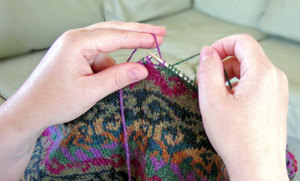
Learning to work with two colors was quite a challenge. I tried knitting with both colors in my left hand, both in my right and one in each hand. As you can see in the picture, I finally settled on holding one color in each hand. Of course,I don’t hold the yarns as shown in most books.

The yarn in my right hand is held as I do when knitting with one color. The yarn in my left hand is held between the first and second finger. To give more tension to the yarn in this hand, the working yarn is always placed in front of the object being knitted and held in place with my thumb.

While I can put lots of tension on the yarn with this method, I don’t. I always make sure that tension in both yarns is very even and not too tight or too loose. When switching between yarns I “fan out” the stitches on the right needle to make sure the yarn carried along the back isn’t too tight.

My advice on holding yarn is to practice until you find a way that achieves the best results.

Progress report:
Next week the body of Firebirds should be nearly completed. This week I started the arm steeks.

Giving new life to an old planner

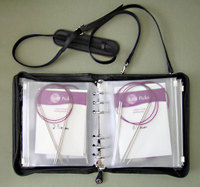
Needlebinderinside_1I did a little more rummaging around at the thrift store and found a decent looking binder for my needles. It’s amazing what one can find in that store. I’m recycling this old Franklin Covey planner cover into a binder for my needles. A little scrub down with leather cleaner and it looks almost new. The detachable shoulder strap is a bonus.

For any of you out there that are also looking at various binder alternatives, I noticed that these binder pages from Knit Picks can fit into  8.5″ X 5.5″ binder. Just stagger them until the holes line up into the rings. I also tried this with a normal sized 3 ring binder and voila, the pages can also be made to fit one of those.

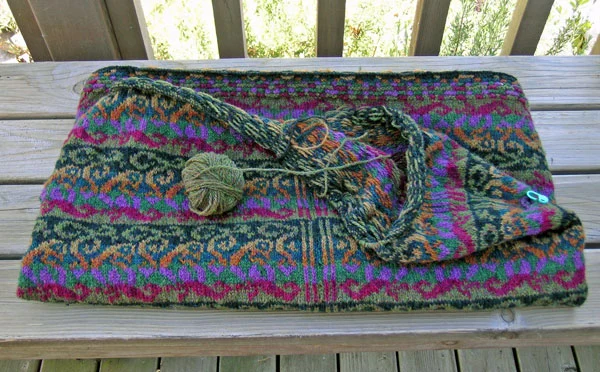
I did make steady progress on Firebirds this week. Here’s a photo of the back. Notice how that birds on the left face left and the ones on the right face right? I love this detail of the design. For now I’ve stuck with the pattern hoping all will work out well when I dress the sweater on a woolly board. On the next row the steeks for the armholes will be started.

Ss_socks_yarnEven though it’s hard to put Firbirds down, yesterday I started winding yarn for another sock project. Although I generally knit one item at a time, I’m itching to take on another more portable one.

Working with two hand painted yarn colors on my last sock project was so enjoyable that I want to explore similar possibilities. So my next little project will be the Sunrise-Sunset Socks from Big Girl Knits.