Much better fit the second time

Touchstone2

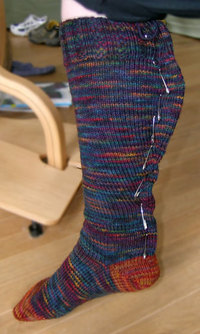
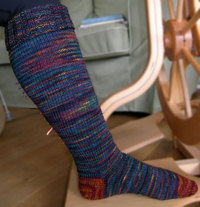
The fit is perfect and well worth the extra effort to get right. Now I have a sock that I can use as a “touchstone” for other socks.

Instead of working cuff to toe I reversed course and started from the toe, adjusting the fit as I knit. This time my tension seemed to be a bit tighter which helps the whole sock to fit much more snugly. Seems a bit odd; I don’t know if this change is due to knitting toe-up or something else. So although the foot and ankle are the same size as the previous sock they do fit more snugly and no adjustments were needed in these sections. There are 48 stitches around the foot with gauge of 6 stitches to an inch and 9 rows to an inch with size 3mm needles.

The increases for the lower section of the leg started at ~3.5 inches after the short-row heel, which is contrary to most instructions I’ve read that say increases should start an inch or so after the heel. Before reaching the widest part of the calf, I knit 10 increases every fifth row (about 1/2 inch apart) and then 4 increases every forth row. I got the idea of changing the rate of increase just before the calf from the book Simple Socks by Priscilla Gibson-Roberts. If you look carefully at the photo (click for closer view) you can see the stitch markers I placed at every decrease at the back of the leg; orange for the first 10 and purple for the last four. This section is about 6.5 inches in length.

Once the circumference of the sock matched the widest part of the calf, I worked straight for about 2.75 inches before working decreases every fourth row until the cuff. This small section of decreases conforms to my shapely upper calf and along with the 2×2 rib will hopefully help the stock stay up better.  The cuff is about 3 inches long and is folded over the section of decreases. The total length of the leg minus the cuff is 16 3/4 inches and the foot is 9.5 inches.

This week I’ll finish the mate and start thinking about what to do with my Socks that Rock yarn.

Touchstone knee-high socks

I’ve made nearly a dozen pairs of socks since I took up knitting in earnest a few years ago, but have never tried making knee-high socks. I didn’t think much about making some until I attended Judith’s class on spinning for socks last year. During a discussion on fit, I showed her a pair of my hand knit socks that bulged at the ankles and asked her how I could avoid it.  The solution was simple, add some strategic shaping to the leg. She recommended getting a copy of The Complete Book of Progressive Knitting by Ida Riley Duncan to help figure out the details. I got a copy of the book soon after the class but let the idea linger in my knitting thoughts until now.

While my foot tends to fit any medium sized sock pattern, I usually end up shortening the length of the leg about one inch so it will “fit” below the meaty part of my drumstick shaped leg. It’s a trick that works well for most patterns, especially ones with ribbing, but last month after knitting a few inches of the Fair Isle socks from Blue Moon Fiber Arts , I realized that such a colorful sock would look great with a much longer leg.  At this point I wasn’t able to ignore reality, if the leg was to be longer, I’d have to figure out how to shape the sock so it fit properly. I ripped out what I had done and set the yarn aside so I could worked out the details on a simple sock, without any motifs. A couple of skeins of Mountain Colors 4/8 wool (Northern Lights & Yellowstone) have been lingering in my yarn reserve so I pulled them out and started knitting away after checking various references on the subject*.

Knee_sock

One of the most helpful sources of information came from Holly Shaltz’s tutorial called Shaping Knee Socks. I printed out the worksheets, entered my measurements, did the calculations and started knitting. Her instructions start with knitting the socks from the top to toe so, against my better judgment, that’s how I started.

It’s easy to plug in all the numbers and calculate figures but it’s hard to know how much ease to allow. I started out casting on 104 stitches and ended up revising that to 88. After knitting the ribbing, I worked several alternating rows of increases to reach a total of 96 stitches for the widest part of the calf. This part of the leg is knit  straight for a couple of inches before starting decreases which continue until several inches short of the ankle.

As my knitting progressed, I tried on the sock every few inches or so and thought all was going well after a few initial adjustments. Once off the needles, I immediately tried on the sock and walked around the house.  It didn’t take long for the top to droop and the ankle to sag. There was no doubt that this sock needed more adjustments so I pulled out my safety pins and carefully pinched out the extra fabric. I retested the droop factor by walking around but also added a short trip down the stairs. Turns out that walking down stairs seems to be the ultimate test of whether a sock will stay up.

During the next week, I’ll start working on the second sock making adjustments after considering the amount of ease that I was able to pinch out of the leg of the first. This time I change knitting directioon and start the toe so that adjustments to the width of the leg will be easier to manage and test as I knit.

* References:
– The Complete Book of Progressive Knitting by Ida Riley Duncan
– Hand-Knitting Techniques from Threads
– Knitting Around the World from Threads
– Socks: A Spin-Off Special Publication for Knitters and Spinners

Cotton: back to square one

Judith’s last class at the Madrona Fiber Arts Winter Retreat was called, “Summer Breeze: Spinning Cotton for a Summer Top”. Here’s the Description straight from the website

Thinking that cotton is hard to spin? Think again!
Judith guarantees that this will be a breeze! You will spin a wonderful
cotton novelty yarn and the blues about spinning cotton will vanish.
Come and join the fun and learn Judith’s secrets!  All the cotton fiber
needed for a summer top and pattern are supplied.  You can’t miss!

Cotton

Sounds easy, right? Although Judith never  said out right that spinning cotton was difficult, it didn’t take long to figure that out.

This combed cotton top required learning a spinning technique that I’m not familiar  with doing – long draw. The idea is to let twist into the fiber supply while pulling the hand with the fiber supply away from the wheel. The other hand holds the spun cotton and pinches out any slubs that happen to form. Since  cotton has very short fibers it  needs a lot of twist to make a sturdy yarn. To put lots of twist into our spinning Judith had us put on our smallest whorl and set the drive band tension so that the intake was very light; similar to what we did for spinning lace and cashmere.

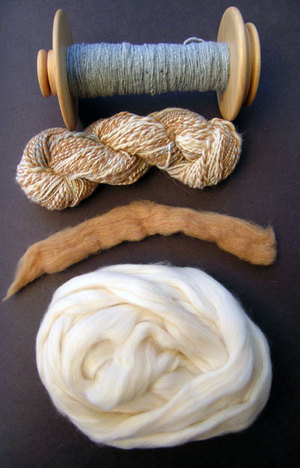
After practicing with a natural brown she handout some cotton colored light blue by bits of recycled demin mixed into it. That’s what’s on the bobbin in the top of the picture. It didn’t seem to go much easier than the brown. While the long draw is a satisfying graceful and sweeping technique, I seemed to always get large slubs as twist from the wheel first entered the fiber supply. As I pulled back with the fiber supply, the yarn would get thinner and thinner until I let it wind onto the bobbin. Then it would repeat all over again, a slub of fiber that progressively got thinner until it was wound back onto the bobbin.

I almost felt as helpless as when I first tried to spin wool on a wheel.

This week I plied the rest of the blue which I didn’t manage to finished during class. I also practiced spinning some white fiber that Judith sent home with us.

Spun_cotton

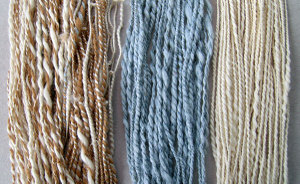
You can see a bit of progress being made. The mix skein on the left is my first attempt and the white on the right is what I did this week.

I still have a whole bag of white cotton that Judith sent home with us along with a pattern for a knitted cotton top. At this point I need much more practice before attempting to spin for a knitting project. To tell you the truth, I’m currently not all that interested in spinning cotton. Not to say it was a bad class, because some of the skills she had been teaching earlier in the week really started to click, but knitting my hand spun cotton just doesn’t appeal to me.

There’s two bits of info in my notes that I should share.

1. To finished the plied skein, boil it with a detergent like Tide. Change the water several times until the water is clear. Colored cotton will get darker each time you wash it.

2. Judith got this cotton from Little Barn.

These days I’ve been thinking about knee-high socks and mittens. Socks for me and convertible mittens for my husband.

He wants convertible mittens with a subtle design around the hand so I’ve been looking around.

At the same time I’m also looking for unique knee-high sock designs. A few weeks ago I started my “Socks that Rock” Fair Isle socks but then got to thinking – what if I make them knee-highs. How would I increase/decrease while knitting the leg and keep design repeat correct.

So, while surfing the web for more info on these two subjects, I came across Catherine Devine‘s gallery of socks and small knits. I especially like the long spiral socks.

Bargains

Vancouver
I just returned from a quick weekend trip to Vancouver.

Two wonderful crystal clear days that we in the Northwest cherish and vistors are convinced near appear. Everyone was out strolling along the waterfront or in one of the many scenic parks enjoying the sunshine.

After breakfast we wondered through the Museum of Anthropology and then scooted over to Birkeland Bros. Wool before leaving the city. While I managed to refrain from purchasing some very soft polworth sliver, I did pick up some very reasonably priced Quebecoise wool for a fingerless glove project that has yet to get started. I found out about this place via an article on Vancouver in Spun Magazine. Cara is indeed very friendly and keen to show her stock. Besides plain wool she also carries beautiful hand painted yarns.

Japanese_string_1

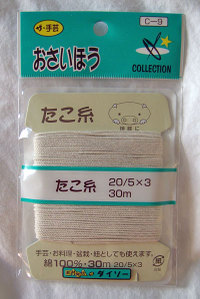
On the way up to the city, we made a detour to Daiso. I wanted to see if I could find some of that Japanese string Judith MacKenzie McCuin brought to her classes at the winter retreat. She says it makes great drive bands for lace weight yarn. The package she brought with her was purchased in a Japanese store in San Jose. She mentioned that she hasn’t found it anywhere else including Uwajimaya in Seattle.

When I found out about the Daiso in Richmond, I had a hunch that they might carry it. Last fall while in Tokyo I happened to visit their Harajuku store and was amazed at the abundance of cheap (100 yen) stuff they carried. I was so overwhelmed that I didn’t purchase anything. I just soaked in the the 100 yen experience.

Once again I felt overwhelmed. Much like in Japan, there were people everywhere in the tiny isles. It took a bit of searching but I finally found several different packages tucked away in two different places. I first spotted it in the sewing section near the pins, needles and etc. Next to it was another package of similar string, but this one had an English label that said it was “kite string”. I also found some, with yet different packaging, in the kitchen paper wear section next to the picnic supplies.

This week I’ll give it a try while I attempt to finish my cotton samples from Judith’s last class on spinning cotton.

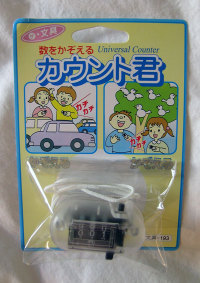
During the search for string, I happened to find this small counter that records up to 999. What a bargain – only 2 Canadian Dollars. The Kacha-Kacha’s from Clover run about 10 US dollars and only count to 99.

Counter

Love the packaging. Looks like it can be used to entertain blond headed siblings that love to see who can count the most cars or birds.

Diagonal Hat

Diagonal_hat_4

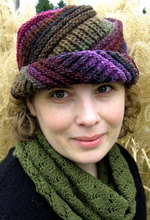
Late this week I received Jean Wong‘s* diagonal hat pattern that I mentioned a couple of weeks ago. The next day I ran over to a local yarn store and picked up a couple of skeins of Noro Kureyon. Once on the needles, I couldn’t put it down. It took just over one day to finish.

This hat is cleverly constructed by knitting back and forth diagonally between the brim and the crown without the need for short-rows. To finish the hat, the provisionally cast-on beginning edge is grafted together with the other edge at a section where garter stitch rows meet.

Thanks to Principles of Knitting, it wasn’t too difficult to figure out how to graft garter stitches. It’s similar to grafting stockinette stitch from two knitting needles except the sequence is a bit different.

Grafting Garter Stitches:

Place needles parallel. Front needle has purl stitches and back has knit stitches.

1. Starting stitches:
With threaded sewing needle enter first stitch on front needle as if to purl. Pull thread through. Now enter first stitch on back needle as if to purl. Pull thread through

2. With sewing needle slip first front stitch knitwise and remove stitch from the knitting needle, pulling thread through the loop. Enter next stitch on front needle purlwise and pull thread through.

3. With sewing needle slip first back stitch knitwise and remove stitch from knitting needles, pulling thread through the loop. Enter next stitch on back needle purlwise and pull thread through.

4. Repeat 2 & 3 until no stitches remain.

 *Jean doesn’t have the pattern listed on her website. I found out about her pattern when she was the featured speaker at a local guild meeting. Everyone at the meeting was very impressed with her work and asked about purchasing patterns. A week later I asked via email if I could purchase a copy of the hat pattern and she graciously put one together. She’s been teaching for quite sometime at Wool and Wicker in Richmond BC and is apparently branching out. She’s put a lot of work into the DVD on her website but I not sure if she has anticipated requests for patterns of her designs. If you’re interested in this pattern you can email her via her website. Just keep in mind that’s she’s probably doing this in her spare time.

Spinning Cashmere

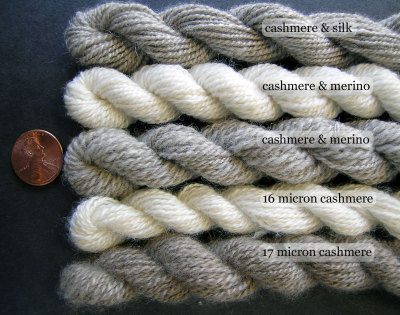
Last weekend I finished plying the singles from Judith’s half day class on spinning cashmere and here they are.

Cashmere_samples

We started with a light brown 17 micron cashmere (at the bottom) and continued across a small spectrum of cashmere blends.

The spinning technique for cashmere is similar to lace in that the tension should be light and the whorl should be small so that lots of twist gets into the yarn.

It was interesting to hear Judith explain that cashmere isn’t a breed of goat but rather a set of certain characteristic of fine goat hair.  The 17 micron fiber that we started with was very soft compared to fine merino but not as fine as the white 16 micron cashmere that we worked with next. While the white fiber was so much finer and a bit tricky to spin, I enjoyed it much more than the 17 micron. The 17 micron fiber had bits of “scurf” that look like dandruff – yuck. Judith says it’s caused by a disease that goats get but isn’t harmful to humans. If, in the future I decide to buy cashmere for a project, I’ll be sure to check for scurf.

After spinning pure cashmere we were given samples of cashmere blends from combed tops. After spinning the pure cashmere the merino and cashmere blends were so much easier to spin; the merino seemed to give the top a bit of grip. The silk and cashmere blend didn’t seem all that hard to spin although not quite as easy as the merino. As you can see, I twisted the heck out of it and it seemed to respond well to all that twist.

When blending silk and cashmere Judith suggested to first cut the silk fiber to the same length as the cashmere so that it blends well. She likes to use cotton cards to “brush” the fibers together, letting them fall a bit off the tips of one of the cards. She then spins straight from the card.

If you ever get a chance to take this class I highly recommend it. While it was challenging, it was also very interesting to try a variety of fibers that were new to me.

Knitting Lace

Knitting_laceLooking for a book with detailed instructions on how to design lace?

This book meticulously investigates the lace stitch patterns on 19th century knitted-lace sampler from the Brooklyn Museum. In the first half of the book the author, Susanna E. Lewis, painstakingly charted each of the 92 stitch patterns on the sampler and presents these charts with a photo and row by row instructions. The second half of the book is a workshop on the characteristics of knitted lace,  classifications of the sampler pattern, information on how to create lace patterns and several patterns for lace garments.

I would venture to say that it’s the best reference on lace knitting – at least for those of us who love getting into the technical details and dream of creating their own designs.

Nancy mentioned in the Estonian Lace class that Estonian lace knitters would learn new stitches by borrowing lace samplers from other knitters and returned the sampler with a new knit stitch added on the end. Although this sampler isn’t from Estonia, perhaps it was created through a similar tradition.

I checked the usual used book sources and was shocked at the prices listed. I suggest checking it out from a public library or a knitting guild.

Estonian Lace with Judith and Nancy

Madrona_06_estonian_lace_04_1

What a great opportunity! Two wonderful teachers teaming up to teach a two day class about Estonian Lace.

Nancy Bush started off the class with a brief slide show of pictures that she had take during her trips to Estonia, giving us the history behind Estonian Lace. Long story short, the women of Haapsalu* started knitting lace shawls in the the 19th century to sell to tourist visiting the resort town. During the introduction I could feel her excitement for this country, it’s people and it’s crafts, so I asked how she became drawn to it. While researching ethnic knitting she came across some pictures of Estonian costumes and knew she had to visit. On her first trip to Estonia she instantly feel in love with it and has gone back several times to do more research.

After the slide show Judith took over and got us started spinning Corriedale top as a warm up. As we spun this rather course top, Nancy and Judith mentioned that Estonia really doesn’t have a sheep raising tradition so the yarn that the lace knitters use comes from countries that surround Estonia. Nancy mentioned that these days it’s hard to find a light-weight yarn to reproduce the lace shawls from the last century. Judith says that commercial mills are not able to spin very fine wool, at least not the type that was used in Estonia. Nancy also mentioned that she gave showed them some merino wool to use for lace knitting and they wouldn’t believe it was wool. Apparently, the softness of the wool threw them off.

After warming up Corriedale top, Judith brought out mill prepared Rambouillet that I believe had been combed. Rambouillet is a breed of sheep that originated from Spanish Merino sheep in the late 18th century. Like merino, this breed produces very fine fibers that are well suited for lace spinning.
Although I haven’t spun much fine weight yarn, I do find that spinning lace isn’t all that difficult if you use a fine wool, such as Merino or Rambouillet, that’s been well prepared and combed.

The best technique for spinning fine yarn is the worsted method; letting no twisting into the fiber supply.  Judith had us using our smallest whorl and setting our drive band tension very low. essentially no pull from the uptake of the bobbin. She suggested that if our wheel came with a Scotch tension option, then we should use it for better control. She also mentioned that a thinner drive band is better for spinning lace but I can’t remember why.

Madrona_2006_estonia_lace_0We spent most of  morning on the first day spinning our  Rambouillet and getting tips from Judith.  The class  had 30 students  so it  took a while for  her to make  the rounds. This is what I  enjoy about  Judith’s teaching style. No matter how  many students there are, she  always makes a point of  catching up with each person to  see  how they are doing. If a student is having trouble  with their  wheel,  she knows how to fix it and will get the spinner back on the right track.

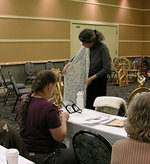
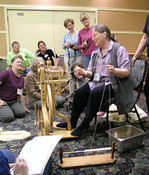
The next morning Judith demonstrated how to ply (see photo on the right). Her left hand is holding two singles almost the same way a knitter will hold two strands of yarn while doing a long-tail cast-on. The trick is to keep this arm stretched out from the orifice and not to let go. She warned that if a free hand is needed to answer the phone or do something else while plying then let go of the threads in you right hand. The fingers on the right hand are used to guide the threads into the orifice. The middle finger is placed between the two threads and the index finger works with the thumb to pinch out any slubs. Notice that she’s plying from a lazy Kate that’s holding two very small bobbins. She likes to wind her threads onto weaving bobbins and alternate between several to get a more consistent yarn.

Jmm_lace_yarn

Since were probably wouldn’t have spun enough yarn to knit samples in the afternoon, Judith gave us all a small ball of hand spun yarn to start our knitting. Here’s a picture of that yarn (left).

During the afternoon, Nancy brought out her collection of lace shawls and explained how she’s working with several Estonian women to document Estonian lace in a forthcoming book.  She mentioned that each trip seems to reveal one more tidbit of information that she’s surprised didn’t come up on a previously.

After getting a glimpse of the possibilities, Nancy had us start on samplers of several common Estonian patterns. I managed to only finish one called “vaosabakiri” (peacock) before moving on to the Lily of the Valley Estonian Lace Sampler.
N_bush_estonian_lace_sample
N_bush_estonian_sample
Both were knit with the yarn supplied by Judith.

I finished spinning the Rambouillet the week after class and have yet to knit any thing with it. I’m not sure if there’s enough to make a scarf or perhaps I’ll knit more of the sample patterns that Nancy gave us. The picture below shows my skeins and for a comparison, includes a piece of Cascade 220 at the bottom.

My_lace_yarn

*For further information about check out Nancy’s article, ” The Lace Knitting of Haapsalu”, PieceWork – Jul/Aug 2005

The night before

It’s taken me almost a week to recover from the retreat. I have so many new ideas and projects to try that it’s hard to know where to start. I did start on a pair of Socks that Rock but then decided I need to finish some of my class samples before I forget what I learned.

While the Madrona Fiber Arts Winter Retreat is mainly focused on knitting, both years that I’ve attended I’ve passed up the knitting classes in favor of the spinning classes. This year I felt a bit conflicted when I saw the class called Fine Finishing the Japanese Way. Unfortunately, it was offered the same day as the Estonian Lace class with Nancy and Judith. I couldn’t pass up a chance to take a class with this duo.

Fortunately I heard by word of mouth that the teacher of Fine Finishing the Japanese Way, Jean Wong, would be at the Seattle Knitters Guild Meeting the night before the retreat.

Jean is an expert Taiwanese knitter that immigrated to the Vancouver area over a decade ago. While she was still living in Taiwan, she decided to expand her knitting skills to knit sweaters for her child and ended up taking classes through a rigorous program offered by Nihon Vogue through Nihon Amimono Culture Association. The classes were so intensive that she ended up quiting her job just so that she could keep up. Her talent was recognized by her teacher and she was encouraged to start teaching classes and earned a teaching certificate through this organization.

When she immigrated to Vancouver she couldn’t converse in English thus she had to give up teaching.  Eventually she decided she decided to learn English, as an example for her child, and also started attending guild meetings even though she couldn’t understand much at first. Now her English is very good and she has built up enough confidence to start teaching again in the Vancouver area. She now offers Nihon Vogue classes through Wool and Wicker and is selling a DVD called knitting with jean – professional finishing techniques.

She brought tons of items to show at the guild meeting and gave a slide show of items that were knitted by her students. As she showed these items she mentioned that her clasess focus on teaching students how to take an item from a pattern (or their own design) and draft a full size pattern based on their measurements. The pattern is drawn onto graph paper that’s the actual size of the finished piece. Someone asked about the graph paper and she showed us a sample. The graph is actually hand drawn by the student using a special gauge ruler from Japan. I thought that this would be a handy tool so I ordered one from Wool and Wicker.

Gauge_measure

It’s a collection of rulers that match each possible gauge that one can knit. It came with instructions but since I don’t read Japanese, I can only guess what it says from the pictures. Perhaps some day I’ll get an opportunity to take one of Jean’s classes and learn how to properly use this tool.

While all of the samples she brought were impressive, I was especially intrigued by the clever construction technique used on a hat that she had with her. I think she’s working on putting together a pattern that she will be selling, but in the mean time, I’ve been trying to figure it out on my own.

Here’s my initial attempt. Please don’t judge it too harshly. I’m just fiddling around with a bit of left over Cascade 220.
Diagonal_hat2_2
Diagonal_hat

I’ll describe what I did and you can following along by looking at the picture on the right, which shows the hat spread out flat.

It’s worked flat starting with a provisional cast on (which I didn’t do this time) – the long open edge on the lower left in the photo.

I then knitted twenty rows decreasing every other row on the outside edge (right edge). This leaves the left edge straight while the right edge starts to curve.

After knitting twenty rows I then knitted across the piece to the left edge and picked up ten stitches along the left edge. After picking up stitches, I knitted another twenty rows, decreasing along the right edge just as I had done previously.

The twenty rows & picked up stitches were repeated until I had four ridges (or spines) on the top.

At this point I would have sewn the remaining edge together but left it open so that I could show how this was done.

While my version is done in garter stitch with dull gray Cascade 220 yarn, Jean’s version is constructed in a different stitch pattern. Her finished sample was done with a skein of Noro Kujaku but she mentioned that it’s a great pattern for using left over yarn. I look forward to purchasing the pattern from her and seeing if I was on the right track.
Don’t adjust your monitor …

Socks_that_rockI’ve been at Madrona Fiber Arts Winter Retreat for the past four days, learning how to spin lace-weight yarn, cashmere, and cotton with Judith MacKenzie McCuin. This year I also learned a bit of Estonian lace knitting from Nancy Bush who co-taught with Judith on Thursday and Friday.

I’ll have more details and pictures soon.

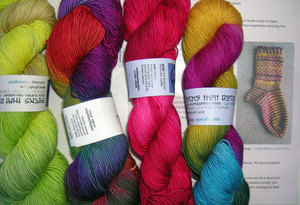
I tried to resist the yarn market but gave into Blue Moon’s “Socks that Rock”. Being oblivious to this latest sock trend, I didn’t stop by their booth until Friday. As I stood there drooling over all the wonderful colors, it dawned on me that this vendor must be the reason why a line of people were waiting for the doors to open on Thursday morning.

What wild colors!

I’ll try using the two skeins on the right to knit their Fair Isle sock. They didn’t have the colors used in the pattern but I think these will still work out OK. Not sure what I’ll do with the other two skeins.