More lace, more green

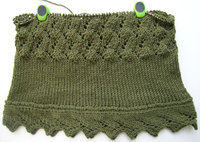
Smoke_ring_lace This week I’ve been working on this Smoke Ring with Lace Edging pattern designed by Jackie E-S of Heartstrings Fiberarts. I didn’t want to go out and buy more yarn so I salvaged some from a scarf that I started last year but never got around to finishing.

As I knit this smoke ring I keep wondering what got into me when I purchased this yarn. While it is the softest I’ve ever found (a blend of merino/cashmere/silk), the color is not all the inspiring. In fact it reminds me of the swatches in Vogue’s Knitting Stitchionary book.

After the lacy middle part is finished, I’ll be knitting another three inches of stockinette stitch and then the pattern calls for a decorative edge. I was having a bit of trouble figuring out the instructions for this edge, but after tinkering a bit, I think I’ve got it.

While the pattern describes the bound off edge as being worked in rows it doesn’t mention that these are very short rows of only two stitches. Basically, you knit a couple of stitches turn and then decrease. Each decrease picks up a stitch from the left needle until there are none left.

Knitting_around_the_worldI’m still in research mode this week and have been spending time at libraries and used bookstores chasing down old knitting books.

Last week I ran across this book at a local used bookstore.  Apparently
Threads magazine use to offer articles on knitting by the leading
experts of the day. This book is a collection of reprinted articles that cover several knitting techniques from all over the world, including twined knitting. Several articles are devoted to Scottish knitting and are written by Alice Starmore. I feel pretty lucky to have picked it up for only $8.
Seaweed scarf finished

Seaweed_scarf_done

Once in the grove of lace  knitting, the movements became very fluid and muscle memory started kicking in. I was really surprised that I was able to stick to this project and complete it in a few weeks.

By the way, this stitch pattern is really similar to one called Print O’ the Wave that appears in a book on Shetland lace knitting called Heirloom Knitting. Eunny also has a version of this lace pattern which is available via a free PDF download.

I’m glad that I followed through and ordered the kit from Virtual Yarns. The yarn was a joy to knit and the right weight for a cold weather garment.

North European knit it is dense thing

While getting my daily dose of knitting gossip on the Knitter’s Review forum this week, I happened to click on a post about a new knit along called Crossed In Translation. Apparently, a group of knitters have decided to knit one of the patterns out of New Style of Heirloom Knitting and help each other work through the Japanese instructions. While I’m not planning on joining the knit along, this site did prompt me to look further at this book and eventually lead me to another one by the same author called, European knit it is dense thing (loosely translated via Google) .  The previews on this page made me zip straight down to Kinokuniya in hopes of finding a copy. Lucky me, they had one left.

This book is a real gem if you like traditional gloves , mittens, hats and scarves. Although I don’t read Japanese, I can tell from the pictures that it’s a book about the author’s (Toshiyuki Shimada) pilgrimage to Northern European countries. Beside photos of his trip it also includes 13 patterns inspired by what he found. Pictures of the projects are some of the most vivid knitting eye candy that I’ve ever come across in the knitting book world. The items pop out and say, "come on, you know you want to knit me".

If you don’t have physical access to a Japanese book store and would like to find a copy here’s a link to it on Amazon’s Japanese web site. While the site is mostly in Japanese it is possible to translate it using Google’s language tool. Even if you don’t want to purchase the book, translating Japanese web pages can result in hilarious reading.

While I’m on the subject of knitting books in Japanese, here’s another outstanding book called, Knitting Patterns Book 250. It’s full of several types of knitting stitches and stitch combinations with an emphasis on lace and cables. While I already have several pattern books this one is an excellent addition to the collection. The complicated combinations take lace knitting one step beyond other pattern books without much duplication.

St. Distaff’s Day 2006

St_distaff

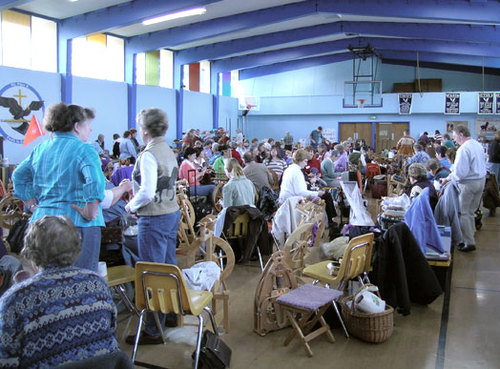
Over 150 people attended this year’s St. Distaff’s Day in Mountlake Terrace on January 7th. This annual NWRSA event is sponsored by the  2010 group.  It’s a full day of spinning, chatting with fellow spinners, eating holiday goodies and shopping the booths of local vendors. Towards the middle of the day many door and raffle prizes are handed out to lucky participants. It was so exciting to see so many wheels and spindles going at once.

Managing a lace chart

The Seaweed Scarf is coming along much more quickly than anticipated now that I’ve found an efficient way to follow the chart. This small notebook that I created holds a page for every charted row. When I’m done with a row I flip to the Chart_notebook_closed next page which has the current row highlighted.

I chose to display all rows on each page so that I can easily “read” the previous row on the knitted piece. This is handy when figuring out if a mistake was made on a previous row. I also put a sticky note to mark the current page in case I get distracted.

To make the notebook, I transferred the chart into an Excel spreadsheet and printed a copy for each row. This chart shows 6 rows so I made 6 copies, each with one of the six rows highlighted. I then trimmed the pages to half the original size and cut a transparent report cover to the same size. The pages and cover were then bound using a plastic binding spine that I got in Japan.

I checked around at the various office stores here in the US and found a similar binding system called Proclick. These types of bindings are very useful. The spines allow easy editing of the pages and unlike a binder, the pages flip 360 degrees. This biggest downside is the cost of the machine that punches the holes. Staples has it listed for $63. The Japanese version was a bit cheaper.

Another recent addition to my knitting bag is this small accessories bag from Eagle Creek. The front is made of a strong clear pliable plastic. I can now see all the tools before opening the pouch and easily pick out the one I need. My mini kacha-kacha row counter is conveniently attached to the side hook.

I’d love to get my hands on some of this clear plastic material to make a small organizer for the tools. Each item would have it’s own pocket. After doing some Google searching I think this plastic is called UVX and is mainly used for the windows of high altitude tents. Unfortunately I haven’t found a source that sells it.

Do I need to make a swatch?

Seaweed_scarf

The Seaweed Scarf was started this past weekend.

Feigning ignorance, I happily started off on 4.5mm needles as specified in the pattern hoping that everything would turn out well and I could avoid the whole swatch thing. After all, this is just a scarf. Isn’t that why beginners start with a scarf? No swatching needed.

As I finished row 48, I got curious and pulled out the measuring tape to see how close my tension was. The measuring tape plainly revealed that the darn thing was a couple of inches wider than the dimensions given in the pattern. At this rate, the end result wouldn’t be good. If I continued in this manner I would probably end up with a wide scarf that wouldn’t be as long as I would like. If I had purchased the yarn from a local source I could just pop over and pick up a couple more skeins but this yarn came from Virtual Yarns in the UK.

So, on row 49 I switched needle sizes and started a swatch on the first 34 stitches.
Turns out that size 3.75mm needles give me the correct tension.

Today I’m on row 77. The biggest challenge now, will be hanging in there until the thing done. While this lace is interesting it’s very repetitious and I foresee the remaining 523 rows getting a tedious. So, in the near future I’ve decided also work on some pop up paws.

Is it Groundhog Day, again?

Log Cabin SocksThis week I feel like Phil Connors (Bill Murray) in the movie, Groundhog Day.

At this point I can’t even remember how many times I’ve knit this sock. Just as I think I’ve got it done, I find another reason to rip all or part of it out.

The one on the upper left was done on 3.75mm needles (per the pattern) and the one on the right was done on 4mm needles. The ones on the larger needles are a much better fit; not so tight. So, don’t let the picture of the skinny model in the book or a swatch of stockinette stitch deceive you. The cables will make the fabric less stretchy and possibly a bit tight unless you do some adjustments.

The mate to the second edition is still in progress after having been ripped back to the heel flap to correct a problem with the last cables. Upon finishing the toe I noticed that one side got turned the opposite way. Oh, I hate when that happens!

While ripping out the yarn on the mate, I got thinking about that last set of cables on the heel flap. Doesn’t it look a bit odd  with only two turns? It does to me . So, I checked the book again and noticed that the socks in the picture don’t have that cable! I could just scream at the editor and/or designer. Why was this tidbit of info left out of the pattern. Oh well, there’s only so much rework that even I’m willing to do. Besides, I’m dying to start a new project. Look at the yarn that arrived in the mail this week. It’s from  Virtual Yarns and will become this scarf.

Log Cabin Socks

Log Cabin Socks half done

This week I finally did cast on and start the Log Cabin socks from “Handknit Holidays”. I dumped the idea of doing a tubular cast-on in favor of a “K2, P2” cast-on. Here’s a photo of the edge.

There really wasn’t any reason to worry about the elasticity of my cast-on edge since the yarn I’m using already had lots of it. In fact, my swatch ended up being about 1/2 inch larger than the gauge listed in the pattern. I tried to be a diligent knitter adjusted my needle size but after much trial and error found that the cables constricted the fabric so much, that when I used 3.75mm needles as recommended in the book, the circumference of the sock amazingly matched the final measurements. The picture illustrates this by showing that the “cuff” of the sock is somewhat larger than the leg.

As with many projects, this one has turned out to be quite different than expected. I had visions of a somewhat over-sized sock that would be comfortable to wear around the house or with slippers. That’s not quite how they’ve turned out. The fit is snug compared to the photo in the book. Now, I’m not saying that I don’t like the socks, they’re just not quite like I expected.

I’d also like to note that the cable design on these Log Cabin socks is very similar to another pair I knitted last year called Crossing Cables. It’s interesting how such a  similar design can be knit with different construction methods.  I think the designer of the Crossing Cables sock is much more experienced at knitting cables and actually has a more technically correct way of doing these cables.

So here’s a close-up of the yarn, Cork by Rowan. Click on the photo for an expanded photo.

Rowan Cork

Isn’t it a really odd yarn structure? Reminds me of softly spun singles that have been felted before being made into I-cord. The result is a very soft sponge-like yarn with tons of elasticity. Too bad I won’t have an opportunity to use this yarn in future projects. Rowan discontinued it last summer.