Merino Tencel blend spun

Merino_tencel_finished

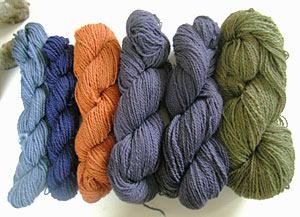
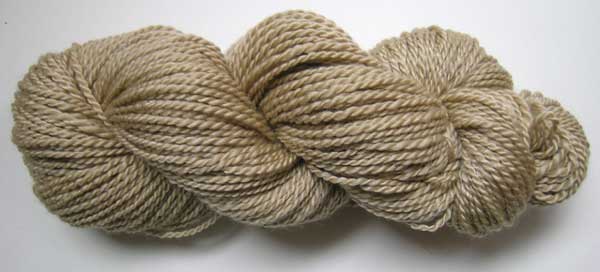
So this is what it looks like spun into a 2 ply. I’m pleasantly surprised at how nice this fiber mix is.  The plied yarn looks a bit stiff when if first comes off the wheel but once it’s washed it becomes soft and silky.

After spinning three bobbins of spinning singles, it became much easier to handle and to anticipate how fast the fiber supply slips through my fingers.  Now that I’ve got the rhythm down, It’s hard to stop and do any knitting. At this point I have three finished skeins and have three more to finish.

While spinning this fiber, I decided to start weighing my fiber before I spin it. I figured that this would hopefully help in getting the same amount of fiber on each bobbin and thus eliminating left over singles on one bobbin. Each of my bobbins seems to accommodate about 2 ounces of singles that can later be plied onto one bobbin.  For the most part this method works, although results do vary depending on how many self-plying samples I take while spinning singles.

Cardigan of many colors

Harvard_square_sleeve1_1

This is all that I’ve managed to knit during the past.  It only took a few hours to complete this sleeve, so the rest shouldn’t take too long. It’s really a simple pattern.

I carried the yarns for each color up the left side of the piece. By doing this, I won’t have to go back later and weave in a bunch of ends. Whenever I got to a larger stripe (yellow or orange), I tried strategically tuck in the unused yarns by wrapping the current yarn around them before I would start a row.  Click on the photo for a closer view.

New Project

Dalegarnfalk

It’s baby time.

I know of three that are due next month so, it’s time to start working on a baby shower gift that needs to be done withing the next few weeks.

The project will be the Harvard Square Cardigan from Knitting for Baby. The designer, Kristin Nicholas has a picture of it on her website.

The one in the book was done in Wollywasch but I had no luck in finding it in the specified colors.  In fact, I had a hard time finding  a good online source.

At first, Debbie Bliss DK merino seemed like a good substitue but unfortunately her green is just too dark.

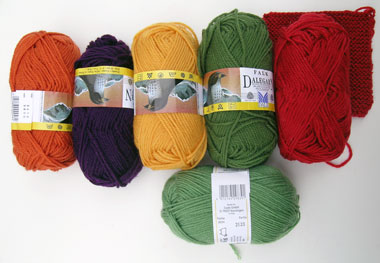
While searching for a better green, I came across Dalegarn Falk. It has all the right colors, just a little brighter than I was initially hoping to find. Since the  sweater is for a baby,  I think it should be ok.

I was toying with the idea of using a lighter green, hence the odd ball of Schachenmayer Nomotta Extra under the Falk.  After getting a quick opinion from my husband, the darker green won out.

Merino tencel blend

Merino_tencel

For the past couple of weeks I’ve been slowly spinning this merino/tencel top which has proven to be quite a challenge compared to the pure merino top that I just finished.  The fibers slip so easily that it’s difficult to maintain a consistently sized single.  So far I’ve only been able to fill up one bobbin, so I haven’t had a chance ply a large quantity to see how the yarn will actually look.  I’m curious to see how it will look once it’s knitted.

Melinda and Melinda

I haven’t seen too many Woody Allen movies but I thought since my name is Melinda I would steal the title of his latest film.

Smoke Ring Smoke Ring

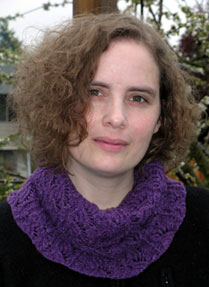
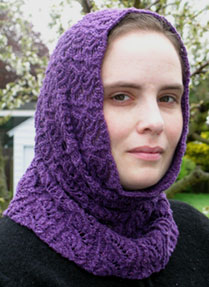
I finally finished the Flared Lace Smoke Ring, so here it is with pictures showing two ways to wear it.  Here’s a closer view of the stitch pattern.
Apparently this type of knitted object is also called a wimple.

Now that spring is here, it probably won’t get worn until next winter.  Isn’t that how it always goes with knitting projects? Somehow I tend to finish projects just as the season turns and the item has to wait to be worn.

Red

Red_merino

I’m now back in my spinning grove. The red is coming along just fine. I did however have to put this skein through the wheel twice in order to get the right amount of plying twist. The second time I used a larger whorl so that I wouldn’t over do the twist.

Rob shared this link to pictures of the Spring/Summer  issue of Vogue Knitting on her blog the other day. I usually don’t buy Vogue but couldn’t resist this issue. I think it’s  much more inspiring than the Spring issue of Interweave Knits. I’d love to do this sweater but not in the acrylic/polymide yarn that they used. Cotton or a cotton/silk blend would be much better.

As the wheel turns

Here’s proof that I’ve been working on the Spin-Off sweater.  I’m currently working on the red – all 9 oz. After the red, there’s 1.5 pounds of  a honey merino & tencel blend.

Spinoff_yarn

I’m not the only one around here that loves looking at yarn, hence the paws in the upper left corner.

Some other knitting projects are on the horizon but nothing definite yet. I’d love to knit this Seaweed scarf designed by Alice Starmore.

Spring cleaning

While working on spinning the rest of the fiber for my current sweater project, I’m also attempting to clear out a back log of small projects lurking around every corner of my small house. I honestly try not to let projects pile up, but it always seems so easy to justify buying a few skeins of yarn for small projects.

Smoke_ring_1

My latest small project is the Flared Lace Smoke Ring from Heart Strings Fiber Arts, which is being knit out of  Silky Wool by Elsebeth Lavold  (65% wool and 35% silk).  It’s a stand in for the Rainbow Roving that I spun last year but is not nearly as nice;  Silky Wool just isn’t as soft and springy.  With only 4 ounces of Rainbow Roving,  I’m still looking for a perfect compliment yarn and/or pattern.

Twist Gauge

I’m back to spinning merino top for the Spin-Off magazine and remembered that I’ve been meaning to share the latest in my twist saga.

Did you notice the picture a “Twist Gauge” on page 68 of the latest Spin-Off magazine? Well being the yarn techie that I am, I noticed it right away.

I’ve had a weird fascination with the subject of yarn twist, ever since I found out that I was putting too much twist in my yarns, causing them knit up into a tough dense fabric. This photo of a twist gauge  intrigued me because it looked like such an easy tool to use. I immediately e-mailed Amy, the editor, and asked where this came from.  She said that it’s from an article called Measuring Yarn by Rita Buchanan in the Winter 1993 issue of Spin-Off.

Twistgauge

Well, I finally got my hands on a copy of this issue and here is the twist gauge in action.

It is easy to use. I just take a piece of my hand spun yarn, line up the twist ridges of the 2-ply yarn with the lines in the middle of the gauge and then read the angle indicated on the outside of the circle.

I think It would be easy to make one of these gauges using a protractor to draw the circle and mark the angles.  Once the circle is drawn, add vertical lines inside the circle which are  a millimeter apart.

One skein Mountain Goat crew socks

Mountain_goat_socks

For the past year or so, I’ve been tempted to make a pair of heavy crew socks from Mountain Goat but didn’t give into the temptation because I figured socks would take two skeins.  Despite the beautiful colors, I just wasn’t willing to spend $40 for a pair of socks  (Mountain Goat sells for around $20 a skein).

Last month, I ended up with an extra ball of yarn from the kitty hat project and decided to return it for something else. Well, the only thing in the store that attracted my attention  was the Mountain Goat. I finally gave in and decided to get only one skein and see how far it would go.

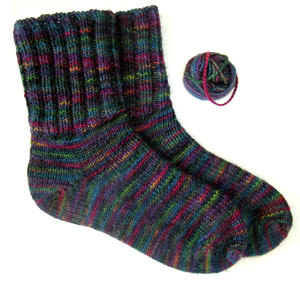
I easily got a pair of socks (women’s US shoe size 8) out of one skein.

To keep track of how much yarn I was using and to determine the half way point, I decided to weigh the yarn ball at various stages.  At the start the ball weighed 118 gms and upon completion it was 8 gms.

After wearing these socks a few times I can report that they are quite warm and comfortable; perfect for Birkenstock’s or clog.  The only potential down side to this yarn is, that as the heel and foot of the sock rubs against the shoe, fibers seem to lift out of the yarn and create areas of fuzzy clumps.