Firebirds is officially finished

Firebirds_finished_1

Good thing we snapped a picture of the sweater yesterday. Today a storm has come in and it’s so cold that the rain might turn to snow. What a wonderful day to wear a warm sweater.

Now that I’ve had a chance to actually use a woolly board, I would recommend it to any one who thinks they’ll be knitting lots of Fair Isle sweaters. It stretches the sweater a bit while drying so that any irregularities in the knitted fabric are straightened out.

When starting this sweater I intended to shorten it by one lengthwise repeat because I like sweaters to hang well above my hips. However  once  the body was half way done I got cold feet after checking my tension. At that point it looked like my row gauge would make the sweater a few centimeters shorter and I was afraid that taking out one lengthwise repeat would make it way too short. Now that it’s been dressed on the woolly board, I wish I would have shortened it. Oh, that’s not to say I don’t like it. The length won’t keep me from wearing it but it’s a good lesson for my future sweater projects.  It’s quite easy to adjust the length and/or width a couple of inches when using a woolly board.

What’s next? I must really get started on those fingerless gloves. I’m also very tempted by another VY kit. But wait, I also have lots of fiber to spin.

More on buttonholes

woolly board

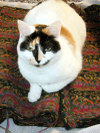
Finally, I finished the front band with the button holes. Today I soaked the sweater and put it on the board. “Muffin” couldn’t resist playing with the yarn that I used to bast the front bands together. I also put some basting stitches around the armholes and neck to help keep them from stretching too much.

As I mentioned before the pattern says to make thirteen two-stitch buttonholes over two rows but didn’t like the results. I then started wondering if these tiny holes would be big enough for the buttons I purchased; After all, the pattern didn’t mention how large the buttons should be. The only way to find out was to make some samples and see for myself.  Turns out that there is enough give in the fabric so that the two-stitch buttonhole will generally accommodate a small to medium sized button.

Even though the two-stitch buttonhole would work OK, I decided to do a three-stitch one row buttonhole similar to the one described in Ann Feitelson’s book. In my opinion this one is much neater with less stretch.

Here’s how I do it.

Before  I start, note that this button band is worked in garter stitch. Also, I decided that because of the two row motif, it was easier to knit the button hole while knitting on the wrong side row.

1. Figure out the position of the buttonholes and use stitch markers to indicate which stitches will be cast off for the holes. I decided to use 12 buttons and figured I could space the buttons as follows.

k 6 sts, work 3st buttonhole, *k 12 sts, work 3st buttonhole, k 11 stst*, repeat from * until twelve buttonholes are made, k 6 sts. Total number of sts = 173.

2. Knit to first buttonhole. Bring yarn to front and slip one stitch from left needle to right needle. Take yarn to back. Slip another stitch from left needle to right needle. Pass first slipped stitch over second one. Slip another stitch from left needle to right needle. Pass second stitch on right needle over stitch that was just slipped. Bind off a total of three stitches in this manner. Turn band to other side.

3. Cast on four stitches using “knitted cast-on” technique, making sure to twist each yarn before each cast on stitch. Turn band to other side. With yarn in back, slip first stitch from left needle to right needle. Now cast off one stitch on right needle by passing second stitch the over the first one.

4. Continue knitting to start of next buttonhole. Repeat steps 2 & 3 for each buttonhole.

It’s really hard to get good pictures of this. If you need to see pictures I would suggest picking up the latest issue of Interweave Knits (Winter 2006). Page 32 has instructions on how to knit a one-row buttonhole. My instructions are a bit different; I prefer a knitted cast-on while IK’s instructions use a cable cast-on.

The girls

the girls

These two youngsters came home with us yesterday. No official names yet. Both are adjusting well to their new home and the other feline house guest. We haven’t tried knitting yet; that will probably have to wait until nap time.

Buttonholes

Button_sample

After four years of knitting I can’t believe that I’m just now finding out how hard it is to make professional looking medium to large sized buttonholes.

The instructions for this cardigan essentially say to knit 13 two-stitch, two-row buttonholes using the following process.

On the first row work to the start of the buttonhole and then bind off two stitches. Work to the start of the next buttonhole and  bind off two more stitches. Repeat binding off 2 stitches for each buttonhole until the row is finished. Turn work. On the second row, work to where the stitches have been cast off on the previous row and then cast on two. Repeat for the rest of the buttonholes.

Sounds easy enough, right?

Well I did it and didn’t like how it looked; a tiny hole punched through the band with stranded yarn peaking through the hole. Yuck. Sometimes I can be very picky about my knitting and this odd looking button hole wasn’t up to snuff.

Feeling a bit frustrated, I pulled out all the reference books. Most mentioned making buttonholes just like the pattern. When I got to “Principles of Knitting” I had to chuckle at Ms. Hemmons Hiatt’s assessment of buttonholes. She says, “Buttonholes make me rather unhappy, I suppose because I am a perfectionist by nature and it is quite impossible to make a perfect buttonhole in a knitted fabric. Oh we can make reasonable buttonholes, but they all look rather better when covered by the button than they do alone.

Buttonhole

The most reasonable buttonhole that I’ve found is the one described in Ann Feitelson’s book. It’s a one row buttonhole that’s a bit firmer than the one mentioned in other Fair Isle books. I’ve adjusted the buttonhole spacing to accommodate this three-stitch one-row buttonhole.

Working buttonholes and keeping track of color changes is quite a task. I found that for this button band working buttonholes on the wrong side made it much easier to manage both tasks.

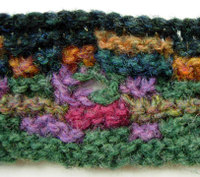
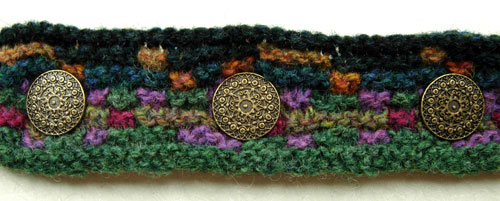
Notice there are two rows of each double color combination (purple/green or orange/green)? When I knit the first row I need to keep track of the color changes by following the chart but on the second row I only need to follow what I did on the last row. Since I can easily follow the color changes from the previous row, I can forgo looking at the chart and concentrate on making “reasonable” buttonholes. The picture on the right shows one buttonhole from a short sample piece that I did earlier in the week.
Muffin

In the next few days I’ll get back to working on the actual sweater. Buttonholes should become second nature after I’ve finished all twelve so I’ll report back soon with a description of how I work this type of buttonhole. By the way, I also noticed that the latest issue of Interweave Knits has an excellent set of drawings and instructions on how to do a one-row buttonhole that’s very similar to what I’ve been doing.

Now if only my house guest will give me back my sweater. I’ve tried to trade her for an older sweater but to no avail.
La Barcelana, Barcelona

La Barcelana
After visiting Museu Tèxtil i d´Indumentària we wondered the narrow streets of this old neighborhood enjoying the shops and old architecture.

I knew there was another small yarn shop in the area but thought I had done enough yarn shopping that day. Lately I’ve been trying to not to make any more impulsive yarn purchases until I use up what I have. It’s amazing how fast yarn can accumulate over the years, especially if there was no intended project when it is purchased. Only one stray ball of yarn has actually turned into a finished object, that was the yarn I used to make the swallowtail shawl. That yarn was purchased almost three years ago while on vacation in Paris. OK, so earlier in the day I did buy some  J&S Shetland yarn from Persones Llanes. I justified that purchase because I can’t readily get that brand where I live.

Well, somehow we eventually ended up at La Barcelana.

peak inside Labarcelana

We popped our head into the door and I briefly looked at the yarns. Our timing wasn’t great because I think they were just about to close for the afternoon break. Various unlabeled yarns were stashed in bins along one wall and in the back room a woman was weaving on a large loom. This time I stuck to my pledge and didn’t buy anything. While the shop did display a few knitted items I got the idea that this shop catered mostly to weavers.

Persones Llanas, Barcelona

Personesllanes

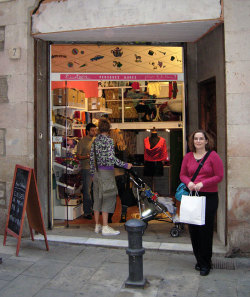
My first yarn store visit in Barcelona was to Persones Llanas. That’s me standing in front of the store happily clutching my purchases.

So, this is crazy – while in Barcelona I end up purchasing wool from Shetland.

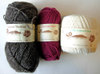
J_s_shetlandOfficial Tally:

– 1 ball of J & S Jumper weight

– 6 balls of J & S Lace weight

– 3 balls of J & S cobweb

We asked about local Spanish wool. Isn’t merino from Spain?

Apparently it’s not being produced although the owners mentioned they are working with a local artisan and were hoping to get a shipment soon.

I don’t speak Spanish so I’m not sure a what the whole story is. That’s what my husband relayed to me after a long discussion with one of the owners who is from Barcelona. The other is originally from Tucson but she was giving a lesson in the loft.

My husband wryly mentioned that we were on a world wide tour of yarn stores. The response was, I know what you mean.

This is a really small yarn shop. Notice the display on the left? That’s just about the whole stock and I think much of it is from the US. In case you’re interested, they do offer a PDF catalog via their website. Since my current knitting phase is learning about Shetland knitting, I was thrilled to buy some Jamieson & Smith wool. Now I have some for comparison with VY and Jamieson.

The owners are very enthusiastic advocates of knitting and are encouraging Barcelonians to expand their knitting horizons. The next day I purchased a copy of Verena Moda De Punto, the local knitting magazine and noticed an article about “Nuevas Costumbres” which included a photo of group of  young knitters gathered in the loft knitting.

The store is conveniently located in the old part of town not to far from the Picasso museum. Across the street from the Picasso museum is an interesting textile museum.

Swallowtail Shawl

Swallowtail Shawl
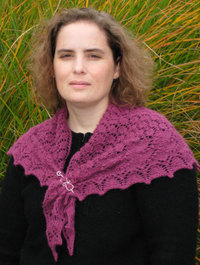
I keep meaning to write more about my fiber finds in Catalonia and the Pyrenees but just couldn’t put the Swallowtail Shawl down long enough to get anything done. It was started on the plane trip back and I just finished it last night. Besides the nupps (which I would call knitting speed bumps) it’s a really quick knit.

Last week I meet Evelyn (the designer) at a local knitting group and asked her my burning question about this pattern. Why does it suggest placing a safety pin on the wrong side? She said that when the pin serves as a reminder that the  last two stitches need to be knitted (not purled) to maintain the garter stitch border.

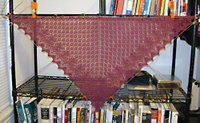
Dressing Swallowtail

Finally, an excellent opportunity to use the dressing wires that I purchased this summer while attending the NWRSA conference.

It was easy to slide the wire into the yarn-over holes on the edges but figuring out how to keep the shawl spread out was a bit tricky. The best solution was to clamp the wires to my bookcase which happens to be the same width.

By the way, I couldn’t resist getting one of those shawl pins made by Romi.

So, now it’s back to finishing those darn buttonholes on Firebirds. I promise.