A few changes

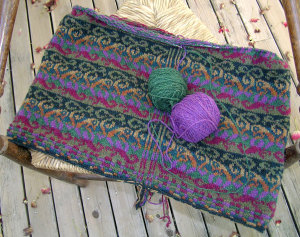
Body3repeatsKnitting on Firebirds continues as usual, with a pace of about one lengthwise repeat per week.

Previously I mentioned that I was going to shorten the sweater by one repeat. Well, plans have changed after taking a moment to check my tension.

While my stitch tension seems to be fine (~7 sts per inch), I found that my row tensions is off a bit. I’m knitting 8.43 rows per inch while the pattern calls for 8 rows per inch. Yikes! that’s going to make the sweater about one inch shorter.

I’ve gotten squeamish about shortening the sweater one whole repeat. That would be 3.5 inches, which seems too much. At the same time I’m also concerned about the width. As I’ve been contemplating this dilemma, I remembered hearing the teacher in a beginning knitting class say that you can always block a sweater so it’s wider or longer but not both. With that in mind, I’ll go ahead and knit all seven lengthwise repeats and try to stretch the sweater out an inch with a woolly board.

Besides worrying about the overall length, I also started thinking about how my row tension could affect other parts of the sweater; specifically the armholes and neckline. The difference in row gauge means that I’ll need to start the armhole steeks a few rows sooner so that the length of the armhole matches the length specified in the pattern. However, no adjustments for the neck opening will be needed. After doing a bit of math, I found that the tension differences won’t make enough of a difference to merit adjustments.
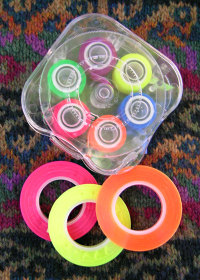
Chart_marking_tapeOn another note, I was at the fabric store yesterday checking out fabrics to cover my needle binder and found these tapes near the  rulers used by quilters. Apparently, quilters use them to mark off frequently used measurements on their rulers. When I saw them I though, wow I could use those for marking my knitting chart for my current project.

My first attempt started with a piece of blue tape from “Tape Go Round”; the funny tape dispenser with six little tape rolls. It didn’t take long before I found out this tape wasn’t going to work. When I tried to move it to another row it didn’t come off very easily and started tearing my paper chart.

Next I used one of the tapes called “Glow-Line Tape”. This tape was about $1 cheaper with couple more yards of tape. This one worked much better but oddly isn’t quite tacky enough to last more than a couple of rows.

I ‘m considering going back to good old Post-it notes.
DIY needle binder

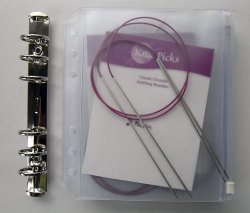
Ring_binder_parts_1My new KnitPicks needles are working out great. Now I just have to keep them organized.
My other circular needles are in one of those large soft-sided fishing tackle cases.  It works well but has been bulging at the seams for some time now. It’s way too bulky to take to classes and I’m not so crazy about the fishing logo on the front. Clearly these new needles need another home.

I like the binder idea that KnitPicks uses for their case but didn’t buy the cover. I was hoping that I could just buy some of the needle pockets to use with my old day planner.  Turns out that the needle pockets are much smaller than my old day planner and have six oddly spaced holes. After visiting an office supply store and comparing the needle pockets with other planners I soon found that the hole configuration will fit binder mechanisms with six rings but that planners using these types of rings are not wide enough to hold the needle pockets.

Not daunted by this, I headed over to a local thrift shop and sifted through the mounds of unwanted planners and binders. After a few minutes I found one with rings in good shape and the right price – $.69. When I got home I tore the binder mechanism out of the planner and started thinking about how to make a cover and secure the mechanism to the cover.

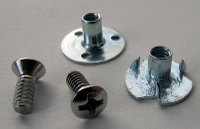
I quickly recalled finding a nifty binders called Rebinder that is made so that the cover can be easily replaced. Hoping to use this same idea to fasten my binder mechanism to a cover, I looked closely at the parts and headed over to the hardware store.  Bolts

Here’s what I found. The nuts are called t-nuts, tee nuts or blind  nuts. They either have prongs that will dig into the item being secured or without prongs but with small holes for brads. My Rebinder has the one with the prongs which dig into the cardboard cover to hold it securely.  These t-nuts come in various sizes. The ones that fit into the holes on my binder mechanism are 6-32. The screws that fit into the holes of the t-nuts are 6-32 x 3/8 machine screws with an oval head for Phillips screw drivers.

Now that I have binder rings and a way to fasten it to a cover, I just have to design and make the cover. Not sure what I’ll do. There are so many possibilities.

In the mean time, I’m still working on Firebirds.

Body2repeats

Progress is a bit slow since I’m trying to make sure all my stitches are even. Parts of the chart have long gaps between color changes, which I think makes it harder to be consistent. I’m trying to remember to weave in unused yarn when knitting through such gaps, hoping this will help.

It’s 89 degrees and still knitting

Body_one_repeat

Got one repeat finished this week. I’m coping with the heat by mostly working on Firebirds in the evening and morning when it’s cool. Otherwise, I can’t concentrate and end up ripping out all that I knit.

To get out of the heat, this afternoon, I went over to Fusion Beads thinking I might pick up some beads to make some of those fancy stitch markers.

For this project, I’ve been using one to mark the back of the sweater so I don’t forget to flip the repeat (birds on the right side face right and ones on the left face left). I have no trouble keeping track of the front because the steeks are very noticeable. So, no stitch marker for the front.

Anyways, the stitch marker that I’m using came in the goodie bag give out at the  NwRA conference . Ordinarily I wouldn’t purchase such things but I work on this project I’ve grown fond of the one I have and like the feel of a metal marker. The colors even match the sweater.

So, as I was sifting through the packages of crystal beads at the store, I realized it was all quickly getting out of hand; I don’t need another hobby.  I leave the store with only a few plain sterling silver jump rings  that will work well with my new needles.

By the way, I noticed some excellent tutorials on Fusion Beads’ website, including this one on wire wrapping.

Firebirds started

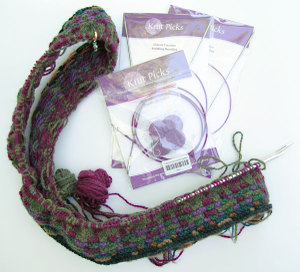
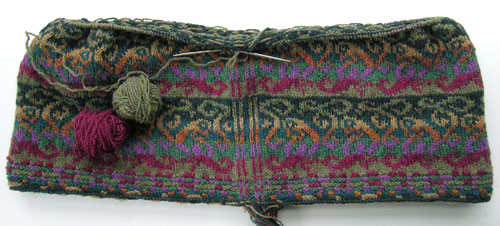
Lowerbandneedles After a week of crunching numbers I finally got enough confidence to cast on. Figuring out how wide the body should be wasn’t a problem but I wasn’t sure about adjustments to the neckline. Luckily I got some help from a fellow knitter/blogger whose already tackled this pattern.
When I looked through my supply of 3.5mm circular needles I only found two 24″ and one 47″. I tried using the longer needle but quickly found it was way too large. I then tried using both 24″ needles but found the needle tips a bit troublesome to work around. I was about ready to make a trip to the yarn store for a new 40″ circular when my Knit Picks needles arrived.

A couple of weeks ago after reading all the positive comments about these needles on Knitter’s Review I decided to give them a try. I placed an order for some of the Classic Circular needles and one set of the Options Line needle tips and cords. Apparently, these needles are so popular that Knit Picks is having a hard time keeping up with orders.

So what do I think? After working several rows, I can say they’re much better than my Addi Turbo needles. The cables are wonderfully flexible and the tips are a bit sharper which makes two color knitting easier for me. I’m currently knitting with one of the needles with removable tips and so far haven’t had any trouble with them coming loose. Kudos to Knit Picks for taking knitting needle design one step further. By the way, Clara from KR has an excellent detailed review of these needles.

Done!

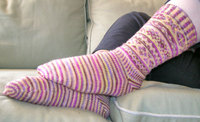
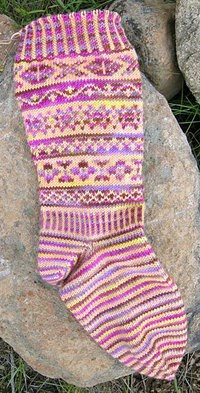
Fair Isle SocksThese socks sat around waiting to be bound off. I finally did it this week using the elastic bind-off from page 47 of “A Treasury of Magical Knitting” by Cat Bordhi.

The border designs came from Alice Starmore’s Book of Fair Isle knitting. The repeats for each band fit within the total number of stitches so there are no partial repeats. Here’s a picture of the back of the leg
where each round began.

OK, I’ll admit it – I love looking at these socks. Here’s a another picture from the front.

Better second time around

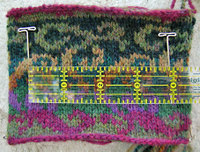
Firebirds_swatch3 I’m calling it good.

I increased needle size from 3.25 mm to 3.5 mm and also worked in the round, just as the sweater will be knitted.

Cast on is around the corner once I figure out how large to make the cardigan.

For those who aren’t familiar with patterns from VY, this specific pattern was originally printed in child sizes and the adult size comes as an addendum in the size ordered. I ordered an XL to make sure I have enough yarn but requested the addendum for a large. Now after pondering sizes and measuring all my sweaters, I think I should have asked for a medium.

This week I’ve been looking through every Fair Isle knitting book under the sun trying to get a handle on how to adjust this sweater to fit me.  Adjustments can be pretty vexing when one has a big difference between chest size and hip size. Since Fair Isle sweaters are just big boxes with no shaping for a feminine waist, there actually not that great for women with my type of body shape. While I know this, I still want to go forge ahead and knit this beautiful sweater.

Traditionally the motifs should line up around the body, centered on the back and front and matching at the shoulders. Keeping this in mind, I think the best plan of action is to shorten body by several inches so the bottom edge hits above instead of below my hips. This way, the total circumference will be closer to my chest size and I won’t have to worry about it fitting over my hips.

Wild fiber

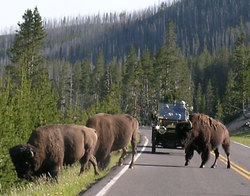
Buffalo

Just rolled in from spending the past week hanging around “wild fiber” in Yellowstone.
The highlight of the week was getting the opportunity to stay at the
Lamar Buffalo Ranch and take a class called “The Carnivore Conservation Challenge”  from the Yellowstone Association
Institute.

Early in the week I came across decent quantities of buffalo fiber left on the ground near a picnic point in Hayden Valley but I resisted the urge to take any.  Later in the week I had a chance to ask a ranger whether it was OK to take buffalo fiber. She confirmed that it isn’t allowed. I could look but not take it out of the park.

The gift shop at the ranch had some lovely stocking caps for sale from a local company called Thirteen Mile Lamb & Wool Company. Hang tags on the caps mentioned that the company uses locally raised predator friendly wool. I’ve known for some time that ranchers weren’t keen on loosing livestock to wolves and bears but wasn’t aware that there was a program to recognize products that use predator friendly methods to raise their livestock. One of the teachers mentioned that it’s hard to get ranchers interested in having their product labeled “predator friendly” since calves are usually sold to large feed lots with many other cattle. This makes it hard to distinguish between ones raised on predator friendly ranches or non-friendly ranches.

This whole topic is very new to me and has got me thinking more about the wool I use. I’d like to do a little more research on the topic.

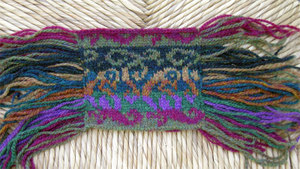
Firebirds_swatch2Like every vacation, I usually have grand ideas about getting lots of knitting done while traveling in the car or plane. As usual, I was only able to manage a small fraction of what I had planned. This time I only managed to knit a swatch of the Firebirds cardigan.

Instead of knitting the swatch in-the-round, I decided to knit it flat as described in the pattern, which I gather is the more traditional “Fair Isle” way. Using a circular needle I started each row with new strands of yarn and cut them at the end of each row. In this way each row is knitted in stockinette (no purl rows) and is suppose to mimic knitting in the round without having work twice as many stitches.

Notice the long yarn ends? I think it’s unusual to leave them so long, but cutting the ends made me nervous about loose edges so I kept them long.

The swatch turned out to be very tight ,~ 9 sts X 9 rows per inch. I’m was aiming for about 7 sts per inch.  After measuring this swatch I started to regret not knitting it in my usual manner (in-the-round). I suspect that managing all those ends made my tension tighter than it really is. This week I’ll work another swatch but this time do it “in-the-round”. Hopefully I won’t use up too much yarn trying to get a “good” swatch.

Myrna’s variations

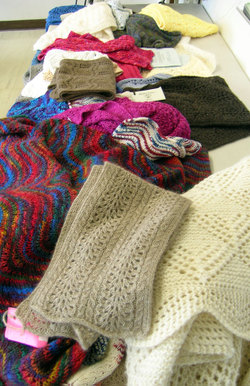
Myrnas_samples2 So how many variations of Feather and Fan (a.k.a. Old Shale/Shell) are there? After taking Myrna Stahman’s class called “Variations on a Theme”, I learned that there are more than any one can probably count. Perhaps, the number of possibilities is what’s taking her so long to finish her next book.
This was a full day class devoted to discussing the basics of understanding the mechanics of stitches on the needle, reading lace charts, viewing samples of the variations and trying our hand at design our own variation. Overall it was a very informative class. Her samples were very inspiring and innovative. In the photo there’s the most amazing circular shawl (just beyond the brown scarf) made out of Mountain Colors yarn. It was made using a special technique that she developed which allows one to to knit Feather and Fan as a flat circular item. We were all dying to learn this special secret but alas she said that she’s saving it for her book.

While most of the other knitters in the class took on her challenge of attempting to design a new Feather and Fan stitch pattern, I just stuck to one of the basic variations. As you can see by this photo, I didn’t get very far. To tell you the truth, I’m anxiously awaiting her next book. Unfortunately the room was very hot and muggy due to some very strange weather at the time so it was too difficult for me to concentrate on designing anything.

To dress lace shawls Myrna uses dressing wires. Dressing wires that she helped develop are now available through HandWorks NorthWest. Since one of the vendors was offering them at the show with a small discount, I went ahead and purchase them. The kit comes with plenty of wires, blocking pins, instructions and a plastic tube for storage. I haven’t used them yet but I’m sure they’ll come in handy when I work on my next lace project.

Yep, still working on these darn socks

First_sockAfter a couple of months struggling with these Fair Isle socks, there’s light at the end of the tunnel (and it’s not a freight train). All that’s left is to cast off the ribbing of the first sock, complete about 20% of the other sock and then block both.

I won’t mention how many times I redid these toe-up socks to get them to fit properly. While at the NwRSA conference I was showing some classmates the other pair and mentioned I was going to rip the yarn down to the toe and heard gasps. I just sighed and mentioned that they didn’t fit. Besides, one reason I love knitting is because I control the project and if I want to redo it, I can.

This time I added four more stitches at the toe and then four more before starting the leg. The first three bands after the heel do not have increases while the two upper purple bands have 4 increases just before and after the design within the band (two in the back of the leg and one at each side).

I’m hoping to wrap these up this week and move on to my next project, Jade Starmore’s Firebird Cardigan.

Actually this week I got a bit of a head start by winding a skein of each color and clipping a sample for a home-made color card. After doing this, I transformed the black and white chart into a color version using a cross-stitch program called Pattern Maker. Now I’m all set to start the swatch.

Sorry, I didn’t get a chance to write up my class notes. I was too busy knitting. Maybe I’ll get around to it this week.

NwRSA Conference 2006

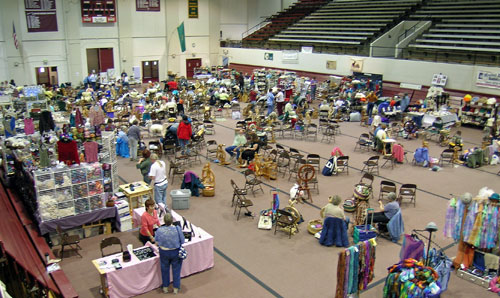
Gym

This weekend NwRSA’s annual conference was held at University of Puget Sound in Tacoma.

Unlike last year, this time I commuted each day. Since it was quite a drive I just attended a couple of full day classes and didn’t have a chance to stay for most of the evening events. On Friday I attended Variations on a Theme, Part II  with Myrna Stahman (the Faroese Shawl guru) and on Saturday I took Spinning for Socks with Carol Rhoades (Spin-Off Magazine’s Technical Editor).

I’m still getting my notes and samples in order and plan to post about each class.

One highlight of the weekend for me was Sarah Swett’s keynote address and slide show on Saturday night. She’s an exceptional tapestry weaver from Idaho who’s had several articles in past issues of Spin-Off and was one of the featured knitters in Knitting In America (that’s her in the upper right hand corner on the cover of the book). She also has a new book out called Kids Weaving that explains how to create an inexpensive loom from PCV pipes.

While wearing a her beautiful long vest, Sarah showed slides as she talked about her work, her life and how unexpected surprises influence her creativity. She describes herself as a story teller that uses tapestries to convey stories of her and her friend’s lives. Here’s one with her friend sitting in a “dryer” dreaming about living some place where a dryer isn’t needed. Recently, her attention has shifted to painting with egg tempera, doing a bit of needlepoint and learning to play the cello.