Analysis Paralysis

In the software development world, one can’t help but hear the phrase “analysis paralysis“. We’ll this past week I’ve been stuck in that mode as I try to decide on which cast-on method to choose for the Log Cabin socks from “Handknit Holidays”.

I’m not a novice when it comes to knitting socks but I still can’t help wondering if I’ll ever come across the perfect 2×2 cast-on.

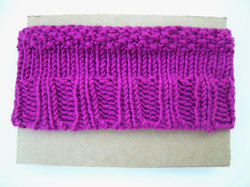
Here’s my attempt at swatching the tubular cast-on as shown in “Basic Knit and Crochet” by Ondori.
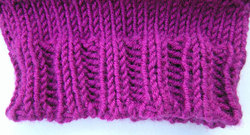
2x2 tubular cast on relaxed

2x2 tubular cast on stretched

Kind of sloppy for my taste. OK, I will admit that if I had used a smaller needle it might have come out better but I don’t think that would get rid of the splayed knit stitches.

At this point, I’m toying with the idea of doing an provisional cast-on and then binding off using the sewn method show in Simple Socks. It won’t be the first time I’ve used that method but to be honest, I really didn’t think it was all that elastic.

Funny thing is, this afternoon I happened to see this commercially made knit hat (made by Pistil) in a shop that has a very neat elastic edge. It didn’t look like any cast-on / bind-off that I’ve seen before. For the life of me, I couldn’t figure out how it was done and although it’s a splendid cap, I wasn’t willing to plunk down money for it just so I could figure out how the edge was finished.

Great Balls of Fiber

Great Balls of FiberOn the 18th The Weaving Works had another drop-in spinning night that was well attended despite the pending holiday. Shirley mentioned that spinning is getting so popular that she’s had to add another beginning spinning class to the Fall schedule. That’s amazing considering just a couple of years ago they had trouble filling even one class.

This time I brought along some fiber that I picked up at the NWRSA Conference that I attended this summer. It caught my eye because it resembles the blended fibers that Deb Menz makes.

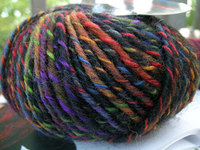
I don’t have any immediate knitting plans for this one. Perhaps someday it will turn into socks since the fiber is superwash colonial. Here’s a closer view of a swatch in stockinette stitch on size 3.5mm needles.

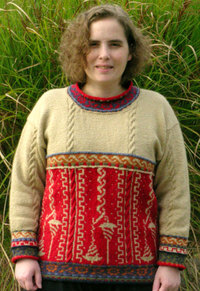
While surfing knitting sites this afternoon I ran across this Fair Isle sampler project called Onslow’s Vest on A Time to Knit. I suppose it was inspired by Onslow on the BBC show, “Keeping Up Appearances”. Doesn’t the yarn that I’m spinning almost look like the yarn used to make this sampler? At least I think so.

Fiber Details
Name: Great Balls of Fiber by Sarah Anderson of Snohomish WA
Fiber: Superwash Colonial
Color: Winter Spirit
Source: NWRSA Conference 2005
Weight: 5.6 ounces

Things Japanese

It’s been one of those odd weeks. Work has been hectic, I’m feeling uninspired with my current knitting projects and my mind keeps floating back to my recent trip to Japan.

To fuel my desire to learn more about Japan, I picked up Japanland: A Year in Search of Wa.This quick insightful read was just what I needed to help take me back to Japan. Not only did it cover aspects of Japanese culture that I missed but also reminded me of previous home stay situations that I’ve encountered in the past.

Japanese_knitting_bookUnfortunately I probably won’t be going back to Japan anytime soon so to satisfy my craving for things Japanese, I went to the Kinokuniya book store within Uwajimaya grocery store yesterday. I was curious to see if they carried a 2006 calendar that I saw at their Shinjuku store but didn’t purchase.

Not only did I find the calendar but I also ended up browsing through the Japanese knitting books and found one on how to make mittens, gloves, and socks.  Despite the fact that I do not read a word of Japanese (and have no idea what the actual title of this book is) I purchased the book because of its wonderfully detailed diagrams and pictures. It walks the knitter step by step through the whole process, sparing no detail. Gosh, this book puts almost all of my English books to shame. The prices also wasn’t that bad; only $10.

Today, I’ve been studying the “Ladies’ socks” in this book; learning yet another method of  doing short-row heels. I think it shows a way to use “Japanese short-rows” for shaping sock heels, but I’m not sure until I try it out and compare it with some of my printed resources on Japanese short-rows.

Okadaya

When I started knitting again several years ago I made a point of visiting several yarn stores while on vacation in London and Paris. As a knitter it seemed like an excited thing to do but, for my husband it turned into several diversions that I’m sure weren’t on his list of places to visit. Although he was very patient, I could tell he’d much rather else where.

It was on that trip, after checking out several yarn stores, that I realized that I could buy most of the best yarns from around the world at my local yarn stores or through the Internet. With that being the case, I started to question whether it was really a wise idea to spend time seeking out yarn stores while on vacation.
Okadaya_1
Well as I mentioned several weeks ago, while on vacation in Tokyo last month, I did happen to stop by Okayada in Shinjuku to pick up  Clover’s new row counter which is called “Mini Kacha-Kacha”. This time I decided it was OK to check out this craft store since it just happened to be within walking distance of our hotel and I knew exactly what I was looking for. I promised that I wouldn’t stay too long.

If you do like searching for yarn stores while you’re on vacation and find yourself in Tokyo I would recommend two sources of information on where to go.
1. Download Pinku’s excellent list of stores that I found thanks to a post on Knitter’s Review. Just find the link to the Excel spreadsheet.
2. Vogue Knitting, Fall 2005 has an article on knitting in Japan that list several stores.

Okayada is a craft store destination that’s in a couple of skinny buildings between Studio Alta and the JR train tracks. To get there just walk out the east exit of the Shinjuku JR station and start heading north towards Studio Alta, a building with a big movie screen (which is just below the JCB Card board in the picture). It’s just a couple of blocks to the left near the train tracks. Somehow we ended up in the building that sells fabric and after climbing several fights of stairs realized that the knitting section was in another building on the fifth floor around the corner.

Since I didn’t need any yarn and my husband had tired feet, I only stayed there long enough for quickly tour around the fifth floor to peek at the yarn and to buy the row counter.  Although I didn’t look too closely, they seemed to carry a good selection of yarn. Unfortunately,  I forgot to check the prices but think Japanese yarns probably are not any cheaper than in the US. At least the row counter wasn’t.

Moebius in Tahki Shannon

Scottish_wave2

I finished the Scottish Wave scarf from the book A Treasury of Magical Knitting (by Cat Bordhi) this week.

A few weeks ago I took it with me to Japan, hoping to get it done during the flights but only managed to get eight rows done.  The cast-on proved to be a bit tricky, taking several hours of practice.  It was a bit frustrating to find the stitches formed during the cast-on more loose than the following rows.

It’s a good thing I didn’t get too far because when I returned home I found out, after visiting Cat’s website,  that the pattern in the book has some major errors.  I had to rip out four of the first eight rows.

Takhi Shannon is such a beautiful yarn (although, beware it’s not very soft).

I keep dreaming about making a sweater out of it. Perhaps, I could spin something similar on my wheel.

Tahki_shannon__11_1

As I’ve mentioned in a previous post, I never imagined knitting anything from Cat’s book when I first flipped through it. I wasn’t too inspired my most of the designs but one day,  several months ago, I happened to see the actual scarf from the book on display at The Weaving Works. The colorful yarn was so lustrous and gleamed with flecks of color that I just had to find out more about it.

I held off getting the yarn, thinking I would eventually try to spin something  similar. While waiting ages to get the book from my library,  I couldn’t help thinking about this scarf and yarn. I frequently found myself loitering near it at the yarn store,  trying not to give in to temptation.  Eventually, I did surrender and after three trips to various yarn stores I gathered enough yarn to make the scarf.

Jet lag

Kacha_kachaJust got in from a trip to Kyoto and Tokyo so I’m in recovery mode today.
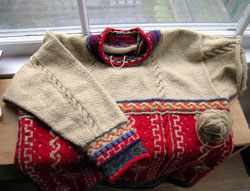
Instead of  hauling the current sweater project with me I took a new  project, the Scottish Wave scarf from A Treasury of Magical Knitting.

Despite two very long flights, I only managed to get eight rows done and now after checking the corrections on Cat Bordhi’s website, have to rip out half of those rows. Oh well, at least I got a lot of practice doing her “moebius cast-on”.

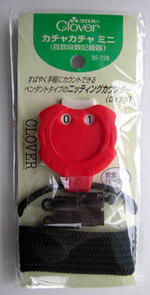
While in Tokyo I picked up this row counter at a craft store called Okadaya in Shinjuku (parallel to railroad tracks, left of Studio Alta – fifth floor). I’ll post more about Okadaya soon.

Patternworks has them listed as a Mini Kacha-Kacha on their website but haven’t gotten any in stock for a couple of months now. So, I feel a bit lucky to get a chance to pick up a couple while on my trip. Surprisingly, it wasn’t cheaper than the one Patternworks is offering.

What’s so special about this one? It can be hung around the neck on a string and  has a lock to keep the counter from accidentally being clicked when not in use.

Controlling that loose end

Oxo_farI think all spinners have  faced the dilemma of what to do with that end of freshly twisted fiber when they need to stop spinning.
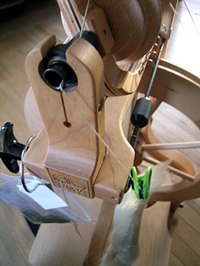
Until recently, I would pull off my remaining fiber supply and wrap the end around the tension nob on the top of my Schacht. While this worked most of the time, occasionally the thread would come unwound and cause a small mess.

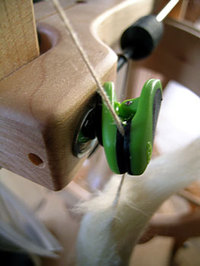
Several months ago when I was at the NWRSA Conference, another spinner showed me how she used a small clip to contain the end. I thought, what a great idea and since then,  have been meaning to find a clip. A few weeks ago I came across this  Oxo Magnetic Mini Clip in a kitchen supply store.

Oxo_close_1This week I had a chance to try it out and found that it was the perfect solution to my problem. Not only does the clip  contain the twist but I’m also able to place  it in a convenient spot on the wheel without having to permanently attach itl.  It just happens that there’s a bit of metal just below the orifice where I place the clip. This also allows me to leave the fiber supply attached and ready to it pick up and start spinning immediately without another join.
To expand on this idea, I plan on attaching a magnet to my oil bottle clip so that the bottle can be also be stored on the wheel.

Oh by the way, I finished spinning up another skein for the other sleeve and already have 1/4 of it done. This skein working up nicely so I should have the sweater done soon.

I would have been done but …

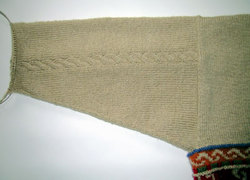
So_other_sleeveWhile contemplating what to do about the length of the sleeve I realized that the fabric on the first sleeve felt a bit dense compared to the upper part of the body. This was reinforced by the fact that the sleeve was already about 1 inch longer than it should have been. So, I  to eventually faced the fact that the current ball of yarn didn’t match previous ones and that I would need to rip it out, spin more yarn and knit the sleeve again.

Although I need to spin two more ounces to re-knit the left sleeve,  I decided to started knitting the right sleeve with a remaining ball of yarn. You can’t see a difference in the photo but I can definitely feel it. This one turned out much lighter with the stitches looking much more even. So, ripping out all that knitting was the right decision.

Now back to the cuff.

The pattern specifies a sleeve length of 19.5 inches which is one inch too long for me so I’ll need to make an adjustment. The instructions says to stop knitting the honey yarn when the sleeve reaches 15 inches and there are 64 stitches on the needle but I stopped after reaching 14 inches and now have 72 stitches after decreasing two additional stitches at the middle of each cable.

At this point I’ll start following instructions for the medium sweater instead of the “small” one as I have been doing. This will add one repeat of the patterns on the cuff;  just six extra stitches. I’m positive that this won’t make the cuffs too big because I already attempted to follow the pattern for the small sweater and ended up with cuffs that were too tight.

All of my re-knitting hasn’t gone unnoticed. My husband commented today that it seems like I’ve been working on this sweater much longer than any other (not including spinning).