More on the Winter Retreat

Dmenz_skeinsDmenz_swatch

I came back from the winter retreat with lots of ideas, fiber and the flu.

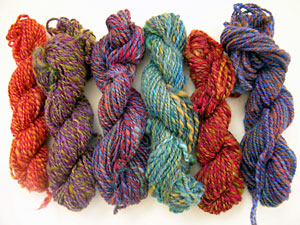
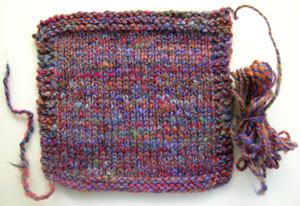
Yesterday, while recovering in bed, I managed to knit up a swatch from one of the sample skeins that I created in Deb Menz’s class. Just in case you’re wondering, the swatch was knitted from the third skein (from the left).  I’ve got to admit, the swatch turned out much nicer than anticipated. During the class I was having a difficult time trying to imagine what my yarn would eventually look like. Although it’s really beautiful I don’t think I’ll run out and buy a $500  drum carder. Hopefully I can get similar effects with hand cards or mini-combs.

… And speaking of mini-combs, here’s Judith MacKenzie McCuin demonstrating how lash multi-colored Lincoln locks onto mini-combs.

Judith_mackenzie_mccuinThis photo was taken during her class called “Three Bags Full: Spinning for 3 different types of yarn”.

We spent the whole morning spinning her wonderful Rambouillet top into a very fine lace weight yarn. In the afternoon we sampled some Lincoln, and possibly some other fibers. Honestly, the second half of this class went so fast that I don’t remember everything we did.

Judith is a wonderful teacher and I would highly recommend any of her classes.  Not only did she supply us with a multitude of  fiber samples to enjoy, but she also found time to talk to each student and critique our spinning styles and wheels.

After her discussion on worsted spinning techniques, I found out that I’m should probably switch hands (in snowboarding terms, I’m goofy-handed).  So, since I’m right handed, I should have my right hand pinching the twisted strand and the left hand holding the fiber bundle. She swears that the dominate hand should be forward, but understands that it might be difficult to switch.  I tried very hard to switch during class but I’m still not completely convinced that I can.

I also took one of her other classes called, “The Great Sock Caper: Hand-spun yarn for hand-knit socks”. This was another wonderful class where she taught us to create three ply, four ply and cabled yarns.

She started us out with three pieces of merino top, each a different color, and  instructed us to hold all three in our fiber hand while we consecutively spinning from each one. We were also told not allowed to strip or draft any of the fiber! Of course, we all asked why she was so adamant on this point.  Her response was, that stripping and/or draft of the fibers will get them out of alignment and thus we wouldn’t be able to achieve a truly worsted yarn.  I believe she mentioned or at least implied that if you want durable socks only worsted yarn will do.

I found it entirely too difficult to manage three pieces of top at once and could only manage to two. After we struggled a bit, she pulled out the mini-combs and showed how this can easily be done right off a comb. I did indeed find  spinning three  colors off one comb much easier although, as Judy would say, my yarn ended up potage de canard (duck soup).

In the sock class we not only talked about spinning but she also went into great detail on how to get a good fit. I even modeled a recently finished pair of crew socks, hoping to understand why they tend to bulge above the ankles. The answer was simple; the top of the cuff needs to be bigger than the circumference of my ankles.  I clearly need to add decorative increases so my socks can fit my rather large calf.

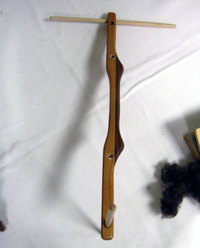
Now on an entirely different subject. I caught a glimpse of a niddy noddy that I’d love to have but fear is no longer being made. The owner kindly allowed me to take a picture.
Simple_niddynoddy_1

Although it is really simple design, I think it’s much more functional than any other niddy noddy that I have found to date. Why?  Well, for one simple reason; the cross bars can be easily removed.

I always seem to wind my yarn on tight and have a heck of a time getting it off.  If I only had one of these ….

Oh, I just love coming across interesting spinning tools.

Plying for Color Effects

Dmenz_plying_classJust got back from the first day of the Madrona Fiber Arts  Winter Retreat.

Look at all these fabulous balls of fiber that Deb Menz brought for us today.  All were hand blended on a drum carder by the master herself. She says it’s a lot of work so this  probably was her last plying class. It sounds like she wants to  focusing on selling her art and just teach a classes  from her new studio.  She currently working on a website which will be at http://www.debmenz.com.

By the way, the second printing of her book, Color in Spinning,  has just been released. She had some interesting tidbits about how this book finally got back into print.

The goal of the class was to help students learn how to use plying as a design element. While looking at these rovings you might think, wow what beautiful stripes, but that’s not what she’s after. She avoids creating striped yarn (why create yarn that is easily purchased)  and tries to develop yarn that gives an impressionistic feeling.

I’m not quite finished with my last sample but hope to share all of them when I get a chance.

Irish Moss

Irish_moss_finishedPattern: Irish Moss from Aran Knitting by Alice Starmore
Size: medium
Yarn: 17 skeins of Jamieson’s Soft Shetland
Anthracite (1050)


Notes:

– Pattern calls for 16 skeins while I used 17. Extra skein was from a different dye lot which was used for shoulder panels and ribbing around the neck. Difference is not noticeable.

– Able to achieve tension mentioned in the pattern using size 4.5 mm needles.

–  Easier to obtain correct tension sample when sample did not have borders.

– Perfect yarn and pattern for splicing yarn ends so there are no yarn ends to weave into the sides.

I found this interesting Aran website called www.clanarns.com.

Splicing ends

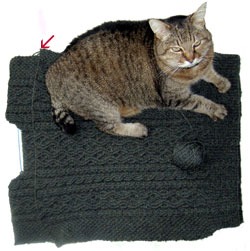
Cat_basket  Last night I was busy finishing the other sleeve and looked down to find the other pieces being used for a new cat bed. I guess that’s a sure sign that the sweater is almost done.
While working the first half of Irish Moss I joined new balls of yarn at the sides leaving ends that will need to be woven in when I sew up the sweater. However, a couple of weeks ago, while thinking about my dwindling yarn supply, it suddenly dawned on me that splicing yarn ends would work well with this 2-ply Soft Shetland yarn. It’s really easy to do.

Irish_moss_other_sleeve

When I have about six inches left on the current working yarn, I pull out a new ball and unravel the plies on this new ball for several inches and do the same with the current working yarn. Once the yarn ends are unraveled, I break several inches off of one of the unravel led strands from each yarn end. I now over lap these strands and fuse them together by quickly rub them between my palms after adding some spit. The friction and spit cause the strands to felt together. It’s an old trick that works quite well.

Passing inspection

The cat takes his job so seriously that I couldn’t get him to move out of the picture.

The red arrow shows  how much progress I’ve made on the back .  For comparison, the front  piece is under  it.  Irish moss back
In only a week I’ve been able to complete most of the back piece by working the pattern from memory. Look mom, no chart! At this rate I hope to have it done by Valentine’s day.

I’m ready to move on and look forward to getting back to my spinning projects. Besides, the Winter retreat is only a few weeks away!

Strategic knitting

Irish_moss_sleeve1It took about 2.5 balls to complete the main part of one sleeve.
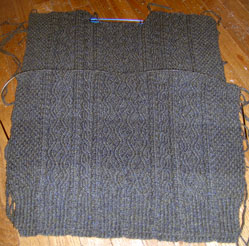
So now the question is, will I have enough to finish the whole sweater with 16 balls of the same dye lot or will I need to use yarn from another dye lot?

Considering that the front took 5.5 balls, It will be very tough to get by with one dye lot.

This weekend I’ll take some more body measurements and see if I can shorten the the torso pieces a bit to get enough yarn  for the collar and maybe the shoulder band. If this is not possible or doesn’t produce enough yarn, then I’ll plan on knitting the shoulder band and collar with yarn of another dye lot and hope it won’t be so noticeable.

When I started the front piece several months ago I had some suspicions  that I might not have enough yarn so I did pick up two extra balls which are from yet another dye lot. Perhaps these will not be as dark as the one that created the stripe on the back piece but I won’t know until I start adding one to the project.  I tried put the skeins on one of the pieces to see if I could tell the difference but they look the same to me.

Are dye lot numbers important ?

Irish_moss_backYes they are.

Can you see the stripe?

I swear I checked all the lot numbers when I purchased the yarn so, I didn’t double check as I was winding up the balls.

Oh well, another lesson learned.

At this point I’m not exactly sure what I’ll do except that I’ll delay the frogging (rip out)  decision until after I finish one sleeve.  At that point  I’ll have a better idea of how many balls it will take to finish the sweater. The pattern calls for 16 and I purchased 17. Perhaps the  yarn godess will bless me and I’ll really only need 16.
The front took 5.25 balls  so if the back uses the same and each sleeve takes 2.5 balls  I should be ok.

A Purr-fectly warm hat

My niece Emma loves being a kitty.

I whipped up this hat from http://www.kittyville.com last week just before we headed up to the mountains for a week of fun in the snow.

Kitty_hat

Yarn: Debbie Bliss Merino Aran
100% merino wool
color 325606

Needle: US size 7

Notes:

– hat  measures approx. 20 inches at base (above the ear flaps)

– worked stockinette stitch for 2.75″ instead of 3.75″

– used provisional cast-on and knitted flaps after working top.

– next time will try starting from flaps first so that hat edge won’t be so noticeable

– once top and flaps were done, picked up stitches along  flap edges and then casting off these stitches along with provisional stitches to make a  finished edge.

Happy Holidays

Wishing everyone joy and peace for the new year.
Carol's stocking

I just finished this new stocking for my mother-in-law who loves visiting lighthouses.

The designs come from two sources, www.sweaterscapes.com and “And a Time to Knit Stockings” by Katherine Pence.

Here’s the back.

The intarsia part was done in the round using a new method described by Priscilla Gibson-Roberts  in the new version of Knitting in the Old Way and in the winter 2003 issue of Interweave Knits.  I highly recommend this method over others.