Buttons

buttons

The Lace Cardigan hasn’t made it out of the knitting bag for a couple of days now so it’s time to get quick gratification. I passed up mounds of pastel yarns in the baby section for this bright sport weight yarn. It’s made of 83% wool and 17% polyester effect yarn. The effect yarn is actually a thread with slubs* which has been plied with three other strands of wool. The swatch comes out to 24 sts X 32 rows for a 10cm square, knitted on size 3.25mm needles, almost exactly what I’m aiming to get from the merino top that I’ll be spinning for the Spin-Off sweater.

*a soft thick uneven section in a yarn or thread -from www.m-w.com

Spin-In

The Weaving Works hosted a Spin-In last Saturday. Approximately 30 people appeared through out the day with a variety of wheels and handspindles. Our equipment was arranged in a large circle so we could chat while spinning.

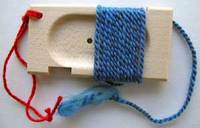
There were quite a variety of fibers being spun. One brave novice learned how to use a spindle for the first time while spinning soy silk. I stuck to practicing with some dark purple (not black as the picture shows) merino which will be used to learn Navajo Plying in a class on Wednesday night. Here it is on the lazy kate, although I noticed that I put the pegs in backwards.

Lazy Kate

It’s too bad that I forgot my camera although Terri did remember her camera and promised to post some pictures on her blog.

Shirley said that the next Spin-In is scheduled for October 9th. Besides getting a chance to meet and compare spinning techniques and advice with other spinners, it’s a good excuse to pickup spinning supplies since all spinning related items are discounted 10%.

Knitting on the Edge

knitting_on_the_edge For a few weeks now, I’ve been patiently waiting for Knitting on the Edge to show up at a local yarn shop or bookstore so I could flip through it to see if it’s a keeper.  Last week my patient wore out and I ended up ordering a copy, sight unseen.

Well, I’m happy to report that I haven’t been disappointed. It’s full of beautiful and clear pictures of hundreds of stitch patterns designed for the edges of knitted projects. While I recognize many of the stitches from other stitch pattern books, Nicky Epstein puts them together in a myriad of combinations that spur my imagination. The book also includes seven patterns that hint at how the edges can be used, one of which is pictured on the cover of the book. Hopefully the written instructions will prove to be as accurate as the pictures are beautiful.

The Yin & Yang of Yarn

balanced skein Here’s my latest skein of wheel spun merino yarn. Notice how nicely balanced it is. It hangs in a nice round circle. My plying skills have definitely improved after lots of practice, reading several spinning books and watching two videos.

Last night I picked up a copy High Whorling by Priscilla Gibson-Roberts (PGR) that’s been sitting on my book shelf for a year. I guess I didn’t really think much about it when I purchased the wheel since it “only” covered handspindles. Oh, that was an oversight. Yes, it doesn’t discuss spinning wheels, but it does cover all other aspects of spinning. In many respects, I think it’s probably the best of all the books and videos that I’ve used.

Here are some tips that I’ve picked up from PGR’s book and other sources.

1. Make a “self” ply sample that can be used as a reference during plying.

Most sources mention this by saying that a sample can be made by letting a freshly spun single strand fold back on it self. PGR takes it a logical step further by mentioning that a sample should actually be made under tension to get a much more accurate sample.

Incidentally, I came to this conclusion before reading PGR’s book. I make all my samples under tension using my hand spindle by pulling out a long section of the freshly spun single, placing the hook of the handspindle in the middle of the strand and putting the two ends of the strand together, letting the single ply itself with the weight of the spindle. Don’t add any extra twist.

2. Frequently refer to the ply sample while plying.

It might not be easy to see differences between the ply sample and the plied yarn on the wheel. A good way to check differences is to count the number of bumps per inch in the sample and compare that number with bumps per inch in the yarn being plied.
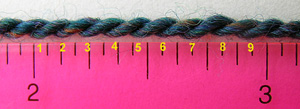
Ply with 9 twists per inch

3. Don’t bother measuring whether a yarn is balanced during plying.

Many sources say that you can determine whether your yarn is balanced by hanging a long piece of freshly plied yarn between the orifice and your hand or a similar test from the spindle. If the piece twists then it isn’t balanced.

Well, there’s no need to do this test. PGR and Alden Amos mention that the twist in a single will set almost immediately, so such ply tests with “old” singles don’t give accurate results. It’s best to just refer to the plied sample that was done from freshly spun singles. Wool has memory of the original twist once it is washed.

4. Don’t over twist when plying.

PGR mentions that the stitches in knitted fabric with over-twisted yarn will look odd. One side of the stitch will be fat and the other thin. I’ve noticed this effect with commercial yarns such as Cashmerino. To minimize this effect, make sure the angle of the ply is appropriate for the diameter of the single.

5. Finish the yarn by simmering it in a pot on a stove.

I finished the skein, shown in the picture above, by following PGR’s instructions. I put the yarn in a large enameled pot with warn water, placed the pot on the burner and then set it to medium heat. I monitored the heat with a thermometer so that the water didn’t get hotter then 180 degrees Fahernheit. Once it reached 180, I turned off the burner and let the water cool before I removed the yarn. I gently squeeze much of the water out of the skein with a towel and then hung it to dry. PGR mentions that she doesn’t put any weight on the yarn while it dries since this tends to take elasticity out of it.

You might be wondering why I’m so obsessed with getting a balanced yarn. Well, if the yarn isn’t balanced then it will knit up in a skewed fabric that slants on a bias.
Change in Strategy

After further practice with Ashland Bay merino top, I’ve changed to a slightly larger whorl which has a 13:1 ratio. Although I was getting pretty good results with the 15:1 ratio, I did notice some over twisting. Perhaps this switch will also help solve some of my problems with getting a balanced 2-ply.

blue_merino_wpi Singles:

27 – 28 wraps per inch

13.5 twists per inch (with 13:1 whorl)

2-Ply:

14 -15 wraps per inch

9 twists per inch (with 9:1 ratio whorl)

I’m working away on a second bobbin of singles and plan on using the 9:1 ratio whorl to create a balanced 2-ply yarn. If all goes well with this new skein then I might start spinning the fiber from the Spin-Off sweater package.

Mindless Lace Knitting

I haven’t abandoned Gilet Lace; it has just slowed down a bit since the next two pieces (sleeves) are all lace. Progress has been slower than normal over the past few days due to bouts of mindless knitting, ending in several rows being ripped out because of forgotten yarn overs. This pattern is almost etched in my mind so; I’ve totally abandoned the chart. The other day a fellow bus rider complimented my work mentioning that it looked like a difficult lace pattern and was surprised that I wasn’t following a chart. I guess she didn’t realize that most of the knitting consisted of a stitch pattern repeated a zillion times.

gilet lace: sleeve & stitch pattern

If you click on the picture you’ll see a close-up of the rather simple lace pattern. In a previous post I mentioned it includes right and left crossed stitches and posted a few pictures on how to work them. I however neglected to add a photo of what the end results look like. Well here’s a “Where’s Waldo?” moment. The crossed stitches are on either side of the reverse stockinette triangle patterns, just after/ before the yarn overs (holes). I have a vague memory of doing crossed stitches while working on a Nancy Bush sock pattern.

Plying Along

girl_spinning
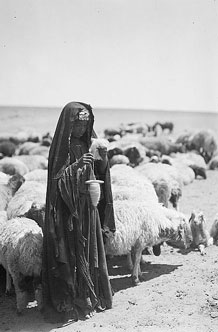
Library of Congress, Prints & Photographs Division

Emma suggested that I might try putting my unruly yarn through the wheel once more to see if that would help. Well I’ve been respinning some of it on my hand spindle and it seems to be working. I also marched over to the new library and checked out The Alden Amos Big Book of Handspinning. He takes up the subject of plying in a much more detail fashion any of the other spinning books.

I never thought that plying on a wheel would be so difficult.

Gilet

(a) waistcoat, N Am: vest; (b) g. de sauvetage, life jacket; g. d’armes, fenching jacket; (c) g. (de corps, de peau de dessous), vest, singlet, N Am: undershirt; (d) (woman’s) cardigan. – Harrap’s New Collegiate French and English Dictionary

Oh, so that’s what gilet means in English. I translated the instructions but neglected to translate the title.

gilet lace: front pieces Yep, this one is turning out to be a quick one. The most challenging aspects have been acquiring the yarn, translating the pattern and dealing with the messy half used yarn balls.

Figuring out how to cross two stitches was a bit tricky. While I understood the word-for-word translation of this stitch, I wasn’t familiar with the technique. Here’s how I ended up working these stitches after referring to several English knitting books.

Crossing Stitches

(enlarge any photo by clicking on it)

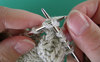
2 maille croisées à droite / cross 2 stitches right –

Knit into the second stitch on the left needle but don’t slip it off the left needle.

Right Cross: Knit into second stitch.Right Cross: Knit into second stitch.

Knit into the first stitch on the left needle and then let both stitches slip off the left needle. In the photo on the bottom right, the two stitches on the left needle will be dropped off.

Right Cross: Knit into first stitch.Right Cross: Knit into first stitch.

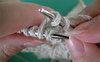
2 maille croisées à gauche / cross 2 stitches left –

Knit into the back loop of the second stitch on the left needle but don’t slip it off the left needle.

Left Cross: Knit into back loop of second stitchLeft Cross: Knit into back loop of second stitchLeft Cross: Knit into back loop of second stitch

Knit into the back loop of the first stitch on the left needle and then let both stitches slip off the left needle. In the photo on the bottom right, the two stitches on the left needle will be dropped off.

Left Cross: Knit into back loop of first stitch.Left Cross: Knit into back loop of first stitch.

Taming Handspun

merino practiceAfter a couple of attempts to ply the merino using a wheel, I think I’ve got it. The singles were spun with 15 twists per inch and plied with 10 twists per inch. This time I took more care when plying although the skein does have a slight “S” twist. According to The Spinner’s Companion, I’ll need to add more twist during plying. At least it doesn’t look as bad as my first attempt (the red skein). Maybe Patternworks could sell my first attempt as scarf & novelty yarn. It would fit right in with Cool Stuff for $50.00/skein.

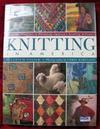
KnittingInAmericaWhile browsing books at the library yesterday, I came across Knitting In America by Melanie Falick. Wow, what a beautiful and inspiring book. It profiles 38 knitting designers, authors and fiber related places in America. I’m enjoying reading about Priscilla Gibson-Roberts, Nancy Bush, Lizbeth Upitis, Sarah Swett and others.

I was especially interested in the profile on Sarah Swett who designed the Spin-Off sweater that I’m making. Check out her web site. Her all tapestries are truly amazing, but I especially like Hands. Her Kestrals Alight Cropped Kimono is now on my list of future projects. The pattern is in Knitting In America.

Another pattern added to my sock list is the Pretty Comfy Socks pattern that Emma is currently knitting. Emma thanks for sharing this pattern by Debbie Young. Your socks are coming out beautifully and look quite comfy. I just happen to have several balls of Fixation that needed a pattern.