Pretty in Pink

Lily was so excited to finally get her bright pink socks this weekend.

Lily

Lily

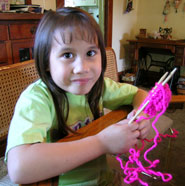
We started our first lesson today.

I casted on the stitches and she worked a few knit rows while I sat behind her directing her hands. She came up with a unique way of holding the needles so that she could throw the yarn and not drop stitches. Hopefully grandma will keep up the lessons.

While I was away the postal service attempted to deliver a package from Club Direct Laine. It’s got to be my order of Bergereine yarn!

Possibilities

Spinning_wheel Here’s the new wheel

Oh, I love my local libraries. Even though I haven’t had time to spin I’ve been reading “Handspinning, Dyeing and Working With Merino and Superfine Wools” to get some tips on how to spin up all the merino that I got for Christmas. So this weekend I’ll be spend time getting more acquainted with my new toy and practice spinning merino.

I’ve been trying to decide whether I should get the super high-speed whorl to spin merino. From what I’ve been reading, it looks like I  have two options. Two get the right amount of twist I can either use the fast speed whorl that comes with the wheel and do more treadling or I can buy a smaller whorl and treadle less. I need exercise so I’ll pass on the smaller whorl for now.

Folded Picot Edge

Samina asked if I could show how I did the picot cuff on the Whisper Rib socks.

picot_done

The folded picot edge is actually quite simple. Start with a provisional crochet chain cast on, knit a few rows, knit a row of *yarn over, knit 2 together* stitches, knit several more rows and then fold the cuff in half and knit the cast on stitches together with the current row. Pictures are worth a thousand words so if you’re interested I took several pictures of the process.

Continue reading

I didn’t come home with sheep but …

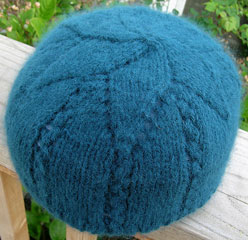
Here’s the completed Shining Star hat.

shining_start_finished.jpg

Occasionally I come across Elizabeth’s Fiber & Yarn Store while searching for spinning products and have thought that I should make a trip down there to check it out in person. I love the idea of visiting a fiber store located on a farm. Yesterday I finally made the trip. My husband joked that he didn’t want me to come home with any sheep.

It was a pleasant hour drive from Seattle to Buckley. The shop is located in a renovated green farmhouse next to a goat pasture. I was pleasantly surprise at how large the shop is. Her yarn selection includes a variety of Cascade Yarns, Manos del Uruguay and various other brands. Not a huge selection but respectable. She also carries a full range of knitting tools and books. I picked out several balls of Cascade Fixation to knit another Shining Star hat.

Besides yarn Elizabeth carries fiber and three brands of spinning wheels.  I mentioned to her that I was interested in spinning wheels and have my name on waiting list for a Lendrum wheel at a shop in Seattle. I also mentioned that I hadn’t tried a Schacht wheel because I was afraid that I would like it but didn’t want to spend that much on a wheel. Well she invited me to try one. I spent a couple hours chatting, spinning and watching the goats in the pasture. The wheel was just too hard to resist. It’s just so smooth, beautiful and conveniently ready to take home. So now I’m a proud owner of a Schacht spinning wheel and a Strauch stool.

I look forward to returning to Elizabeth’s shop. She has started a monthly spinning group that I hope to attend in the future.

Twinkle Twinkle

Here’s my version of the Shining Star hat. It might be hard to see but there’s a star on the crown with lines radiating from the sides.

shining_star_half.jpg

Kate mentions in the pattern that she uses 6 double point needles but I decided to use the “magic loop” since I only have one circular needle in the correct size. While the “magic loop” can be a little cumbersome to handle at times, I happy to make due with one needle.

The start was a little challenging. Although the pattern doesn’t mention that the hat is knit from the top, I quickly surmised this bit of info from the small number of cast on stitches. The biggest puzzle was how to cast on with so few stitches. It took a little thinking but I finally remembered the figure 8 cast on that I learned in a sock class with Sarah Hauschka. She mentioned that this cast on could also be used to start lace patterns from the center.

Once I figured out the cast on, my needles started flying and after a couple of hours I got half way through the pattern. Kate’s innovative approach to color coding the stitch counts is ingenious. This pattern comes in six sizes and each size is denoted by a different color to easily keep track of which size is being knit.

For more information on the figure 8 cast on check out The Magic Loop or Wendy’s article (with double point needles) in Knitty.

Yarn Auditions

I was going to continue working on the Christmas stocking that I started last year but got side tracked by this cute Shining Star hat pattern by Kate Gilbert.

shining_star.jpg

My small yarn stash didn’t have any soft worsted weight yarn so this weekend I made a trip to the yarn store and came back with a couple of skeins of dark blue Classic Elite Inca Alpaca. It seemed like the softest worsted weight yarn in the store but now that the swatch is finished it doesn’t seem soft enough for a tight fitting child’s hat.

Yesterday I looked through my stash again and found a lone ball of Classic Elite Lush that was originally auditioned for the Tea Tree sweater. This green three-ply yarn, made of 50% angora and 50% wool, is definitely soft enough but I’m disappointed with the quality. I keep finding spots where one out of the three strands is frayed. Gosh, this reinforces the fact that swatching is a good thing. I’m so glad that I decided against using this yarn for a sweater.

I was hoping to join a local knitting group this evening but I’ve been sniffling the past few days and don’t want to pass around my germs.

Lily, your socks are done!

Whisper Rib & Sheperd's Lace Socks As I write this entry I’m listening to French hip-hop rap accordion music  by Java. I acquired this unique CD after listening to an NPR music review while on the way home from a Java programming class a couple years ago. At that time, I appreciated the music as well as the coincidence between the group’s name and my choice of programming languages.
This morning I noticed that the coincidences continue.  The woman on the cover is holding knitting needles and yarn although she doesn’t appear to actually know how to knit. On the back cover there’s a picture of her grasping the needles in an “X” position and the yarn is draped around the needles in a tangled mess. Not to take this too seriously, but it’s funny how others perceive knitting as only a kitschy thing. I guess we can blame that on knitted toilet paper covers and the like.

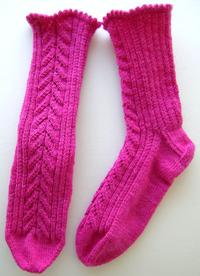
Here are the completed socks. I’ll be giving them to Lily in a couple of weeks and hope to get better photos then.

Since I started from the cuff I had to close the toes using the Kitchener stitch. I can never remember how to do this from memory so I decided to capture pictures of the process.

Continue reading

Knitting Geek Code?

Knitting helps me unwind from deciphering and writting Java programs during the day, so you won’t find any knitting geek code here. I shutter at the thought of knitting emulating computer programming.

I’ve been meaning to make a short list of my knitting quirks so instead of code here’s my knitting history in a “nutshell”.

  • modified picker (wrap yarn around the needle with my index and thumb)
  • 2 years experience (+ six months many years ago)
  • not a fast knitter, will immediately rip any mistake but manage to get all projects completed
  • strongly prefer Addi Turbo nickle plated needles
  • favorite yarn is Koigu merino
  • swear to only use natural fiber yarns unless making socks, then a little nylon is ok
  • try not to stash yarn but …
  • knitting book stash is bigger then my yarn stash
  • like challenging technical projects
  • have done intarsia in the round, lace, fair isle (but all have been small projects)
  • haven’t knitted any blankets, shawls, scarves, hats, washclothes or aprons
  • will never knit an apron, cell phone cover or knitting bag
  • avoid anything with more then a few rows of garter stitch
  • first project was a sweater and second was a pair of socks
  • knit first pair of socks twice, first time with traditional heel then second time with short row heels
  • will knit garments flat or circular without prejudice
  • swatching is a must
  • knit in public on the bus, in a car, on a boat, before a movie
  • never more then two works in progress
  • usually stick to fingering, sport, DK weight yarn
  • mostly self taught via books
  • started spinning yarn with a hand spindle and have a wheel on order
  • haven’t quilted since taking up knitting
  • not thrilled to hear crochet is the next big thing

Instep on One Circular

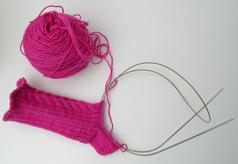
Yesterday I showed the sock that’s being worked on two circulars. Today I’ll show the other one that’s being worked on one circular. Here’s how it looked after I picked up all the heel flap stitches.

mloop_instep

It’s really not difficult to get the stitches rearranged. After all the heel stitches were worked I pulled the cable between half of the heel stitches, creating a loop to the right side. Next, I created a loop on the left side between the two halves of the instep stitches. At this point I was set to proceed with picking up stitches along the heel flap and working half of the instep stitches.

With half of the stitches on one side of the cable I was now ready to start the second half of the sock by flipping it so that the loop was on the left side. I positioned the needles to work the rest of the instep stitches, pick up stitches from the other side of the heel flap and knit the remaining heel stitches.