A weekend of knitting, dyeing and spinning

Jean_at_madrona_1
Just got back from Madrona Fiber Art Winter Retreat.

Another great year of classes, lectures, and meeting new and old friends.

I attended three fabulous classes over the past four days.

-Tailored Knitting the Japanese Way with Jean Wong
-Dyeing for Socks with Judith MacKenzie McCuin
-Spinning Scottish Wools with Carol Rhoades

I’m so exhausted but excited at the same time. Every year I learn so many new techniques. This week I’ll try to give a synopsis of the classes.

Plugging along

reknitted body

There’s not as much progress as I’d hoped due to a false start and one major fix. Also since I’m not using “fresh” yarn, I have straighten out the previouisly ripped out otherwise stitches would tend to have a puckered look.

Until this week I straighten yarn by hand washing it gently and letting it air dry overnight. This week, while waiting for a few balls to dry, it dawned on me that I could get quicker results by just steaming the yarn.

I just wind the balls into small skeins then put a kettle of water on the stove and when steam comes out the stout I pass the skein back and forth over the steam being careful not to burn my hands. In just a few seconds the yarn is no longer kinky and is ready to knit.

On another note, have you ever wondered what designs are in The Scottish Collection? I finally got a look at this elusive book. Here’s what I found.

Allover – Traditional Fair Isle diced pattern in 2 designs; a button down vest in browns and light blues or a pullover in pinks and oranges.

Azeri Jacket – It’s the one on the cover.

Brocade – Vest or pullover with large pink and purple flowers outlined in gold, regularly staggered on a black background. Also has a large zig zag motif around the bottom edge in same color scheme as the flowers.

Catriona – Tradition Fair Isle cardigan with main motif being vertical Nordic stars alternating with traditional X motifs in light turquoise, purple, pink and blue on a white background.

Cold Duck – In this picture it’s the one she (the designer) is holding. She’s wearing the Oregon cardigan. Instructions for either a cardigan or pullover.

Entrelac – Designed by Carol Lapin. Jewel toned pullover with large entrelac squares.

Five Triangles – Designed by Nancy Marchant. No instructions included just a picture. Originally appeared in Threads Magazine Aug/Sep 1992.

Luskentyre – Pullover in yellows, golds and pink.

Mara – Cardigan or vest

Mardi Gras – Cardigan or pullover

Marina – Cardigan or pullover. Photo in the book has a very dark background compared to other versions I’ve seen.

North Country – Designed by Nicky Epstein. Pullover with large  white silhouettes of bears, reindeer and trees in rows that alternate with snowflakes on a black background. Between the large rows there are smaller ones with abstract motifs in red and black.

Oregon – Cardigan or vest

Plaid Jacket – Jacket with either red or orange/yellow background. Stripes are grouped in threes with each group being several inches apart.

Quartz – Vest which is very similar to Mara but in  blues and reds that are more toned down. Large border pattern has flower type motif.

Rannoch – Traditional Fair Isle pullover in green, brown and oranges. Large border pattern is same as in the Quartz vest.

Squares and Diamonds – Designed by Nancy Marchant. Large squares with diamonds in the corner where the squares meet. Has two color ways; blue or red.

Thoroughbred  – Vest with Nordic stars running vertically down center and trellis on either side.

Tokyo Rose – Large abstract roses in an allover pattern with gold lines that link them together. Reminds me of tiles.

The more traditional designs are made with Shetland jumper weight yarn which I gather means J&S. Some of the motifs in these designs look very similar to ones in the book “Charts for Colour Knitting”. Of course the most popular ones are available as kits from Virtual Yarns.
Back to square one

Restart_1

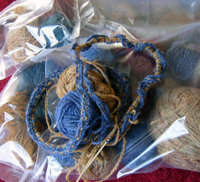
Here’s the vest neatly packaged into small plastic bags by row motif. This might disturb the faint of heart, but yes it’s as bad as it looks. I ripped out the whole vest yesterday just as I was about to start the steeks.

I did a trial fit and realized that it would turn out much too large, even though it was a medium. Normally that’s the right size for a sweater that sits at my hips but got thinking about how short this vest is. It will sit well above the largest part of my hips so I can go ahead and make it a few inches smaller to fit the bust area better.

I’ll just add that this is my first vest ever so it’s been a little hard to tell what would be a good fit.  I’m sure the second time around it will knit up just as fast and I should be able to show some progress next week.

Needles are flying

Roscalie_lower_body

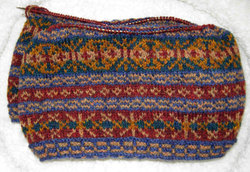
Lots of progress on the vest since last week. All the pattern changes are so interesting and fairly easy to remember that I can’t seem to put it down. So far changes between colors is no longer than four stitches which makes it darn easy to knit.

The weather here has been gloomy so it’s hard to get a good shot in natural light. The colors are much deeper and appealing in person. I love this update take on a traditional Fair Isle.

As you might have noticed in the photo, I went ahead and started off with the garter stitch border. The down side of working from a kit is that you only get enough yarn for a specific design, making it hard to do any significant adjustments. I suppose I could have done an invisible cast on, knit the patterned part and then added a corrugated rib later if I enough yarn was left over.

Happy New Year

I wish every one a wonderful and peaceful New Year.

Roscalie Vest

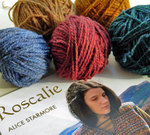
Roscalie_swatch The swatch for the Roscalie vest is off the needles and has been blocked. Correct tension has been achieved using 3.25mm needles. That’s kind of a surprise since I used 3.5mm needles for Firebirds.

One thing I didn’t catch before ordering this kit was that the edgings on the waist, arms and neck don’t have corrugated ribbing the  version in the book “In the Hebrides”. This one has a garter stitch version of the motif with the blue background. I can’t help wondering why she changed it.

So with no sleeves, buttonholes or corrugated ribbing this design has got to be one of the easiest Fair Isles offered by Virtual Yarns.


Sunrise-Sunset Socks

Sunset_sunrise_foot

Can’t believe I have two active projects on the needles at once. For those  of you unfamiliar with my knitting style, I tend to stick to one thing at a time. It my way of keeping momentum going and hopefully finishing almost every project that I start.

Here’s those socks I started a couple of weeks ago.

I’ve reversed the pattern and started at the toe. Although I’ve reversed the work order , I’m sticking to the traditional heel shown in the pattern by adapting the heels from  “You’re Putting Me On” socks to fit these socks.

Time for another pair of socks

Sunrise_sunset

The Pacific Northwest had a huge storm roll in Thursday night. In Seattle it rain about two inches in one hour! I’ve only seen that kind of rain during the rainy season in Thailand.

Many areas are still without power and/or phone service. We were lucky and didn’t loose power or have any trees fall on our house. Our ISP, however, is located in an area that got hit hard so our Internet connection has been down and was just restored a few hours ago.

Since I’m making slow progress on my mitten design I decide to get clicking on another small project. It’s Sunrise-Sunset socks by Jaya Srikrishanan from Big Girl Knits. The photo shows my swatch. Yeah, I do swatches even for socks.

I’m not sure if I like the colors. The red/purple yarn is beautiful but the blue/purple is a little bright for my taste.

Instead of following the pattern, I started from the toes using Judy’s Magic Cast-on and adjusting the size to fit my feet. The pattern is for a specific size but the book also includes a section after the pattern that describes how to adjust a pattern to fit  a specific foot and leg.

This week I’ve been reading “A History of Hand Knitting” by Richard Rutt. I just had to laugh when I got to the last section on page 161.

Socks and Stockings were the most frequently hand-knitted garments from the beginning of popular knitting until the 1950’s. Today they can hardly be seen, and only the old can remember how to turn a heel with out referring to a book. … A few patterns only remain in print; and hosiery wool, though still spun, is not readily available. Stockings were always dull work. Today’s knitter expects more pleasure from the craft.

I wonder what he thinks now (if he’s still with us).

Mittens & fingerless gloves

MittensThe girls went to the vet for their spay surgery yesterday. Mittens came home today but her sister Sophie was too active after waking up from surgery and opened her stitches while recovering at the vet. They’ll fix the stitches today but that means Sophie won’t be home until Monday. It’s hard not to be nervous about this after just loosing Toby last spring.
This week I’ve been web surfing finding mittens and fingerless gloves for inspiration. Here’s what I’ve found.

– Early 19th century mittens in the National Museum of American History

– A blog tour of mittens in a Selbu museum

– Fair Isle mittens, gloves, hats and sweaters offered by Shetland Collection

– Check out Eunny’s Anemoi Mittens

– Not gloves or mittens; but I love the pattern on this purse

I’ve been working on sketching a snowboard related motif to go on either fingerless gloves or mittens.

Vists to mohair farms in the Pyrenees

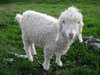
Goat_farmRecently we flew to Barcelona and then drove over the border  to France and spent several days wondering around the small region  in the French Pyrenees called Ariège.

Our first day in Ariège we arrived at Auberge Les Myrtilles late in the afternoon and decided to settle in since it’s quite a drive to get to anywhere from there. It’s at the end of a road that stops at the foothills of snow sprinkled mountains.

After exploring the small village (about 20 full time residents) we  warmed ourselves in front of the fireplace and examined their stock of tourist brochures. Until then I really hadn’t given much thought to what we  were going to do in the countryside. I was just glad to finally be on vacation.

One particularly interesting brochure published by the local chamber of agriculture lists all types of farms that one could visit for a tour and/or purchase products directly from the farmer. Two mohair goat farms caught my interest. I suggested that if we happened to be in that area we should stop by for a visit.

The first farm, Les Bergers Cathares, that we visited is between Le Mas-d’ Azil and Pamiers. When we got near Rouzaud we spotted signs with arrows and the word “Mohair”. The brochure mentioned that this farm raised mohair goats and operated a boutique that is open to the public. When we stepped out of the car we noticed the flock of goats out in the pasture. With so much fiber on their backs, at a distance they could be easily mistaken for sheep.

The farm’s boutique offered two types of mohair yarn, one that was 100% kid mohair called Caresse and another with 77% kid mohair and 23% silk called Diva.  Besides knitting yarn they carried various articles of clothing and blankets. At first it was quite overwhelming. I’ve never knitted with mohair so I had a hard time deciding how much to purchase; especially since I had no projects in mind. Inspired by the blue version of this sweater, I ended up purchasing four balls of  Diva in various shades of blue. I just hope that’s enough to make a lace scarf.

Mohair_goat

Unfortunately the other mohair farm that we wanted to visit wasn’t open that day. We should have planned our timing better because both farms are in the same general area. A couple of days later we decided that we would really like to visit a another farm and this time get a tour.

Mohair Pyrénées was well worth the visit. I think the owner was a bit surprised when we drove up for the 5:00 pm tour. I bet they don’t normally see American tourist in October. Even though we were the only tourist there, Nicole was very happy to show us around. We started the tour by watching a video about how mohair yarn from the farm processed and spun into yarn. After the video we went straight off to a barn full of yearlings. Her dog Scottie rounded them all up and guided us to a near by pasture. While in the pasture we petted the goats and visited with Nicole in Spanish and French. After spending time with the little ones Nicole took us to another pasture full of older goats. Scottie guided them to a stand of trees and Nicole pulled down branches for them to feed. She said it was like dessert for them. With 150 goats, we were wondering what happens to the older ones and asked if they ever eat the goats. Nicole emphatically respond, no. We could tell she loved raising these goats and that they seemed more like pets than livestock.

After the tour she opened her boutique for us. I was surprised to find how much bigger it was than the one at the other farm. It seem to have many more articles of clothing and a bigger selection of yarn colors. She also had several pattern books. I tried to resist buying more yarn but as usual, I managed to buy four more balls
of Diva; this time in red. Nicole also gave me a small cotton bag as a special gift.

Firebirds is officially finished

Firebirds_finished_1

Good thing we snapped a picture of the sweater yesterday. Today a storm has come in and it’s so cold that the rain might turn to snow. What a wonderful day to wear a warm sweater.

Now that I’ve had a chance to actually use a woolly board, I would recommend it to any one who thinks they’ll be knitting lots of Fair Isle sweaters. It stretches the sweater a bit while drying so that any irregularities in the knitted fabric are straightened out.

When starting this sweater I intended to shorten it by one lengthwise repeat because I like sweaters to hang well above my hips. However  once  the body was half way done I got cold feet after checking my tension. At that point it looked like my row gauge would make the sweater a few centimeters shorter and I was afraid that taking out one lengthwise repeat would make it way too short. Now that it’s been dressed on the woolly board, I wish I would have shortened it. Oh, that’s not to say I don’t like it. The length won’t keep me from wearing it but it’s a good lesson for my future sweater projects.  It’s quite easy to adjust the length and/or width a couple of inches when using a woolly board.

What’s next? I must really get started on those fingerless gloves. I’m also very tempted by another VY kit. But wait, I also have lots of fiber to spin.