
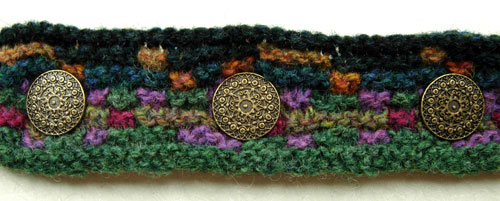
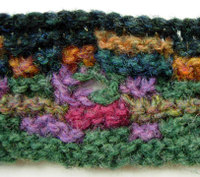
Finally, I finished the front band with the button holes. Today I soaked the sweater and put it on the board. “Muffin” couldn’t resist playing with the yarn that I used to bast the front bands together. I also put some basting stitches around the armholes and neck to help keep them from stretching too much.
As I mentioned before the pattern says to make thirteen two-stitch buttonholes over two rows but didn’t like the results. I then started wondering if these tiny holes would be big enough for the buttons I purchased; After all, the pattern didn’t mention how large the buttons should be. The only way to find out was to make some samples and see for myself. Turns out that there is enough give in the fabric so that the two-stitch buttonhole will generally accommodate a small to medium sized button.
Even though the two-stitch buttonhole would work OK, I decided to do a three-stitch one row buttonhole similar to the one described in Ann Feitelson’s book. In my opinion this one is much neater with less stretch.
Here’s how I do it.
Before I start, note that this button band is worked in garter stitch. Also, I decided that because of the two row motif, it was easier to knit the button hole while knitting on the wrong side row.
1. Figure out the position of the buttonholes and use stitch markers to indicate which stitches will be cast off for the holes. I decided to use 12 buttons and figured I could space the buttons as follows.
k 6 sts, work 3st buttonhole, *k 12 sts, work 3st buttonhole, k 11 stst*, repeat from * until twelve buttonholes are made, k 6 sts. Total number of sts = 173.
2. Knit to first buttonhole. Bring yarn to front and slip one stitch from left needle to right needle. Take yarn to back. Slip another stitch from left needle to right needle. Pass first slipped stitch over second one. Slip another stitch from left needle to right needle. Pass second stitch on right needle over stitch that was just slipped. Bind off a total of three stitches in this manner. Turn band to other side.
3. Cast on four stitches using “knitted cast-on” technique, making sure to twist each yarn before each cast on stitch. Turn band to other side. With yarn in back, slip first stitch from left needle to right needle. Now cast off one stitch on right needle by passing second stitch the over the first one.
4. Continue knitting to start of next buttonhole. Repeat steps 2 & 3 for each buttonhole.
It’s really hard to get good pictures of this. If you need to see pictures I would suggest picking up the latest issue of Interweave Knits (Winter 2006). Page 32 has instructions on how to knit a one-row buttonhole. My instructions are a bit different; I prefer a knitted cast-on while IK’s instructions use a cable cast-on.



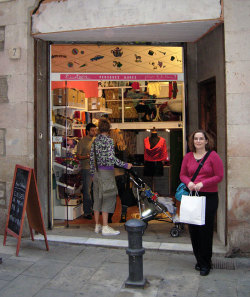
 On our way to the City History Museum of Barcelona in the old town, I was able to convince my husband to pop our heads into
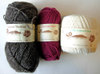
  Like every late Saturday afternoon, this place (and any other store on this busy pedestrian street) was very busy. I sifted thorough the cards as quickly as possible, hoping my husbands patience wouldn’t run thin. While they had a really good selection of buttons and several claps, it was soon apparent that finding what I had in mind in a short period of time could be difficult. I finally settled on some buttons that seemed to fit the bill; ones with a dark metal tone.
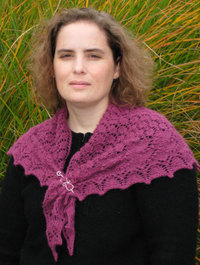
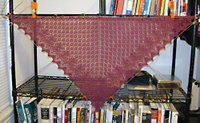
 Not leaving well enough alone, this weekend I went to a few yarn stores here to check out what they had. None had as good a selection as Merceria Santa Ana. I really wanted some clasps but all seemed to either be too big or made in shiny silver. I did however find an alternative.
 Just got back from a week long holiday in Catalonia and the Pyrenees.

 Purlwise
You must be logged in to post a comment.