Time Flies

Fiber

crosspatch_creations I can’t believe that I haven’t touched my spinning wheel for a couple of weeks now. Summer is always a challenging time to keep up with my projects.

Yesterday I got a chance to meet up with another spinner from the Weaving Works Spin In. She worked on some lovely silver angora wool from her rabbit. It was simply lovely.

While she worked on the angora, I tried to finish spinning some bright multi-colored wool fiber that I got at the Black Sheep Gathering last month. It’s fun to spin the singles but when I ply them together, the random colors don’t go well together. I plan on plying the rest of the fiber using the Navajo 3-ply technique so that the same color gets plied together.

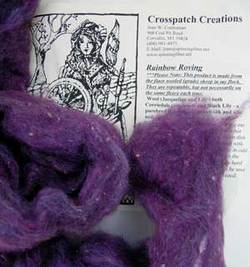
I was tempted to start spinning this Rainbow Roving that I got from The Bellwether at the Black Sheep Gathering. It’s wool, tussah silk and silk noil. Oddly enough, the silk noil specks remind me of dyer lint. If only my dyer produced such beautiful fiber, I’d be in spinning heaven.

Gilet Lace

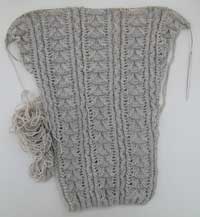
Gilet Lace is coming along well. Once the second sleeve is done, the sweater should come together quickly since I plan on doing the back in stockinette stitch.gl_sleeve2

Crossing Cables

cables

I’m still waiting for Danny Ouellette to send me the PDF that I ordered.

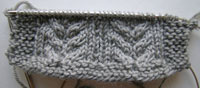
This is my second attempt at figuring out the stitch pattern without the actual pattern. After studying the photo, I think each rope cable is four stitches wide and ten rows tall with a purl stitch on each side of the cables. This sample is close but missing some purl stitches, so I’ll rip it out and start over.

When will I get my pattern?

larkspur

I purchased this sock yarn (click picture for a closer view) for my mother on mother’s day and promised to make her a pair of socks that she could wear this fall.

Earlier this week I came across this crossing cables pattern and placed an order for the PDF file. Well the payment went through but I didn’t get the PDF and the person behind the web site hasn’t responded to my e-mail.

Hopefully I get response soon. If not, I just might have to figure out the pattern myself. After a little searching I found that the same stitch pattern was used in “Wall Street Cables” from Arans & Celtics and according to Jon’s Knitting Blog (via EarthaKnits), it’s also in Harmony Guide 220 Aran Stitches.

Here’s a better picture of the sock on RedBirdKnits.com, which was knit in Wollywasch Tweed.

My mom needs something to cheer her up, look what happened my parent’s business this week. At least everyone in my family is ok and my dad is taking it well. Despite feeling awful for my folks, this other article did put a smile on my face.

Odd Sleeve

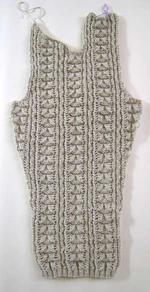
gl_sleeve Finally, one sleeve is finished and yes it is suppose have that odd shape on the top. The square on the top right is one half of the shoulder back and the triangle on the top left is the front left shoulder.

Click on the photo for a closer view.

I would have gotten this done last week but upon finishing the last few rows I noticed that I had strayed from the stitch pattern just as I started the shoulder portion. Although most people wouldn’t have noticed the mistake, I couldn’t live with it. The whole shoulder piece was ripped out and reknitted.
I’ve learned that the most important thing to remember when knitting large lace pieces is to stop fairly frequently to inspect your work. Doing so might minimize the amount of time spent ripping out hours of hard work.

I feel like it’s all down hill from here, so hopefully I’ll get it done within the next couple of weeks.

Two of My Favorite Things

addi Turbo

I made a trip over to Acorn Street to pick up some circular needles for the Japanese Shortrows class that I’ll be taking in August.
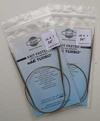
addiTurboWhile I almost always knit with addi Turbo needles, I haven’t purchase any for a while and wasn’t sure I’d purchase more this time. Last year I noticed that the cables seemed to be much less supple and had this observation confirmed by other knitters from Socknitters. The stiff cables just weren’t worth fighting so I wasn’t going buy any more until the cables improved.

Well, I’m happy to report that it seems like the distributor and manufacturer have listen to complaints and are now using a more supple cable.

I advise checking out the cables before you buy. Pull the needle out of the package and see if the needle tips dangle easily without having kinks near the join. The more supple the cable, the easier it will be to knit socks with two or one circular needle.

Jo Sharp DK

Earlier this year, Hilltop had a sample of Jo Sharp’s Tundra sweater on display that caught my eye. I was fascinated with the stitch pattern and decided to pick up a ball to try a swatch. I was immediately impressed with this top quality yarn and returned to purchase enough for a sweater. At the time, Hilltop had lots of Jo Sharp DK that they were clearing out for 30% off. As I purchased their remaining stock of the miro color, I mentioned that it’s too bad they won’t be carrying this yarn anymore but the clerk didn’t offer a reason.

Yesterday while in Acorn Street I noticed that their stock was down to only a few dozen balls, which were marked down. Since I was so impressed with this yarn, I just had to ask why they were no longer carrying it. A clerk mentioned that the distributor, KFI, is no longer carrying Jo Sharp yarn and that DK will no longer be made but some of the other lines have been picked up by another distributor.

I was so curious as to why this yarn was being discontinued and figured Knitter’s Review would have something about it. I didn’t find it mentioned so I wrote a post hoping to hear more. Greta was kind enough to post a comment on my blog pointing out that there was a long post about this and that Jo Sharp has been picked up by another distributor. This morning, I did another search and found it. Check out the distributors reply on page two which says, “… WHY ALL THE NOISE? YOU ARE NOT HAPPY, DON’T BUY OUR PRODUCTS. GO ELSEWHERE.” The mystery is solved; there’s no wonder why Jo Sharp is no longer being distributed by KFI. Someone mentioned that JCA/Reynolds will pick up the DK line. Yahoo!

Greta also asked, “Do you find Morehouse yarn (soft and wonderful though it is) to have way to much chaff and straw. I found myself constantly pulling out straw and burrs- especially when knitting baby stuff. Had to give it up and now find myself looking at my Morehouse stash wondering how big of a rug I could make!

The 2-ply that I purchased didn’t seem soft to me and produced uneven stitches, but that’s my personal observation. I know that other folks really rave about this yarn. The size and twist of the 2-ply is similar to what I need to produce for the Spin-Off sweater so I’m using it as a model but I’m not planning on using it in a project.
Another Tool

Lately I’ve been playing around with this little gadget called a McMorran balance to measure my yarn. To learn more about how to use this tool check out, Using a McMorran Balance on the All Fiber Arts site.

mcmorran

The yarn in the picture is the Morehouse Merino 2-ply that I talked about in an earlier post. It turns out that 14 inches of this yarn balances perfectly. This means that one pound of it measures 1,400 yards which is exactly what the merino yarn for the Spin-Off sweater should measure.

If you have access to back issues of Spin-Off, I recently found the article, Making Predictable Yarns: Using the McMorran balance as an aid to precise spinning by Jude Daurelle (Summer 1998). She actually measures unspun fibers using the balance and then tries to spin to a predetermined length in an effort to reproduce a specific yarn. So, for example, if I want to achieve a yarn that measures 14 inches long, like the Morehouse Merino, then I’ll try to spin a measured puff of fiber until it is 14 inches long. The author mentions that it takes practice to get good at determining how much fiber to put on the balance but eventually it gets much easier and faster to do once you get the feel.

More on Twist & Balanced Yarn

The other day I came across HJS Studio Tutorials while searching for more info on twist. The tutorial on Plying a Balanced Yarn is especially informative with photos of examples. After reading the tutorial on Spinning Low Twist Singles Yarn, I checked out Paula Simmon’s book, Spinning for Softness and Speed. This book has some interesting ideas on spinning soft yarn that I might try out this weekend.

More Good Spin-Off Articles

Spinning Soft Yarn by Mary Spanos – Summer 2003

Mastering Twist by Rita Buchanan – Winter 1997

An Easy & Accurate Way to Compare Yarns by Rita Buchanan – Summer 1999

What’s in my day pack?

mad_river Here is one reason why I’m now an avid knitter and my quilt projects languish. Knitting is just so portable.
Like many knitters, I have my own system for hauling around my projects. When I’m riding on the bus I use my main knitting bag but when I go hiking and need a lower profile, I use a cinch pack. Although I purchased this one at a local store, it wouldn’t be very difficult to make. It’s just two squares with a casing at the top that holds some nylon cords to cinch the bag closed. The front pouch is handy for storing little knitting tools, needles and extra yarn. The ends of the nylon cords are attached at the bottom of the sack through some metal grommets so that the bag can be used as a makesift pack although I usually just put it in my larger daypack and easily pull it out when I get a chance to knit.

The other key element to portable knitting is the container that holds all the various knitting tools. After a long search I finally found this double-sided pencil box. One side holds my folding scissors, markers, crochet hook, ruler and pencil. Flip the box (click on the picture) and the other side holds my measuring tape, sewing needles, counter and stitch holders.

knitting_box1

So what was I working on this weekend? Well, I picked up Gilet Lace again and I’m almost finished with the first sleeve/collar piece.

Eva, I’m sorry it is taking me so long to type up the translation for this cardigan. I want to make sure I get the translation right so I’ll finish the translation as I finish the first sleeve. The upper part of the sleeve is a big tricky so the translation will probably be more accurate if knit it first.

Handspun & Morehouse Merino

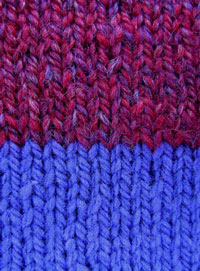
handspun_and_morehouse Can you guess which part of this swatch is handspun and which is not?
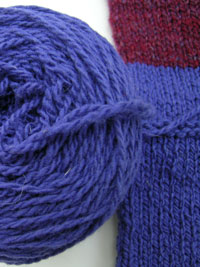
The top half is my latest sample of handspun merino top and the bottom half is Morehouse Farm 2-ply merino.

Morehouse Merino

2-ply Sport Weight Info

plied wraps per inch = 15

plied twists per inch = 7

McMorran Balance = 14 inches

Needle = 3.0mm

Gauge = 24 sts x 30 rows per 4 inches

Almost exactly the same specifications that I’d like to achieve with the merino that I’ll be using for the Spin-Off sweater!

So what is the Morehouse Merino like? Well, it’s not as soft as I thought it would be and definitely not as soft as Koigu. Even my handspun is softer (yeah).

morehouse_ballMy first unwashed swatch was done on with size 3.25mm needles, and produced a slightly stiff and uneven fabric. The stitches became tighter and more even when I switched to 3.0mm needles. Perhaps the stitches would look better after washing but I haven’t had a chance to do a wash test. As you can tell, I’m not too impressed with this yarn. Chances are that it will become a lonely ball at the bottom of my knitting basket reserved as a good point of reference.
Black Sheep Gathering

I had an urge to fondle wool so we made a quick weekend trip the Black Sheep Gathering in Eugene on Saturday and then visited with a good friend on Sunday.

We arrived just as folks were setting up booths. Hand Jive’s colorful display of hand painted yarn and sock patterns was the first booth to catch my eye. I picked up a couple of skeins of Nature’s Palette merino fingering weight yarn, which looks very similar to Koigu.

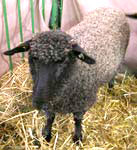
Wensleydale I continued to browse the various wool and equipment vendors but had a hard time deciding on what to buy so I took a break from shopping to check out wool on the hoof. This Wensleydale cross from Carlson Farm has the most beautiful curly wool. It didn’t take much imagine to visual how pleasant it would be to spinning straight from the locks.
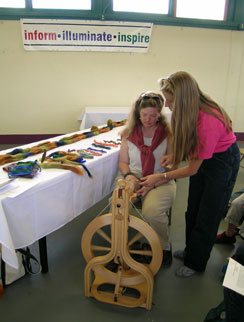
Annie Dachnahl At noon I attended Annie Dachnal’s demonstration on spinning multicolored roving which was based on a workshop taught by Lynne Vogel at SOAR last year.
Besides covering five different techniques for spinning these colorful rovings (check out Lynne’s book, The Twisted Sister’s Sock Workbook), she also demonstrated Andean Plying, which is useful for plying from both ends of one bobbin.

This was a timely topic since I had just bought a couple of these rovings before the talk and had no idea that there are so many ways to spin it up.

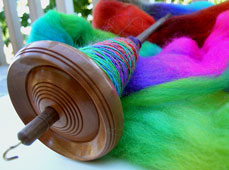
Tabachek HandspindleHere’s a bit of one roving that I spun on my new Tabachek spindle. I’m always on the look out for a well balanced and long spinning spindle. This one has quickly become my favorite.

In a twist

homespun knit sample I was starting to feel smug about the consistency and twist of my handspun merino until I knitted a swatch. Despite producing a beautify skein, the first swatch knitted with this yarn came out less then satisfying (click the photo for a closer view). Although it’s a perfectly balanced yarn, the twist angle produces oddly formed stitches and a stiffly knitted fabric.
Not long after knitting this swatch, I came across an article in the winter 1997 issue of Spin-Off called “Mastering Twist” by Rita Buchanan. She confirmed what I had just learned. “Don’t judge yarn by looks alone. Spinners often like the looks of a high-twist yarn but prefer to hold or squeeze yarn with less twist. However, the final test is in the fabric, not the eyes or the hand.”

Practice makes perfect, right? It’s back to the spinning wheel to make some more sample yarn and swatches.

Figure 8 Cast On

Here’s what I did with the Buttons yarn using the Simple Baby Socks pattern in The Magic Loop booklet. I highly recommend this booklet if you’d like to learn how to knit socks with one circular from the cuff down and from the toe up.

buttons_baby_socks

These socks are knit from the toe, using a figure 8 cast on which can be a challenge to manage but  produces the best sock toe. Last week I tried starting these socks while riding the bus but gave up after several attempts. It’s definitely a task that needs to be done in a comfortable environment.

Keep in mind that this cast on is not only great for socks, but can also be used for other circular items such as hats.

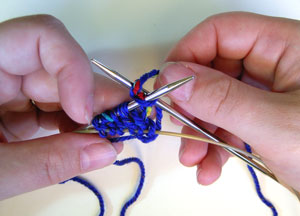
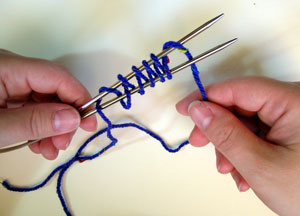
Here’s how the cast on is started on two circular needles. The yarn is wound around two needle tips in a figure 8 fashion.

[Note: 4/9/2006 – I just noticed that this picture is wrong. The yarn end should start be under the lower needle (left side of photo) and then wrapped up over the upper needle. When I get a chance, I’ll change the photo. Athough, I think it’s still possible to wrap the needles this way. Just be sure not to twist stitches as you knit them.]

figure8-1

Once the yarn is wound around the needles, I start knitting through the back loop of all the stitches on the top needle. It’s important to remember to correctly wrap the last stitch on the bottom needle when starting on the top row so that another stitch is formed on the bottom needle.
figure8-2
Now I switch the bottom needle to the top and knit (not through the back loop) each stitch on this needle. Notice that I’m holding the yarn tail between the fingers of my left hand so that the last stitch on the last needle doesn’t get messed up.
figure8-3
Here’s the first round finished. I can now knit in a circle, increasing at the end of each needle as needed.
figure8-4
When the circle is a little bigger I tighten the first row stitches by starting on the opposite side of the tail (which is on the left when looking down at the toe from the top of the sock) yanking on the stitches one at a time to move the slack from one stitch to the next until I reach the tail.