Just over an arms length to go

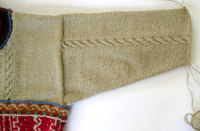
So_sleeveGot back on the project and managed to finish most of the left sleeve.

It’s a pretty basic sleeve, just pick up stitches around the arm hole and knit in the round with decreases every fourth row. It could however get a bit tricky if I have to shorten the sleeve but still want to used the same designs for the  cuff. The instructions say that the ecru part of the sleeve should be 15″ long with 66 stitches on the needle. It now measures 15″ inches and I have 70 stitches.

Looks like a good time to take a break and try on the sweater to see what adjustments might be needed.

Portable knitting reference

TheknittershandbookI’ve been in a bit of a knitting slump this week and busy with other things so there’s been no progress on my current project other than a bit of spinning so that I can finish the sleeves. Tomorrow I should be able to find time to continue.

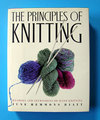
Since I don’t have anything to show I thought I’d mention a handy little book that I picked up a couple of months ago.

Like many knitters, I not only knit at home but also knit whenever I can find a spare moment, wherever I might be – particularly while traveling via car, plane or boat. One dilemma that I always face when preparing my knitting bag, is what reference book I should take. Most are not an option due to their bulky size, while others that are not so bulky don’t contain enough of the techniques that I tend to use.

When I first started flipping through this book, I didn’t expect much because I’m not a big fan of Knitter’s Magazine and haven’t purchased their magazine very often. While I always flip through each new issue, I’m usually disappointed with what they offer and tend to pass it up for Interweave Knits or Vogue Knitting. So with that being said, I was surprised to find that this book contains most of the information I would expect to need while knitting on the road. Now that I think about it, early issues of Knitter’s were filled with articles by Elizabeth Zimmerman, Priscilla Gibson-Roberts, Nancy Bush, and Deborah Newton to name a few.  So, maybe it’s not so crazy to think that Knitter’s could come up with a good compact knitting reference.

So what do I like about it?

  • The publisher has given permission to the readers to photocopy instructions and graphics for personal use
  • Besides a table of contents, it also has an index
  • It not only covers the basics but also mentions some, not so basic techniques, such as tubular bind-off and cast-on, long-tail cast-on, purl, invisible cast-on, crochet for finishing, grafting in several stitch patterns, lifted increases, short-rows for shoulders and the list goes on
  • The spiral binding, durable cover and portable dimensions (8″ X 6.5)

So what would I change?

It would have been helpful if it had some yardage charts for basic sweaters, socks, hats & mittens. Also, the sweater sizing chart could have included sweater sizing for not only bust/chest, but also body length and hips.  I’d also change the cover graphic.

I’m thrilled that the publisher has give permission to copy from the book because I plan to copy selected pages when I work on a project and add them to the  small binder that I carry in my knitting bag. That way I’ll have less to haul around.
Hard to believe but …

Pok_2Last night  I went to The Weaving Works for their first  drop-in spinning session and arrived before the door was open.  Instead of waiting in the car,  I decided to walk over to  Half Price Books  to kill time.

I go over there every once and a while to check out the knitting section but haven’t found anything of interest until last night.  This time I found a copy of The Principles of Knitting by June Hemmons Hiatt for $14.98! The back cover has a water stain but the front cover and pages are fine.

Social weaver bird

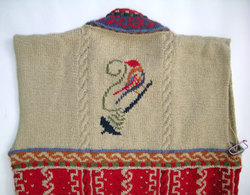
So_upper_back_1Finally, I have enough time to actually post a picture of the back of the sweater.

The pattern mentions to use duplicate stitch to embroider the bird on the back once the sweater is finished but I ended up adding it using intarsia (closer view) .  Every time that I’ve attempted to use duplicate stitch the background yarn usually shows through too much, so unlike many knitters, I actually prefer to do intarsia.

I also joined the shoulder seems using the three needle bind-off even though the pattern says to use kitchener stitch. I figured that a bound off seam would be more stable.

Knitting this part has been so enjoyable that I kept on going and added the collar. Now I’ve run out of the honey colored yarn I’ll be spinning this week, unless of course, work doesn’t preempt my plans.

Fileuse de laine

Algerian_spinning

Ever wonder what they call a female spinner in French?  It’s fileuse de laine (at least that’s this picture says).

Work has really been keeping me busy this week so I haven’t had time to stop and take a picture of the progress I made this weekend on the Spin Off sweater. The back is done, including the weaver bird and I’m working on the collar. Hopefully I get some time tomorrow to take a picture.

After the collar is done, I’ll need to do some more spinning before I start the sleeves.

Total control

So_upper_frontAs difficult as handspinning and knitting might seem to be at times, it still never fails to help me unwind from pressures at work. It’s the one thing that I have total control over, can do on my own schedule and decide the level of quality of the finished product.

It’s been a totally hectic week at the office.  Instead of screaming, I knit.

The upper front is finished after having to redo the upper left side. On my first attempt I used a second ball of yarn but found that it felt a bit harsh as I knitted it because I hadn’t bothered to properly finish the skein after spinning. The yarn became much softer after letting it soak in very hot water for about fifteen minutes and then letting it dry.

Japanese short-rows came in very handy when working the sloping shoulders.

Pressing on

So_sweater_upper_body_1 The Spin-Off sweater is finally back.

It was put on hold while I waited for more of the honey colored merino/tencel fiber. Thanks to Woodland Woolworks, my spinning wheel has been busy for the last couple of weeks.

This time around I used Rita’s loop trick to constantly measure the thickness while spinning the singles. As soon as I got an ounce of fiber spun and plied I knitted up a swatch to check my gauge.

To achieve the correct gauge while knitting this part of the sweater I had to switch from size 3.25mm needles to size 3.00mm.

I know I’ve mentioned it before but, I love knitting with handspun yarn!

The surprising properties of natural fibers

I happened to be watching Nova: ScienceNow on PBS this evening and was captivated by the story about a project to photograph one of the  unicorn tapestries from The Metropolitan Museum of Art and the problems that they encountered.  After doing a quick search on Google, I found this article from The New Yorker which presents the  story in much more detail.

I love how it demonstrates just how resilient natural fibers can be.

Scottish Wave Scarf

Scottish_wave_scarf_3Since I  don’t have any progress to show on my current projects, I’ve pull out one from my “to do” back log.
When Cat Bordhi’s books on knitted moebius garments came out last year I wasn’t terrible interested in getting my hands on one of them until I saw this Scottish Wave Scarf (A Treasury of Magical Knitting) displayed at the Weaving Works. It’s one of those designs that is easily passed over in a book but jumped out at me when I had a chance to see it close-up.

Since I wasn’t interested in the other patterns in the book, I put a hold on a copy from my local library and just got it after a three month wait.

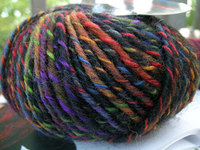
While the design is interesting, I think I was mostly attracted to the yarn, Tahki Shannon. Here’s a closer view of the color called “charcoal” (#11).

Tahki_shannon__11_1

Wouldn’t this be a  fun yarn to duplicate ? It looks like it was constructed in a two steps. First, a smaller black wool yarn is loosely wrapped with  a roving to construct a base and then a smaller variegated single is wrapped around base.