Class Notes: Nice Soft Yarns

The NWRSA conference offered two days worth of classes by various instructors such as Judith MacKenzie McCuin, Myrna Stahman and others. While I would have also like to attend many other classes, I felt like this might be my only chance to take classes from Rita Buchanan, who is now retired. During the past six months I’ve been collecting past issues of Spin Off magazine and always find her articles to be some of the most detailed and helpful. I realized after talking with many of the other attendees that I was very lucky to get into all four  of her classes since there was a limit of 20 students for each class.

Rita BuchananOn Friday,  I was so anxious to get to class and set up that I arrived 1/2 hour early and found Rita setting up her samples. Since on other students had yet arrived this gave me a chance to let her know how helpful and inspiring I’ve found her articles. She was quite pleased to get this feedback and mentioned that writing is so different than teaching since there is no immediate feedback from readers. I also mentioned that I’d sent Amy (the current editor of Spin Off) an e-mail suggesting that they compile Rita’s articles into a book. She seemed glad to hear the articles have been so helpful but that she’s now retired and no longer wants to write. Compiling articles might seem easy but since her thoughts and ideas have evolved over time, she would need to edit the content. This response makes sense. I could tell after reading all of her articles that her ideas have indeed changed over time, i.g. techniques for measuring yarns, and sympathize with her desire to concentrate on the things she loves to do.

One thing I didn’t get around to asking, was if she is still actively teaching. I would guess that she probably doesn’t and might have taught at this conference as a favor to a friend when Norman Kennedy had to cancel due to health concerns.

This  first class was called, Nice Soft Yarns. Rita kicked it off by having us treadle our wheels at our normal pace for one minute, counting each rotation. After the minute was up she had each of us reveal our counts. Mine was within range of most people – 55. She then had us treadle fast for 30 seconds. I got 48 that time. She has done this at lots of classes and said that west coast spinners are pretty relaxed compared to folks on the east coast.

The goal of this exercise was to get us thinking about the fact that we control twist and that the movement of our feet is one of several factors that can help us produce the type of yarn that we want. One of the other factors is how much yarn is feed into the orifice at one time s0 she next  had us practicing hand movements while she  treadled her wheel.  This reminded me of something a sports coach would do, essentially, going through our movements without actually spinning. Our hand movements were mimicking what most people call a short draw.

After getting us to focus on our movements, she passed out pencil roving from Fingerlakes Woolen Mill and a couple of index cards with holes punched down one side.  She wanted us to create plied samples from the finger roving by spinning it without drafting and staying conscious of three factors as we worked. First we needed to keep our drive ratio constant by not changing the whorl. Second, we should try to keep the maximum distance between our two hands the same (about three inches which is the same length of an index card). Third, treadle the same amount of times for each cycle of hand movements that let twist into the fiber.
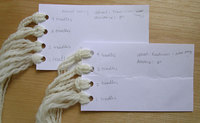
Nice soft yarns - samplesOnce we got comfortable spinning in this mode, we stopped and made a 2-ply sample by letting the single twist back on themselves. My first yarn sample was done with four treadles per 3 inches of  feed, using the outer ring of my slow whorl (the card in the upper left side of the picture). We attached the sample yarn to a card and noted the various factors used.  Next we were asked to make more samples but change the number of treadles. Each yarn sample was labeled with the number of treadles. By completing several samples and changing only one factor we could plainly see the results. A greater number of treadles produced a dense rigid yarn while fewer treadles create a soft puffy yarn. We continued to make another card full of samples (the card in the lower right side of the picture) but this time we changed one of the other factors. I choose to change my whorl. To get a closer look at my samples, click on the picture and a closer view should pop-up.

Once we were finished making our samples, Rita explained that we can use this method to help figure out what type of yarn we would like to make. She then pulled out some samples of items that she had made with soft yarns and debunked some of the common myths about soft yarns. She said that a single only needs enough twist to keep it from breaking as it is unwound  from the bobbin.  But keep in mind that short fibers and thin yarns usually need more twist. Also don’t judge a yarn by it’s twist. Tightly twisted yarns can make great looking skeins but produce an  undesirably stiff knitted fabric.

For more detailed information on this topic, see “Mastering Twist” by Rita Buchanan, pages 34 -43 in Spin-Off Magazine, Winter 1997.

Mission Mill

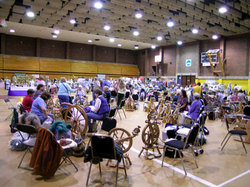
The NWRSA conference was held over four days on the beautiful campus of Willamette University. On Thursday, attendees checked-in and started to get settled in their accommodations and vendors started setting up their booths. I arrived mid afternoon to unpack all my spinning equipment and get my room organized. Since there only seemed to be a few official parking lots, I decided to go ahead and walk across campus with my large backpack over to the dorm. As I approached my door, another attendee was trying to open her door and was finding that her key wouldn’t work. I tried mine and had the same problem. Since I was lugging around my pack she offered to give me a ride back to the gym. It turns out she was an instructor for one of the classes and long time member of NWRSA. She mentioned that there was an interesting museum that has a water powered textile mill across the street from the gym and that if I got time, I might find it interesting.

Once I got the key situation worked out, I dropped my pack
off in my room and then walked back to the gym where the main events and
vendors were located to do a little browsing. Folks were starting to form
spinning circles in the middle of the gym while vendors setup on each side. By
that time most of the vendors were still setting up so there
wasn’t much to look at. I was a bit tired and didn’t feel like spinning or
knitting because my left shoulder was hurting a bit so this seemed like a good time to walk over to the museum to check out
the mill. I have an old text book called Fiber to Fabric that shows how spinning was done in the 30’s
so I thought it would be interesting to see the process in person.

Misson MillThe museum is actually a small complex of several houses from the first Oregon settlement, a mission setup by Jason Lee, and buildings that housed Thomas Kaye Textile Mill, which produced fine wool blankets and fabrics from 1889 to 1962.
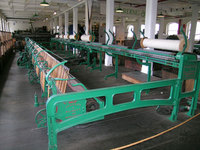
I was really only interested in seeing the Mill so I skipped the houses and started my self guided tour at the machine shop. I was anxious to see machines that actually spin fiber so I glanced briefly at the machine shop and turbine and continued on to the mill. The mill has several floors. The exhibits are currently housed on the two lower floors and the upper floor is used for conferences and meetings. Several textile groups meet in these rooms, including a local spinning guild.

spinning mule The map directs visitors to the second floor, the start of the production facilities, which includes machines for picking carding, spinning and weaving. While I looked at each machine the most fascinating was the  the spinning mule.  Just imaging 360 spindles going at once.  I knew it might be a bit hard to explain how the machine was operated so I took a picture of the placard  next to the machine. There’s also a  caption under the drawing that  says, “Spools of roving are placed on the stationary carriage while the roving ends are hand-spliced and attached to bobbins on the bobbing carriage. The bobbin carriage moves away from the spools and the roving is drawn out and twisted. On the return trip, the yarn is wound around the bobbins, and the mule is ready for the next cycle.” Apparently this is one of only three spinning mules in the country that can still be operated, although it wasn’t running when I saw it.

The tour continued down to the finishing room on the first floor where the woven fabrics were finished with various felting, drying and pressing machines. Unlike the second floor this one is dark and almost made me feel claustrophobic so I jetted through this part and made my way back to the conference.

Woodland Woolworks

On my way to the NWRSA conference, I decided to make a brief detour to Woodland Woolworks. I’ve been getting their catalogs for about a year now and several times have been tempted to place an order but end up talking myself out of buying more stuff until I work through my current backlog.

Although it was a worth while detour (especially since my husband was not in tow), it’s definitely off the beaten track. Once off I5 my trip seemed to slow considerably as I wound my way through the 99W suburban mess. The trip got considerably more pleasant once past Sherwood. At this point, the landscape started looking more like the rolling hills of Tuscany. After passing several vineyards, it dawned on me that I  must be in the heart of Oregon wine country.

After winding  through this scenic country side, I was totally underwhelmed to find Woodland Woolworks housed in new-ish warehouse factory on the outside of town. The building wasn’t even worthy of a photo.  I quickly got over the look of the building once inside. Heck, after all I wasn’t there to see the outside of the building.

At first, I was a bit confused by the set up. The entrance guides you straight into their order packing room and I happened to show up just as  a large group of fellow NWRSA members were finishing their purchases. After I figured out that I shouldn’t be picking through the boxes in this room, I finally came upon the overstock/discount room. It was mostly stocked with yarns but also had a few spinning and weaving item. Nothing caught my eye, but I’m sure lots of other knitters would have been thrilled with some of the bargains. I’ve been trying not to buy any more yarns unless I have a specific purpose for it.

Besides the bargain room there were three other show rooms in the building; one with spinning wheels and tools; another with weaving stuff and a third with knitting tools, yarns, books and fibers. Since I’m not a weaver, I really didn’t give that room a second look.

I spent a bit of time in the room with the spinning wheels, debating on whether I should purchase a pair of Forsyth mini combs.  Since I already have a wheel I didn’t look closely at them but I can tell you that they have just about every brand on the market. I also thought about getting a "Spinner’s Control Card" but wasn’t sure I really needed it. After later hearing Rita mention that this tool couldn’t be an accurate way to find substitute yarns, I sure glad I didn’t get it. I’ll save details about why for a later post.

Since I really didn’t need anymore spinning tools, I spent most of my time wondering through the yarn and fiber sections. My main justification for going to Woodland Woolworks was to purchase 1.5 pounds of plum merino for my current project. (Yes, I’m still considering whether I’ll stick to the pattern or deviate a bit.) Anyways, I quickly found what I was looking for. They definitely had one of the most comprehensive selections of fibers, yarns, books and tools that I’ve ever seen. I just wish it didn’t take four hours to get there.

I was a bit tired and hungry after the long drive so I only browsed for 1/2 hour and managed to get out with only buying what I came to get. While I usually buy most of my yarn and books at local shops, I’ll still consider Woodland Woolworks when  I can’t find what I’m looking for locally. Since they have a wide range of fibers and spinning tools, it’s more than likely that as I use up my fiber stock that I’ll place an order through their website in the future.

By the way, despite advertising in NWRSA’s Loose Threads, they did not have a booth at the conference. Someone mentioned that they haven’t shown up at conferences for awhile now, but nobody knew for sure why.

Catching my breath

I just got back from the NWRSA 2005 Annual Conference in Salem, Oregon today. Four days of shopping, spinning, attending four classes and sleeping in a dorm has totally wiped me out. After unloading Nwrsa_field_house_1my car this afternoon, I couldn’t resist taking a mid-day nap to recover a bit before catching up on a few things tonight.

Today I started organizing my class notes and samples to  start working on post about the conference, Rita’s classes and my visit to Woodland Woolworks. I’ll try to get in several post this week while everything is still fresh in my mind.

It was all so fabulous, especially Rita’s classes and keynote address, but right now I’ve got to unpack and do a bit of laundry.

Knitting continues

Spinoff_twospindlesProgress  has been steady.  As I get farther along it  gets harder to put down and get other things done.

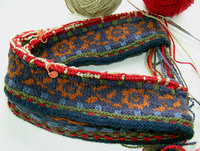
Every project has it’s challenges and this one is no exception.  For the most part it’s coming along  quite well but  I have notice that  red background is  puckering a bit in the  large solid areas where  on the back side I  tacked  down  the unused  white yarn  to minimize the float. I try to monitor my tension on the white yarn, easing up to avoid puckering,  but that doesn’t seem to do much good. At this point I’m crossing my fingers and hoping that the puckering will go away once the sweater is blocked.

On my way to the NWRSA conference this Thursday I’m going to stop by Woodland Woolworks. I’ve been getting their catalogs for the past year but have yet to order from them. They seem to have just about anything a spinner or knitter might need.


Niddy noddy update

Last February I posted a photo of a unique niddy noddy that I’ve seen while attending a couple of spinning classes over the past year.  One of the owners of these niddy noddies works for the Weaving Works and said that she hasn’t been able to contact the maker for years and thus didn’t think he was still in business.  I’ve been holding out hope that someday one of these would cross my path. Well today I did one more web search and finally found a source,  Village Spinning & Weaving !

They also carry his skein winder.  While the skein winder might seem a bit pricey  it does have a built-in counter.  I’ll hold off adding to my order but will certainly add it to my “would like to have” list.

Spin-Off

Spinoff_redwhitestart

As you can see, I didn’t get very far with my knitting. I’ve been spinning a bluefaced leicester top in preparation for the one of Rita Buchanan’s classes called Plying with a Handspindle. Along with our favorite spindle, we’ve been asked to bring three medium sized center-pull balls of handspun singles. The photo shows one of my balls still on a nostepinne.

This bluefaced leicester top is so much easier to spin than merino, because of it’s 6 inch staple length. The unspun fiber seems so soft that I think it will also make a relatively soft yarn with a bit of luster. The price is right at about $1 an ounce.

This quarter’s Spin-Off magazine arrived a few days ago.  What’s up with Spin-Off? The past few issues really haven’t been very good. I guess I’m not the only one that think the content is lacking good quality in-depth articles. One of the letters to the editor mentioned that Spin-Off’s content  has been a recent topic of discuss on a online discussion group. The editor responded by saying that she would love hearing from readers with specific feedback. I’m already working on my letter.

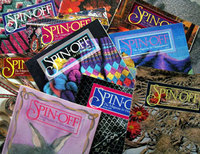
Spin_off_backissues_1 Over the past six months I’ve been collecting back issues of the magazine and can tell you that there’s a big difference between the ones from the 80’s & 90’s and the ones put out since Amy Clarke Moore took over.  Perhaps Spin-Off has covered everything  there is to know about spinning during the first 25 years and is having trouble coming up with original content.
I did sent an e-mail to Amy in December and mentioned that Rita Buchanan’s articles are among the best and suggested putting them together in a book. She responded, saying that I’m not the first to request this but Rita is enjoying her retirement and doesn’t have time to put a book together. That’s too bad. I’ll suggest it to Rita when I take her class. I don’t see why it would be so much work to compile the articles straight from the magazine without any changes. Heck can’t the Spin-Off staff do it?

Besides the lack of truely interesting content, at the moment, my other top complaint is that covers of the subscriber issues are marred by a big white address box. Good heavens, what were they thinking when they decide to do that. If they keep it up, I’ll let my subscription lapse and perhaps buy it at a bookstore.  They should follow what Saveur magazine does, and use a easy to peel (0ff) address label.

Knitting has commenced

It’s taken about a year and a half to get this far;  six months to give myself permission to buy a wheel and another year of  spinning classes and practice to produce acceptable yarn. Spinoff_start

One of the reasons I hesitated to start spinning was an unfounded fear that I would never produce yarn good enough for knitting as well as a bit of nervousness due to the relatively large investment I had to make before having much opportunity to find out whether I would stick with it.

For some folks it might be odd to hear that I  want my hand spun to look just as good as any commercial yarn, but that’s me. With any craft I do, I have this odd need to make my items as perfect as possible. I guess it come from a desire to show others that in this age of mass produced junk, that hand crafted items can be of much better quality and value than run-of-the-mill stuff  purchased at the mall.

So now that I’ve done lots of spinning and have finally started knitting with my handspun yarn, I’m so thrilled that I did eventually dive into this craft. I don’t know if other spinners/knitters feel this way, but I’m finding that knitting takes on a whole other dimension when using handspun yarn.

By the way, in a few of weeks I’ll be attending the Northwest Reginal Spinners’ Association conference . I was lucky to get all my first choices for classes – the ones taught by Rita Buchanan.  As I’ve collected back issues of Spin Off magazine, I’ve been finding her articles  the most informative for learning, so I feel lucky to actually get a chance to take two days worth of classes with her.

Dayflower

Dayflower_stitch

Washing and drying all my hand spun yarn for the Spin-Off sweater is taking a long time, so while I’ve picked up this small project to work on in the mean time.

I came across this a few weeks ago while scouting around for yarn at a local shop called Full Circle. It’s a long skinny scarf made out of very soft yarn called Tajmahal (8% cashmere, 22% silk and 70% merino). I was so attracted to this  curved vine-like pattern that I instantly asked for the pattern after scooping up the yarn.

After getting this far with the stitch pattern, I started to wonder if this was a unique pattern or one that has been around a while.  I quickly identified it using Barbara Walker’s A Second Treasury of Knitting Patterns. She calls it dayflower and says that it has been around since the 19th century.

I graphed the pattern this weekend but sadly can’t get my HP scanjet scanner working.  I just contacted their support and found out they have a software problem. So, I don’t suggest buying their products.

Here’s the stitch pattern written in knitting terms. Just beware that it’s not an easy one to do and takes a lot of patience because it doesn’t have predicable repeats and the number of stitches per row varies.

Cast on 36 sts.
Row 1: wrong side and all other wrong side rows EXCEPT rows 5 and 13 – Purl.

Row 2: k2, *yo k2tog, yo, (k2tog) 3 times, k2, yo, k3, yo, ssk, yo, k2*. (36 sts).

Row 4: k2, *yo, k2tog, (k3 tog) twice, yo, k1, yo, k2, (ssk, yo) twice, k2*. (32 sts).

Row 5: p11, p2tog, p13, p2tog, p4.   (30 sts.)

Row 6: k2, *yo, k3tog, yo, k3, yo, k2, (ssk, yo) twice, k2*. (32 sts.)

Row 8: k2, *yo, k2tog, yo, k1, (yo, k2, ssk) twice, yo, ssk, yo, k2*. (36 sts.)

Row 10: k2, *yo, k2tog, yo, k3, yo, k2, (ssk) 3 times, yo, ssk, yo, k2*. (36 sts.)

Row 12: k2, *(yo, k2tog) twice, k2, yo, k1, yo, (sl1 – k2tog – psso) twice, ssk, yo, k2*. (32 sts.)
Row 13: p4, p2togb, p13, p2togb, p11. (30 sts.)

Row 14: k2, *(yo, k2tog) twice, k2, yo, k3, yo, sl1 – k2tog – psso, yo, k2*. (32 sts.)

Row 16: k2, *yo, k2tog, yo, (k2tog, k2, yo) twice, k1, yo, ssk, yo, k2*. (36 sts.)

Terms:
k = knit

k2tog = knit two together

p = purl
k3tog = knit three together

p2togb = purl two together through the back loops

sl1-k2tog-psso = slip one, knit two together and pass the slipped stitch over

yo = yarn over

*= after working once, repeat once more from * to *

Quick and Easy

Harvard_square_done

The Harvard Square cardigan is officially finished, a relatively quick and easy project that would have gone much faster if I hadn’t ripped out one of the sleeves to try knitting it in the round. I came up with the idea after having trouble sewing the seams under the sleeve with one color. No matter which color I used, a bit of it would peek through a contrasting stripe. Anyways, after knitting a few stripes in the round,  I quickly found out that these small garter stitch stripes are just not possible to do that way. It’s hard to explain why but just take my word, it doesn’t work. OK, it’s not totally impossible; I suppose I could have used one of PGR’s intarsia-in-the-round techniques, but didn’t have enough time to try one of them.

Spinoff_spun

Yahoo! All of my hand spinning for the Spin-Off sweater is finished. Knitting should start this week, once I’ve rewashed the dark colors so that they don’t bleed on the lighter ones.

Progressive Knitting

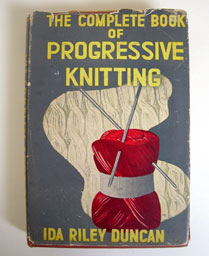
Progressive_knittingI first saw a copy of this book while taking a class about spinning for socks with Judith McKenzie McCuin a couple of months ago. She mentioned that it is the best resource for information about fit for any knitted garment.

Well, a couple of weeks ago when I was considering making a pair of socks from one of Nancy Bush’s books and  lamented how her socks only come in one size. While most of Bush’s socks fit my foot, I usually make the leg portion an inch shorter so I won’t have any problems getting them to stay up.

This dilemma got me thinking more about creating better fitting socks so, after noticing this book as a reference in one of my knitting books, I dug up a copy.

Let me tell you, this 1940’s book is well worth the $7 I paid for it. It has formulas for any knitted garment and gives examples in several gauges. It’s inspired me to attempt a pair of knee length stockings in the near future or at least to go ahead and modify the Bush pattern to get a better fit.