
Pattern from Ethnic Sock and Stockings by Priscilla Gibson-Roberts.
Pattern from Ethnic Sock and Stockings by Priscilla Gibson-Roberts.
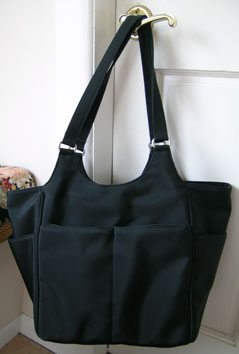 Probably every knitter has an opinion on what would be the ideal knitting bag and I’m no exception. Not only does my ideal bag need to be large enough to carry my knitting, small purse and other commute items, it absolutely has to be water resistant. After fitting these essential needs my secondary criteria are that it should have enough pockets to keep knitting items separated from commuting items and fit in with the downtown business crowd.
This bag meets all my needs and more. I’ve never come across a tote bag that has as many pockets as this one, six outside and three+ inside. One of the inside pockets has smaller ones to organize small personal items such as pens, calculator and wallets. These little pockets work well for organizing knitting tools.
So that’s my 2 cents on the ideal knitting bag. I’ve seen a lot of other cute/functional knitting specific ones but most of those are made out of cloth or wool which just doesn’t work well for this commuting knitter.
Update: I got this bag from www.magellans.com.

Pattern from Knitting on the Road by Nancy Bush
 Yarn: Cascade 220
Needle: 3.5mm
Techniques:
– toe-up on one circular needle as describe in Magic Loop booklet by Fibertrends
– short-row heels from a Regia booklet (no yarn overs)
– intarsia-in-the-round as described in Simple Socks by Priscilla Gibson-Roberts
Designs:
– cardinals from “Knit n’ Style” magazine (Dec. 2002)
– binoculars are my own design
– rest is from And A Time to Knit Stockingsby Katherine Pence.
 It’s been so easy to work on this sweater during my bus commute and at home that I’m finding it hard to get motivated to work on other projects. The Christmas stocking that I started last week will probably not get done this Christmas. I’ve been too busy to spend time concentrating on an intarsia project this week but will probably have time during the Christmas break to work on it.
Speaking of intarsia, Pricilla Gibson-Roberts had an article in the winter issue of Interweave Knits about a new intarsia-in-the-round technique that I’m interested in trying. While this technique probably won’t work for my current stocking project, it probably would have worked for my last one. Maybe after my current projects are done, I’ll have time to make the footlets in her article.
Now that the increases are done, the front and back have been joined by casting on additional stitches at the bottom of each armhole. The pattern suggested using a crochet chain as a base for the new stitches. I had some left over mercerized cotton yarn that worked well this purpose. I believe this slippery cotton yarn will be easy to pull out when I need to pick up those stitches.

The underarm shaping for this sweater is done using raised/lifted increases on each side of the front and back, at least that’s what the pattern implies. It says, “Work increases as k2, k1 in left side of st below, k across to last 2 st, k1 in right side of st below of next st, k2”. Although this is the first time I’ve used raised increases, this description just didn’t seem right. After checking several sources, I confirmed that the pattern incorrectly mentions which side of the stitch from the previous row to raise. Here’s how I’m doing it.
Increase stitch count by raising one side of a stitch from the previous row. These increases will slant to the left or right depending on which side of the stitch is raised. At beginning of next knit row knit two stitches. Now add a new stitch by using the right needle tip to raise the right side of the stitch below the one on the left needle onto the left needle. Knit this new stitch. Continue knitting across the back/front side of the garment until two stitches remain on the left needle. Now add another stitch by using the left needle to raise the left side of the stitch two rows down from the stitch on the right needle. While this new stitch is on the left needle knit into backside of it so that it doesn’t cross. Knit the next two stitches to finish the row. Note that the left increase is raised from the second row from the needle so that the increases end up on the same row.
While The Principles of Knitting has the best description and diagram of this increase I also found a good description in the Fall 2003 issue of Knitter’s magazine.
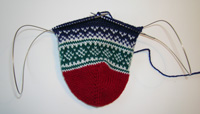 I finally settled on a design for the lighthouse Christmas stocking that I’ve been contemplating for a while now. I started several times but wasn’t satisfied with the gauge so I rearranged the chart and added a sailboat. Hopefully I can get this done before Christmas 2003.
I’m using one 47″ circular needle (magic loop method) since my 24″ ones are being used for my other project. I thought that this needle would be too long but it’s working out just fine.
Lighthouse Stocking Details
Yarn: Cascade 220
Needle Size: 3.5mm
Chart/Pattern: Combination of lighthouse socks from Sweaterscapes & November Sock from …And A Time To Knit Stockings by Katherine Pence.

When I first started creating my blog I researched web page graphics by reading several books and websites about the topic. Each one of these sources mentioned that fonts can be a creative way to personalize a website. I never thought much about fonts before starting a blog, but a whole new world was revealed as I set out to find a font for the title of my blog.
The array of websites offering fonts is endless with some actually giving away their fonts for free. I found a vast online community of folks that are obsessed with fonts. There is even a web forum called typophile which discusses all aspects of fonts including help in identifying them.
Some of the coolest fonts are the tiny pixel ones like knitty uses. The editor mentions in her FAQ that she doesn’t want to tell where she found her fonts but I think it is only fair to give credit to the woman who designed it. It’s called lilany and was created by Danielle Huthart at Pixelyn. She offers this and several other free pixel fonts for non-commercial purposes. Pixel fonts produce very clear tiny text when antialias features are not used. I tried creating pixel text with several photo editing programs and found Adobe Photoshop Elements works the best for this purpose.
If you are curious about the font used for the knitty title, it is called Pesto which is for sale by fonthead design.
Did anyone catch Andrei Codrescu’s commentary on NPR’s All Things Considered yesterday? He drew an artful analogy between a spider in his yard and bloggers. During the commentary he called blogs “a graphomaniac’s perfect outlet”. Well, this blog certainly doesn’t have a graphomaniac behind it. I confirmed that fact by actually having to lookup graphomaniac in the dictionary.
 This knitomaniac is making progress on the current project. I took a break from the open twisted rib stitches and started the back. Soon I’ll be shaping the armhole. Eventually the front and back will be joined so that the rest of the body can be knit in the round. I love the fact that there will be no seams to weave.
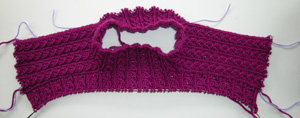
Knitting instructions can be so confusing.
After carefully examining the photos included with the pattern and working the first row on paper, I realized that I was on the wrong track when I thought the three end stitches should be knit stitches. I’m not sure why the author mentions, “Patt st is mirrored with 3 end sts …”. The stitch pattern works out just fine if started as listed in the stitch pattern section.
Actually most of the instructions seem to be quite clear. It is very helpful of author/publisher to include several photos pointing out the various sections of the sweater. It’s rare for a magazine pattern to have more than one photo for a pattern. INKnitter’s magazine seems to give more detailed instructions then the other knitting magazines.
 Purlwise
You must be logged in to post a comment.