Good light is hard to find

V-neck swatch 2I’ve been fretting all week about finding a another stitch pattern for the next project. My criteria was simple – something that would work well with a v-neck and be fairly easy to seam. Also, it couldn’t be something as easy as 2×2 rib unless it had a complicated center panel.

Have you ever noticed that most v-necks are done in either plain stockinette or a Fair Isle type design? That’s what I found after a few weeks of searching pattern books and the Internet. I’d say that the vast majority of hand knit pullovers have round neck collars.

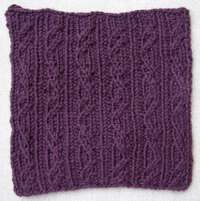
After flipping through my stitch guides countless times I finally came up with this. I broke apart the sections of twisted stitches with a single stockinette stitch, hoping this will make sewing the side seams easier. What I’ll do is start knitting with one stockinette stitch and end with two and seam it like 1×1 rib.

Sorry for the poor photo. This eggplant sport weight yarn is tough to photograph. In real life it’s even darker. These days it’s hard to find good light.


Warm and comfortable

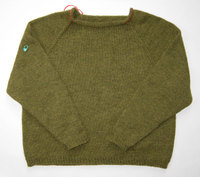
Top-down raglanIt’s fast becoming my favorite comfy sweater. Snow started falling shortly after this picture was taken. I stayed warm and comfortable all day long even when venturing outside.
Redoing the sleeves was a wise decision.

It hasn’t been blocked. Not sure that it really needs to be but I will do it before handing it off to Jean.

Loose ends

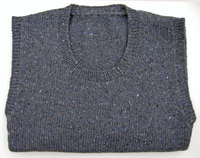
Vest done - folded

One down and 7 more to go.

A word of caution – Rowan Felted Tweed yarn makes 1×1 tubular bind off a tedious job since the tweedy bits and alpaca hair that have a tendency to cling while sewing. Whenever I wasn’t careful pulling the yarn from the darning needle through the first knit stitch it would inevitably stick to the near by purl stitch and leave an ugly blob. Practice make perfect, right? Here’s a closer view
after much practice.

Jean’s formula for picking up stitches is actually very simple and looks great. Strategically pickup one stitch for every row/stitch and then decrease 10% of the stitches on the next round. At least that’s my interpretation of the instructions. Also, I’m not sure if she mentioned this in class, but I noticed that her DVD mentions picking up stitches with a needle .5mm or 1.0mm smaller than the one used for the body. I used one that was 1.0mm smaller and didn’t switch to a larger size to finish the rib.

Kate asked about my supple rib swatch. It’s for one of my class sweaters yet to be created so I don’t have a pattern. In fact I might never create one because this stitch probably won’t work so well for my class project. I tried adding ribbing and it look odd. This stitch really doesn’t need any. I’d suggest checking out Jo Sharp’s Knitted Sweater Style for a V-neck and cardigan that use this stitch pattern. Also her first booklet has a pullover called Tundra that uses it as well.

V-neck swatch

V-neck swatchAt  the end of class last week Jean walked around the room  checking swatches for the next project, a V-neck  pullover. I didn’t have mine out so I off handedly mentioned, “oh, I’m doing stockinette again.” I can’t remember what her exact response was but I remember her firm encouragement to find a stitch pattern.
It’s not that I don’t want to do one, it’s just been difficult to pair one with 1×1 or 2×2 ribbing.

Here what I came up. It’s a stitch pattern from one of my Jo Sharp pattern books that she used on a V-neck  with no ribbing. I’ve seen it named supple rib in some books.

The yarn is Louet Gems in eggplant.

I’m crossing my fingers hoping I have enough.

Zoey asked about the ribbing on my green top-down pullover. Well, I’m sorry to say that I haven’t blocked it yet. In fact I’m considering redoing the sleeves yet again. Several other students had the same problem as I, the lower part of the arm is too tight. I did, however, show my ribbing to Jean and asked if there’s any way to avoid that flaring of the knit stitch. She had no handy tip on that but remarked that some yarns do that.

This weekend I blocked the vest and sewed the side seams. Shouldn’t be long before I finish the ribbing on the neck and armholes.

Madrona Fiber Arts Winter Retreat registration start tomorrow, 8am (PST) sharp!

Ready for class

Round-neck: backRound-neck: frontRound-neck: sleeve

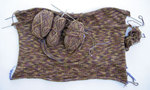
I finally finished the last round-neck pullover piece yesterday.

After finishing the first piece I started swearing that this will be the last time I ever knit a plain sweater on size 3mm needles. I guess I wasn’t thinking clearly when I chose this Panda Cotton sock yarn at the last minute during the “heat” of summer. At that time I couldn’t imagine working on a heavy wool sweater.

It’s not that I don’t like Panda Cotton – it makes a lovely fabric that drapes well. I just got so bored with knitting plain old stockinette. Also, I’m not too thrilled with this “feminine camouflage” colorway but was pleasantly surprised that the colors didn’t pool too badly.

Karen asked about my camera. It’s a Nikon Coolpix P4 with VR and 8 megapixels. VR stands for “vibration reduction” which means that it’s suppose to help reduce blurry photos. VR works most of the time but I was very disappointed recently when most of the photos taken at the Nordic Knitting Conference turned out blurry. Over all, it’s a good click and shoot pocket camera but the key to taking good photos is to make sure there is plenty of light and to use Photoshop for touch ups.

Homework progress

Raglan
Raglan: both sleeves doneIt’s almost done!

Only the neck is left to do. Not sure what we’ll do with it. Jean said to bring needles in a variety of sizes to the next class.

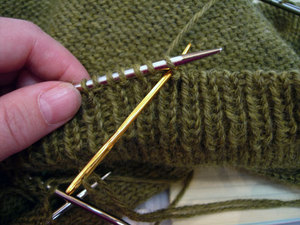
So far I’m satisfied with the results except for the 1×1 rib along the bottom edge of the body and sleeves. If you look closely (click on the photo) you can see how loose the stitches are. It looks sloppy even though I did use a smaller needle size.

I’m sure a 2×2 rib would look better but I really had no choice in the matter. On each sweater we’re learning specific finishing techniques and for this sweater one we needed to learned how to do an invisible bind off for 1×1 rib in the round.

I’m hoping it will look better after a little blocking or steaming.

Vest

Vest: front finished
Vest: back finished

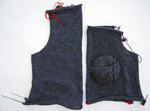
Here are my finished vest pieces (front and back) laying folded in half on top of their corresponding life-sized patterns.

Notice the grids drawn on each armhole and neck. We draw them using special rulers that correspond to our stitch/row count. Once the grid is drawn we determine the decrease steps and trace them out using a color pencil.

If you’d like to use a similar technique I’d suggest using this grid paper  from www.tata-tatao.to.

Round Neck pullover

Sophie checking my pattern

One of our assignments for the last class was to have both pieces (front and back) knitted to the armhole. For the class in two weeks were suppose to finished those pieces plus knit both sleeves.

Earlier this week Sophie decided to check my work. Good thing she did. Turns out I hadn’t cast on the correct amount of stitches! On top of that mistake, my attempt to shape the waist by going down a needles sized didn’t quite work for the way I drew the pattern. Unfortunately I’ve spent the past week redoing most of what I had done for the last class. With luck and diligence I should be able to finish the sleeves soon and then I’m free to work on any project I please. At this point I don’t dare let myself get tempted with other projects.

Lately I’ve been itching to spin. I’m sure these two would love a change of pace as well.

Mittens & Sophie

An odd sight

Sheep in woodsThis afternoon we took a short drive over to the east side of the mountains to look for chanterelle mushrooms and came across this ram standing near the side of a small dirt road, tied to a small tree. A couple of guys with an odd trailer were not far away talking to people in a car. I tried asking about it but didn’t get much of a response. I don’t think the guy spoke English. What an odd sight.

Thanks to everyone for all the info and suggestions concerning the herringbone stitch. I wish I had more time to sit down and figure it out but things got hectic this week. Besides getting a bit frantic with my Nihon Vogue homework, Mittens had to be taken to the vet after I discovered blood in her urine. She’s now on antibiotics for a bacterial infection. I hope I caught it soon enough so that it doesn’t get worse.

Raglan_one_sleeve_2It’s been two weeks since the last Nihon Vogue class and I’ve only managed to finish one sleeve on the raglan.
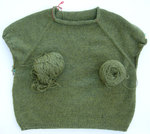
Just as I was about to finish both sleeves last week I happened to read over my notes and was horrified to find I had jotted down the underarm decreases incorrectly. After correcting my notes I ripped back to the underarm and I started the left sleeve for the second time.  It was going well until I reached the last row and realized I was off by one stitch. Darn it! I should have double checked the stitch count after picking up the armhole stitches. Not knowing the consequences of turning in a project that was off one stitch, I went ahead and ripped out the sleeve again. I’m now back on track and should have the right sleeve done in the next few days.


Three garments in progress

Nihon Vogue class

We just completed our third session and have three garments in
progress. I’m itching to complete at least one of these since it’s not in my nature to have so many going at once but alas I have to wait
until the next class.

Besides many other things, this weekend we tried memorizing an invisible bind off for 1×1 rib (in the round).

Invisible bind off

I just kept muttering my own mantra  …

– knitwise, pull stitch off , enter next knit stitch purlwise and pull through
– purl stitch purlwise, pull off and yarn through,  from back to front between knit and purl stitch, into purl stitch knitwise and pull yarn through
– repeat

… and before I knew it my ribbing was done.

Hopefully I’ll remember this when I get to the cuffs, if not I’ll pull out Jean’s DVD.

My projects aren’t much to look at –  just plain old stockinette stitch. The challenging part is drawing the patterns correctly, writing legible notes and doing the calculations correctly .

top downvestroundneck pullover

Pullover:
Cascade 200 heather
Vest: Rowan  Felted Tweed
Round-neck Pullover: Panda Cotton

Next garment will be V-neck pullover. Yarn and stitch pattern for that one is still up in the air.

Vest homework

Vest homework

It’s back to the homework – all in stockinette stitch and no color. Certainly  a big change from rainbow Kauni.

After double checking my body measurements, swatch gauge and pattern, I decided to do some re-drafting. As you can see I didn’t finish filling in the details before starting to knit. I’ll finish it later.

Sorry for the bad photo but this pattern is hard to photograph. The lines are drawn with a .3 drafting pencil and the light on my porch was not so good.

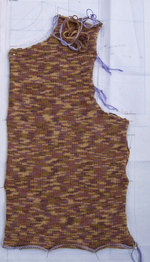
We were told to start off  with a provisional cast-on using a crochet chain made from red nylon waste string that Jean provided. I then proceeded to knit to the waist line, decreasing five stitches on each side. Once I reached the waist I knit straight (no increases or decreases) to the bust. This vest should fit comfortably around my large hips but also accommodate my proportionally smaller bust.

Buttonholes are a pain

extra stitch

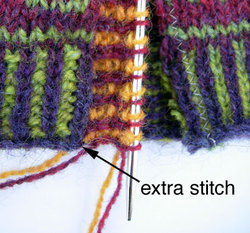
I ripped out what little of the button band that was started last week. I wanted a fresh start and a chance to try a new technique that I found while flipping through one of my Japanese knitting textbook s(page 49 – Beginner’s book).

Instead of picking up the first stitch from a row, it shows how to cast on an extra stitch by looping the yarn around the needle and then continuing to pick up stitches along the edge as normal. Before ending the row another extra loop stitch is cast on as the last stitch.

After applying this technique my button band has 121 stitches instead of 119 as previously mentioned.

My class notes from the Winter Retreat mention that adding an extra stitch at the start and end of a button band will help keep the ends of the band from pulling in. My first attempt doesn’t look so great but once I sew in the ends I think it will look better. I’m also considering crocheting a chain stitch to the bottom of the last row so it looks more like the rest of the bottom edge.

Besides reworking the partial button band, I did make several false attempts at starting the buttonhole row. None looked right. After taking a break I think I’ve hit upon a workable solution after reading (and re-reading) Medrith Glover’s Buttonhole for corrugated ribbing in Sweaters from Camp. It’s based on that buttonhole but tweeked a bit. Once it’s perfected I’ll let you see it.

Homework

topdown

Here’s one of two homework projects for my next class – a top-down raglan pullover.

It’s so simple.

The number of cast-on stitches are based on the circumference of the head minus 10% – 20%. Knit increases every other row until the front and back equal the circumference of the torso. Next we’ll put the sleeve stitches on hold and join the front and back before knitting to the waist.

Notice the red thread at the top? A provisional cast-on was used. Later we’ll add ribbing from those provisional stitches.