Close Out Yarn Purchase

I went back to Hilltop this weekend to pick up another ball of Jo Sharp DK in a lighter color for more swatching and came back with almost a sweaters worth of it. Hilltop has decided not to carry this yarn so they put it on sale for 30% off. I feel lucky to get that much of one color on sale.

josharpmiro2.jpg

Here’s a swatch of the embossed rib* stitch used to create Ripple in Knitted Sweater Style. Although I like the cut of the sweater, this stitch really doesn’t excite me.

ripple_swatch.jpg

*According to 365 Knitting Stitches a Year Perpetual Calendar (July 5th)


Right Sleeve Bound Off

td_right_sleeve.jpg
The right sleeve is done and I cut the cord. Hopefully there is no turning back now. I’m ready for a new project but need to redo the left sleeve to call this one done. I’m giving myself one more week because I will be taking a wheel spinning class the last two Tuesdays this month and won’t have time to futz around with it then.

Still Thinking About Jo Sharp

It turns out that Tundra isn’t the only Jo Sharp sweater featuring the Rib Texture Pattern mentioned in my previous post. I just checked out Knitted Sweater Style from the library and it has a v-neck pullover version with this stitch. Ripple also appears to have an interesting stitch pattern, although it’s hard to tell from the picture in the book.

I’ve flipped through Jo Sharp’s books at the yarn store so many times but wasn’t instantly compelled to knit anything from them. Now that I’m starting to take a second look, I admire many aspects of her designs and enjoyed knitting a swatch with her DK yarn.

Tundra / Rib Texture Pattern

I just happened to find myself in the vicinity of Hilltop Yarn yesterday so I just had to stop by since I haven’t been there for a while.

A few Jo Sharp sweater samples were on display. I was immediately drawn to the stitch pattern on a sweater called Tundra which is in her first book. She has given it the indistinct name of “rib texture pattern”. I haven’t come across it in any of the various stitch books so I don’t know if it has a common name.

tundra_rib_dark.jpg

Yarn: Jo Sharp DK Wool (KR review)

Color: 507 Miro

Needle Size: 6

Gauge: 4 inch square = 25sts and 30 rows

Stitch Pattern:

* = pattern repeat ( 3 stitches + 1)

Row 1: k1, *knit next stitch but leave it on the left needle instead of dropping it, bring yarn forward between needles and purl next two stitches on left needle, take yarn back between needle and knit next stitch*. Basically the second stitch is worked twice, first it is knit without dropping it from the left needle and then purled with the third stitch.

Row 2: purl each stitch if working flat or knit each stitch if working in the round.

Here’s a clearer picture worked up on the same needles in a lighter colored worsted weight yarn called Cascade 220.

Update: The 365 Knitting Stitches a Year Perpetual Calendar list this stitch as Supple Rib.

Upcoming Knitting Books

Did you know that Amazon lists knitting books that are scheduled to be published this year? When I’m curious to see what’s coming out I do a book search with “knitting” as the subject and then sort the results by publication date. All the new books are listed first. I keep hoping that one day I’ll see a revised edition of The Principles of Knitting on the list.

Open Twisted Rib

The stitch pattern on the top down pullover is called Open Twisted Rib which is a variation of one shown in The Harmony Guides 450 Knitting Stitches Volume 2, page 68.

open_twisted_rib2

I also found another version of this stitch pattern on KnittingFool.com. I can’t remember how I came across this web site but it looks quite useful.

Update: A few days ago, Nanette showed a pattern called Step Dance Socks that uses this stitch.

Shaped Cap Sleeves with Wrapped Short Rows

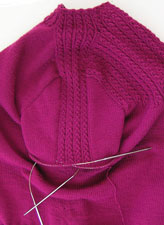
td_second_sleeve.jpg The second sleeve cap went much faster now that I understand how to work the short rows effectively. The wrapped stitches turned out much neater since the additional stitches helped minimize gaps. I still snugged up the picked up stitches once the cap was done.

As I mentioned in an earlier post, to create these sleeve caps I worked around the armhole in clockwise fashion picking up stitches starting at the top left side of the armhole (just after the shoulder strip), then placing the stitches from the underarm waste yarn onto the needle and finally picking up the stitches along the right edge of the armhole.

The “short” rows are started after working the patterned stitches on the shoulder strip plus knitting five stitches. At this point I wrapped the next stitch, turned to the purl side and worked across until five stitches after the strip and did another wrapped stitch. Rows are increased in this fashion until all but the underarm stitches are worked. I started working the sleeve in the round when the last stitches on the left and right were wrapped. I hid these last two wrapped stitches on the first row that was worked in the round.

It’s odd to call these wrapped “short” rows because in this instance the rows begin short and get longer as the picked up stitches are worked.

Why wrap the stitches? All the books I read said that wraps help keep the stitches tight otherwise gaps will form.

Want to see how to wrap stitches?

Continue reading

Here I go again

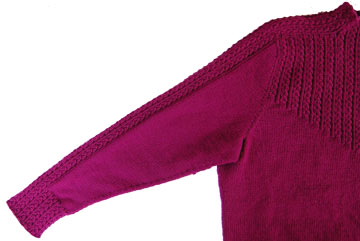
td_first_sleeve.jpg Here’s the lovely sleeve that I’ll be frogging sometime soon. Although I’m not thrilled with the idea ripping it out, I faced the fact that I won’t wear it if it doesn’t feel comfortable.

I had thoughts about forging ahead and hoping that the yarn will relax a bit once washed, at least that’s what the pattern says, but I just have a hunch that washing it won’t do the trick. Before I rip this sleeve out, I’m going to start on the other one but pick up stitches for one size larger. It’s only six more stitches so I think it should be ok.

Kate Buller’s Books

The Ultimate Knitter’s Guide by Kate Buller is actually a decent sweater (flat knitting) reference book once you get past the patterns and the split page design. Split page design? Yes, I’ve never seen a book like this. The bottom 1/4 of all the pages make up the reference section while the top 3/4 are patterns. The book lies flat so you can open it to the appropriate reference section while working on one of the patterns in the book. It’s a great concept except I only like a few of the patterns.

I wish the reference section were a small independent book because it is the best and most useful part of the book. It shows very clear step by step photographs of all the basic knitting techniques which is exactly what a book taught knitter needs. The descriptions accompanying the photos are quite detailed. For example, she accurately describes the best way to do short rows including how to pick up the wrap on the purl side. Many reference books don’t bother with such detail. I thrive on details.

  I also like the format of Buller’s other book Style Your Own Kids’ Knits. She lays out basic designs in various sizes and styles, and lets the reader mix and match the details. A stitch library is included at the back of the book which shows various intarsia motifs, edgings and lace patterns.

Bergere de France Catalog

A couple of weeks ago I was surfing the Bergere de France website which offers free patterns and found a lace cardigan (no. 466) that would be perfect for summer.

I surfed the web trying to find the yarn, Bergereine and could only find one place to get it in North America, Club Direct Laine in Québec. I promptly ordered their catalog (~ 10 USD) and received it last Friday.

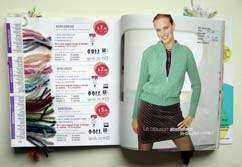
It’s a beautiful catalog with color cards of all the yarns. Here’s the page that shows Bergereine.

creations-inside.jpg

So now that I’ve seen BdF yarn what do I think of it? While all the yarn is eye-appealing, almost all of it contains lots of polymide and/or acrylic. My current project with Debbie Bliss Cashmerino (which has 33% microfiber) will probably be the last time I knit with microfiber. Isn’t microfiber just a trendy name for acrylic? I find that wool is much more forgiving and comfortable to wear.

Bergereine is the only pure natural fiber (50% wool / 50% cotton) yarn in the catalog so I’ll probably go ahead and make this sweater with it. Marie is currently working on a sweater made with Bergereine and finds it easy to work with.