Almost Done

It is finally coming together. Now I just need to fix all the yarn ends, sew on the knitted collar and then sew on the satin ribbon hook and eye tape. The yarn ends are going to be quite a job, which gets me thinking that perhaps I should have attempted to knit it in the round. Oh well, maybe next time.

phil_almostdone.jpg

As you can see, I had a little fun with Photoshop Elements today. I have almost as much fun with this program as I do knitting.

Starting Toe-up Socks

toeup.jpg I prefer to knit my socks starting at the toe with a figure-eight cast on. Wendy demonstrates this and two other toe-up sock cast ons in an excellent article for Knitty. While Wendy uses double point needles (DNP) in this article, I prefer to use one circular needle instead. I tend to do a majority of my knitting on the bus and found that DPNs are easy to loose while traveling.

I was first introduced to knitting socks with one circular and the figure eight cast on in a class given by Sarah Hauschka at Hilltop Yarns. Sarah inspired Bev Glaeskas to document both techniques in a booklet called The Magic Loop. I found a website with good photos of the magic loop method. It really isn’t too difficult and helps saves money if you already have a circular needle. I’ve also used this technique for other projects.

One thing to keep in mind when doing the figure eight cast on is that the yarn tail will be on the opposite side of the beginning of the round.

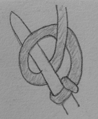
Sarah mentioned in the class that she does a make one increase a little differently from the ones described in the Magic Loop booklet. Instead of picking up a stitch from the bar between stitches, she just makes a backwards loop around the needle. After the class I experimented with backward loop increases and drew pictures to remind me which way the loops should appear on the right hand needle for each side of the toe.

Make One:
m1left.gif

m1right.gif

Paris & London Trip

Yesterday I purchased a ticket for a short trip to London and Paris this winter! Maybe it is good karma resulting from my Phildar yarn odyssey. I can’t wait to visit a Phildar yarn store in person. I’ve been so excited about the trip that my knitting has suffered a bit. I put the stripped sweater aside this week so that I can start designing my next Christmas stocking that incorporates the lighthouse pattern from Sweaterscapes. I’m going to combine it with a design from A Time to Knit Stockings. I’ll probably start the stocking this weekend and also try to finish sewing the stripped sweater.

Winter Interweave Knits Update (again):
I thought that the subscriber-only code was printed in all of the magazines. Well, today I made a trip to Barnes & Noble to look at guide books and happened to checked out their shipment of winter Interweave Knits. Their shipment of IK did not have the subscriber-only code. I guess Interweave printed two winter issues, one for subscribers and another for bookstores. Last weekend I just happened to come across a bookstore that got ones with the subscriber-only code.

Color

Simon Garfield: Mauve: How One Man Invented a Color That Changed the World
Mauve: How One Man Invented a Color That Changed the World.

Science history buffs and folks curious about how synthetic dyes entered the world might find this book interesting. Because of my long-standing interest in color theory and dyes, it caught my eye during one of my recent visits to The Weaving Works.

Before knitting dominated my needlecraft life, I dabbled in the quilting world. I really like the concept of quilting but seem to get stumped when I can’t find fabric that matches what I have in mind. Sometimes I’m looking for a certain design to fit a theme and other times I’m looking for a specific color. My constant quests for the perfect fabric eventually lead me to the world of dyes. While I haven’t been able to commit much time to developing my dyeing skills, I still dream about being able to find more time to pursue this interest.

This book is a biography of William Perkin who accidentally came across a way to produce dye from coal-tar. He was one of the first chemists (if not the first) to translate his new discovery into a very profitable market. The author believes that Perkins is directly responsible for the hugely profitable modern chemical industry. Companies such as DuPont, BASF, AGFA and Bayer all have roots in dye manufacturing.

Besides being a biography about Perkin, this book gives some brief tidbits about the modern textile industry. My favorite is about an observation by Don Vidler who is a sales director for a company that markets Tencel. Vidler noticed that while designers and color forecasters love to come up with new exciting color pallets each season, most adhere to a “New York uniform” of all black for their personal dress.

While the subject of the book caught my interest, I didn’t particularly like how the author organized the content. The first couple of chapters were confusing. He starts by talking about Perkin but then jumps to the modern world. Once I understood the author’s formula, I started enjoying the book more. I noticed that quite few of the reviewers on Amazon also had mixed feelings about this book. I would recommend it as mildly interesting reading for those interested in dyes and textiles, giving it three out of five stars.
Graph 53

Lizbeth Upitis: Latvian Mittens: Traditional Designs & Techniques
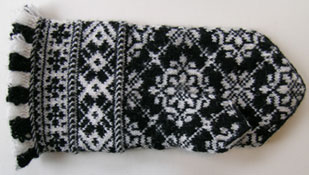
Pattern: Latvian Mittens by Lizbeth Upitis (graph 53)

Yarn: Satakieli from Wooly West

Needle: 2mm (two circular needles)

The second mitten is much easier then the first now that I’ve got the tension figured out. I started out picking up each color with the same hand but that made the mitten too large. Once I got to the main design I switched to the two handed approach with one color in each hand. This seems to produce a little tighter gauge and helps the project knit up faster.

lat_mitt2.jpg

lav_mitt.jpg

I started sewing the side and underarm seams on the Phildar cardigan but got stuck. It’s a about an inch or two bigger than I would have liked. I’m trying to think of what I can do to make it smaller. I’ll start with making the seam allowance a little bigger and see how that works.

Subscriber-Only, Not !

I just saw the winter issue of Interweave Knits at a local bookstore. Anyone can access the “subscriber-only” site; the code is printed on the second page of the magazine!

If I didn’t already subscribe I would have bought this issue. I especially like Marcel’s Sweater by Véronik Avery and Uptown Boot Socks by Jennifer L. Appleby. There’s also an article by Priscilla Gibson-Roberts, which describes a new intarsia in the round technique. I still think they should have put Annie Modesitt’s sweater in this issue. They could have bumped Three for the Road (simple hat, scarf and fingerless mitts), the Granny Square Pullover and Knitting Behind Bars. Maybe they are hoping to get some of those inmates to subscribe.

Sleeve Seam Continued …

stitch.jpg
The seam is worked in two steps starting from the top of the shoulder. Pull half of a piece of thread through to the right side of the sweater.

Take a stitch from the rows on the body of the sweater by catching the bars between stitches.

row_stitch.jpg

Then take a stitch from the sleeve by placing the needle under one knit stitch of the sleeve.

Repeat these steps until you reach the seam under the arm. Pick up the other half of the thread at the top of the sleeve and sew the other half of the seam.

supervisor.jpg

It helps to have a quality control inspector on hand.

I’m making progress on the Latvian mitten and will take photos this weekend.

Set in Sleeve Seam & Interweave Knits Update

armcap.jpg

One sleeve is now attached to the body of the sweater. Like always I looked at several books before doing this. I think “Knitter’s Book of Finishing Techniques” by Nancy Wiseman has the best description and diagram for this technique*.

This armhole is larger than the sleeve so I carefully pinned the two pieces before starting to sew the seam. I made sure to well-measured stitches, keeping in mind that I needed to fit the “large” armhole to the sleeve. Nancy’s book says that the proportion of sleeve stitches to shoulder rows is 3 to 4. I found that it was more like 2 to 4 on this sweater. Nancy’s book also mentions to start from the shoulder seam, which really works well. This makes it much easier to fit the armhole to the sleeve.

After subscribing to Interweave Knits last Saturday I asked Pam Allen if I could get the subscriber code for the new subscriber only section. She sent me one today and I just zipped through the web site a couple of minutes ago. There are quite a few free patterns (most from old issues), a sock and crochet column, an extensive illustrated glossary and “Beyond the Basics” columns.

*I don’t have Vogue Knitting.

Starting Assembly

collar_rib.jpg

pin.jpg

Saturday we went hunting for chanterelle mushrooms but could only find four. While the mushroom hunt wasn’t productive, my knitting was. I finished the sleeves and the collar ribbing for the striped cardigan. If my translation is correct, the pattern says to iron the collar before sewing it on to the sweater. I guess this might keep the stitches from unraveling but it could also melt this yarn. I started to iron the knit stitches and quickly remembered that the orange yarn is made of 50% acrylic. Luckily, I didn’t end up melting it.

The next step is to assemble the pieces by sewing on the sleeves and side seams, weaving in all the ends and then attaching the collar.

The next project will be a Christmas stocking for my mother-in-law. The pattern will be based on the lighthouse socks by Sweaterscapes but will tweak the pattern a bit. The lighthouse and landscape will be more like the one on the lighthouse sweater.