I need to forgo writing today.
Just returned from another two-day Nihon Vogue class session and my in-laws are in town.
I need to forgo writing today.
Just returned from another two-day Nihon Vogue class session and my in-laws are in town.
With all my homework finished last weekend, I was finally free to swatch Arabesque.
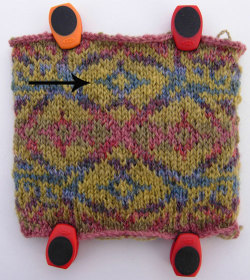
It’s hard to tell but there are actually three colors of green in the background; chartreuse, pistachio and marjoram. The arrow is pointing to a band of chartreuse. Pistachio is just below chartreuse and marjoram is in the center (with the pink).
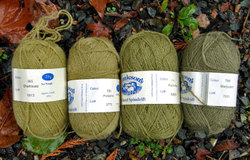
Here are the skeins laid out from light to dark (left to right) with two skeins of pistachio in the middle. The one on the left was purchased at the mill (and used in the swatch) while the other was purchased at a local yarn store. Can you see the difference between the two skeins of pistachio?
Ever since my problem with “Irish Moss” I’ve know that dye lots of the same color can vary significantly but I never stopped to think of the ramifications for a Fair Isle garment. These two skeins are so different that it’s hard for me to tell what pistachio should look like.
Karen was kind enough to indulge my curiosity this weekend and brought skeins from her stock for comparisons. It looks like my lighter skein of pistachio is similar to hers but my skein of chartreuse is a bit darker.
Gosh, this type of problem sure makes Fair Isle knitting even more tricky than I ever imagined. The right colors can be rather elusive.

Thanks for all your healing thoughts.
Turns out Mittens had bladder stones that had to be removed immediately.
Now she’s back from her four day stay at the vet.
Poor girl has to wear this collar for a couple of weeks and is now on a special diet (forever). I thought I was feeding her quality food but …
It’s a good thing we caught the problem when we did and she’s now on the mend.
Seems as if Sophie forgot she has a sister so I’m running around trying keep them both civil.
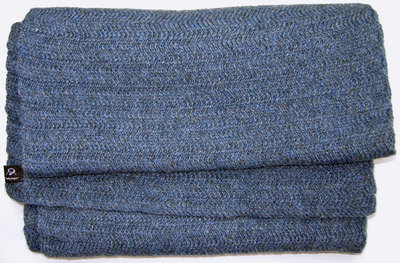
That herringbone stitch I came across while shopping at Ninian haunted me until I purchased this Racket scarf from them. It has the same pattern.
With a closer view you can perhaps make out the zig-zag traveling stockinette stitches. It looks the same on both sides so it’s some sort of interlocking double knit stitch. It’s still a mystery to me how this is done. I couldn’t find it in any stitch book and haven’t found time to decipher it. I’m pretty sure it’s machine made.
Check out the cute tag on the side.

While in Edinburgh we visited the National Museum of Scotland which had an excellent display of textile machinery and a small display of Fair Isle knits. Click on the photo to enter my photo gallery.
I’ve also included several photos taken outside Joyce Forsyth‘s shop. We happened across her shop while wandering the streets. Her garments are amazing.

Yes, I am still knitting. I just finished the knitting portion of my Nihon Vogue homework for the next class. We’re working on three garments; a top-down raglan, a round-neck vest and a round-neck pullover. All are in various stages. Unlike most of the other students, mine are in plain old stockinette stitch. Yes, it’s boring but it’s been a busy summer so keeping these first three garments simple has helped me keep my sanity. But, at this point I’m bored to tears and need to find a stitch pattern or colorwork for the next garment. a v-neck pullover with 1×1 rib.
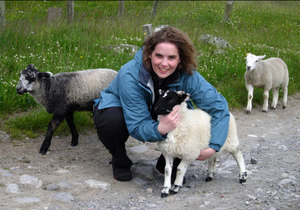
Just posted my photos taken during our visit to Leault Farm.
 Just two days after I got home from my trip to Shetland (now two weeks ago) my sister called and asked if she, her kids and my mother could come visit the following weekend. My nephew had qualified for a regional track meet in this area and wanted to drop by. That was last weekend. Last Sunday, I just barely found time to load the first days worth of pictures from our trip.
This week I was desperately finishing my homework for the Nihon Vogue classes with Jean. I was in good shape until Tuesday when I noticed that I had incorrectly redrawn my vest pattern. Wednesday I went to monthly guild meeting. Thursday I started drawing the vest pattern over one more time. I also started feeling a cold coming on. Friday I stayed up late knitting another swatch for class. Today and yesterday I’ve been in class all day.
The Sudafed has worn off and I’m wiped out.
I managed to load more photos of my Shetland trip this evening but that’s about all I can manage. Hopefully tomorrow I’ll have more energy to write.
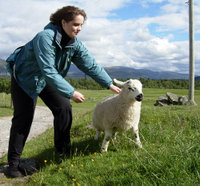
The above photo was taken in the Highlands at Leault Farm. I think this pet lamb was a bit suspicious of my motives.
Sorry for the long absence but I’ve been away on vacation in the UK. Each day was so packed with activities that I never got a chance find a computer. Yes, two whole weeks without logging on!
The first four days we drove around Mainland Shetland – checked out the
summer festival, visited knitwear studios, bought yarn, visited
museums, enjoyed the scenery and observed the wildlife. I didn’t want to
leave but we had already arranged to meet up with up with family in
Inverness. For the next few days we stayed at B&B near Beauly and we drove around the highlands of Scotland and visited museums, saw a sheep dog demonstration and soaked in more wonderful scenery. Then it was off to Edinburgh after dropping folks
off at the airport in Glasgow (two days after the attack). We spent three days in Edinburgh before heading on to London to see a Shakespeare play at the Globe and watch the start of
the Tour de France.
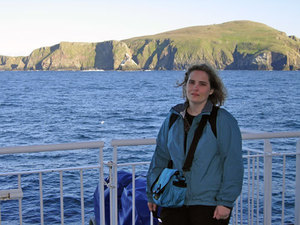
The photo was taken during our ferry ride from Lerwick to Aberdeen. It’s the closest that I got to Fair Isle.
I’m just now getting a chance to sort through my email and load photos. Stay tuned for more details.

A couple of weeks ago I was asked about Jean’s DVD and was embarrassed to admitted I hadn’t watched it even though I’ve had it since January. I finally finished watching it this past Saturday.
I first became aware of this 2 DVD set (and Jean) when she spoke at the
Seattle Knitter’s Guild meeting in February 2006. After her talk we were treated to a short preview of the first cast on segments. My initial reaction was that while I thought it was well maded, I didn’t particularly need to purchase a copy. I suspected that I was already familar with most of these techniques through various books I’ve accumulated, especially a couple of ones put out by Ondori (a Japanese publisher of knitting booklets). It was only after taking Jean’s class and hearing her mention that she has as a better way of doing a three-needle bind off that I decided to purchase it.
The each DVD starts with a menu that lists each category of techniques. You just select which one you’d like to view and all the techniques for that category are played. Some only show one specific technique while others show several similar methods. I immediately put in the second DVD and selected “joining shoulder seams”.
Just as Jean had mentioned, she does have a “new-to-me” method of joining shoulder seams with three needles that, unlike the old familiar three-needle bind off, doesn’t leave a noticeable ridge. Although I haven’t tried it yet, it looks like the perfect way to join shoulder seams that have been knitted in the same color. One thing to note is that it probably wouldn’t work for seams knitted with two colors on the same row. I’d love to describe the technique but I’ll leave that for Jean to teach you.
I continued to viewed some of the other techniques but soon found that I lost interest; not because the DVD wasn’t good but because it was a beautiful afternoon and there were other things I needed to get done. So, I guess I’m trying to say that while these DVDs will come in handy when I find myself in the midst of casting on a sweater, sewing seams or casting off a sock cuff I won’t be popping them into the DVD player as something I watch when there’s nothing good on TV.
While I think many of the techniques can be found in books (if you search), these DVDs would be especially useful for knitters that learn better through watching rather than reading. Each segment shows clear close-ups of the knitter’s hands as she steps through each technique. Some are narrated by a woman with a native Canadian or American accent while others only have classical music playing in the background. A small booklet is included that summarized each technique, gives very brief suggestions on usage of the technique, includes a diagram on joining yarns mid row and a picture illustrating pick up spots around the neck.
What’s missing is a discussion on the merits of one technique over another and any explanation of why these techniques work better than others. But with that being said, I wouldn’t let these be the only reasons for passing up these DVDs. I would recommend them for picky knitters that learn better through watching another knitter.
You can find a list of all the techniques that are included in the DVD on her website, www.knittingwithjean.com.
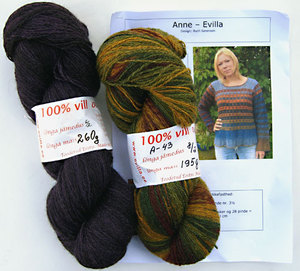
The long awaited yarn came yesterday!
It’s for another design by Ruth Sørensen and available from BendixGarn. This pattern is in Danish.
Included in my package was a skein
of varigated green single strand lace-weight Evilla yarn. It was part of a trade in exchange for Socks that Rock yarn. Thanks Vivian.
Natalja asked how I like the Kauni yarn.
Well, not only do I like the colors, I even like the feel of the knitted fabric. It’s a light and soft fabric the suits my taste, but that’s my opinion. I’m not quite so particular about how soft my wool is, especially if it’s used to make a cardigan or pullover that will be worn over a shirt.
One thing that I’ve noticed about Kauni is that it can get very thin in spots. I do wish it was more consistent in thickness.
Natalja, I’m sorry to hear that it’s hard to get some North American yarns over there. This last fall I was in Barcelona and stopped by Persones Llanas. They had Lorna’s Laces.
Evilla yarn doesn’t seem quite as soft as Kauni but maybe it will get softer once it’s been washed.
June mentioned Nancy Roberts’ dye technique. I saw her article in Spin Off and immediately though of Kauni. Now that I’ve had a chance to look more closely at Kauni, I’m not sure how well Nancy’s technique would work as a way to duplicate Kauni. She paints a knitted piece of fabric with dye. Wouldn’t that leave white spots if the the dye didn’t soak in well? Kauni, on the other hand, is probably spun from dyed wool. It’s as if the the subtle transitions from one color to the next flows so smoothly because of how the yarn is spun. These transition spots are like a marled/heathered yarn, similar to some Shetland yarns I’ve used. That’s why I mentioned that duplicating this yarn would be a good dye + spin + knit project.
 Purlwise
You must be logged in to post a comment.