Here are brief summaries of the three classes I took at this year’s Madrona Fiber Arts Winter Retreat.
Tailored Knitting the Japanese Way – Jean Wong
 I was first introduced to Jean’s work last year when she spoke at a Seattle Knitter’s Guild meeting the evening before the Winter Retreat. At this meeting she talked about what got her interested in knitting and she got involved with Nihon Vogue. She also brought many samples of items that either she or her students knitted. Each one was expertly tailored and every detail professionally executed. I instantly intrigued and was regretted not having signed up for her class. Luckily, Jean came back this year and her class on tailoring was expanded to two days.
Day One:
Each student was given two large sheets of engineering graph paper and a hand out listing each step in the process of creating a full sized diagram for a pullover sweater.
We started the day by working with a partner to record an extensive list of torso and arm measurements. Once the measurements were taken and recorded we preceded to follow along with Jean as she guided us in drawing our pattern pieces. It was kind of like doing one of those dot-to-dot drawings that kids do. Jean would tell us to draw a line and then mark each end with a letter. Our handouts listed the sequence of the lines so that we could follow along and also remember what we did afterward. As we added lines the drawing started looking more like a pattern.
 Towards the end of the day we worked on calculating increases/decreases for curved sections such as the neck, armholes and hips using a special gauge ruler to determine the number of stitches and rows in the area. With these numbers we calculated the number of decreases (or increases) and the number of rows between each. She had to explain it a few times before some of us were able to get it. Since it was the end of the day I think our heads were full of so much new information that it was getting difficult to do any kind of math. Nevertheless, Jean was very patient and willing to explain this calculation several times, explaining that it not easy to pick up the first time.
By the end of the day we had finished our front and back pattern pieces including calculations for all the curved spots.

Day Two:
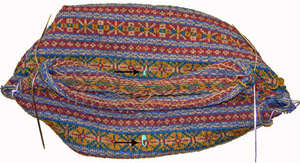
Jean reviewed calculating decreases and how to graph and outline the armhole and neck decreases before we started on the sleeve pattern. In the photo on the left she’s holding a student’s back side pattern and probably explaining the decreases around the armhole or the neck. Click on the photo to see a closer view. Notice the red outline denoting the decreases.
Next we started drawing the sleeve and did some calculations to determine if our sleeve pattern would fit the armhole of the front and back pattern drawn the previous day. It didn’t take nearly as long to draw the sleeve as the back and front so we spent the afternoon learning how to set in a sleeve.
 Jean demonstrated her technique of setting in sleeves by breaking us into small groups. Each group took turns gathering around while she walked through the process using a one of her student’s sweaters. She turned the sweater inside out and then put the sleeve through the armhole so that right sides were together and then carefully pinned the pieces together. Although you can use regular dress pins, Jean was using some bamboo ones that she got in Japan. They seemed to stay in better than steel dress pins. When the pieces were well pinned she used a crochet hook to sew the pieces together with a chain stitch.
This class fed the techie side of my knitting by helping me better understand the process of drafting a pattern. I suspect that many knitters would find it too technical for their tastes but I was pleasantly surprised how well the class was received. There seems to be enough interest that Madrona Fiber Arts might consider having Jean do a series of classes in the Seattle area.
Check out Naomi’s blog for more photos. We met at the registration table and sat at the same table during class. She also likes designs from that famous Scottish designer and is a member of Feral Knitters.
Here’s a link to Jean’s website: Knitting with Jean. I purchased a copy of her DVD from Acorn Street Shop while shopping at the fiber market. In class she mentioned a different way of doing a three-needle bind off that sounded very interesting. She said it’s on the DVD.
Dyeing for Socks – Judith MacKenzie McCuin
 It’s been a few years since I’ve take any classes on dyeing and have managed to avoid dyeing yarn since taking up knitting. You see, I have a sorted history with dyeing. I love the concept of it and taking classes but don’t seem to get motivated enough to do it on my own. I signed up for this class on a whim, knowing that Judith’s spinning classes are always an entertaining and perhaps it would motivate me to start dyeing my own yarn. Besides, I love colorful sock yarn.
Judith started out the class by explaining that the primary colors for dyeing protein fibers are magenta, yellow and cyan (the same three primary colors used for printing). Using transparent squares in all shades of these colors, she demonstrated how one could “mix” these colors to create other colors such as green, purple, red and etc. While mixing colors she talked about how most people don’t really see the full spectrum of colors. She was going to teach us how to experience the full spectrum.
After the brief talk about mixing dyes Judith demonstrated how to dye a skein of sock yarn. First she prepared three containers of the primary colors by mixing water, dye powder and vinegar. Then she laid out a piece of plastic wrap and placed a skein of white wool that had been soaked for a few minutes in water.  Next she dipped a brush into one of the dyes and started dapping it on the wool to create a small spots of color. She cleaned the brush with water when switching between colors. Sometimes she painted another color on top of an already dyed spot and created a whole other color.
Once the skein was totally covered with dye and no white spots showed she carefully wrapped the skein with the plastic wrap, rolled it into a puck shape and put it in an unsealed plastic bag. This bundle was then ready to pop into the microwave for 7 or 8 minutes to set the dye. The bundle was taken from the microwave and left to sit until it cooled to room temperature before unpacking it to rinse in clean water.
After her short demo it was our turn. Judith pulled out white skeins of wool for us to start dyeing. While we started soaking the wool Judith walked around the room filling our containers with dye. With 20 or so students it took quite some time for her to get all three containers for each student filled.
 Finished skeins were put in a line for the microwave. This line quickly grew as students kept dyeing more and more skeins. I think some dyed up to five skeins. While we were painting skeins Judith was pretty much occupied with keeping the microwave going and mixing dyes. She didn’t get much of a chance to circulate around and help us with mixing new colors.
While I did have fun with the three skeins I dyed (with only primary colors), it seemed like the class got a bit chaotic and we were left to fend for ourselves. This class would have gone much smoother if Judith had a couple of helpers to operate the microwave and mix dyes.
And although this wasn’t of the most organized classes I’ve taken, I did get a small taste of the almost unlimited possibilities of these dyes and ended up purchasing one of her kits from The Artful Ewe.
Spinning Scottish Wools – Carol Rhoades
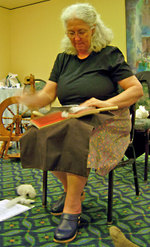
And now for something totally different.
I can’t believe it’s been over six months since I’ve spun. In fact, as I was setting up my wheel I noticed the wool on my bobbin was from a classes I took from Carol last summer.
Time flies when you’re knitting Fair Isle type sweaters.
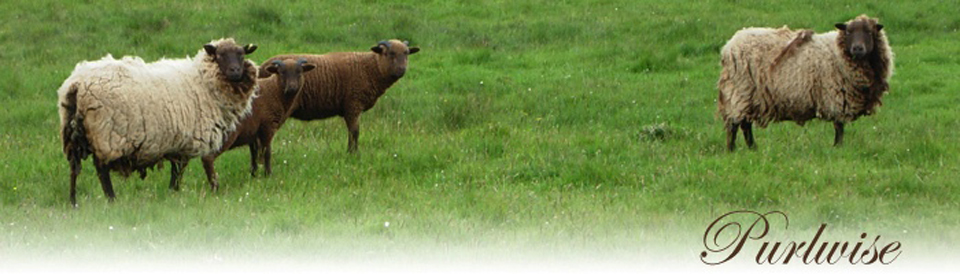
Since I’ve been mostly knitting with Scottish wools I thought it would be a great opportunity to learn more about the various kinds. This class covered three; Scottish Blackface, Cheviot and Shetland. I was mostly interested in learning more about Shetland which she saved for last.
We started off with Blackface. She gave us a couple of samples, one with lambs wool and the other from an adult, with which to experiment. This wool has a very long and strong staple that’s great for rugs, carpets and perhaps upholstery. Maybe because I don’t weave, I found it difficult have much enthusiasm for spinning this wool and was anxious to move to another kind but we ended up spending the whole morning just one this one type.
After lunch we started working with Cheviot which I found a bit more interesting. The staple length is shorter than Blackface and a bit softer. It’s great for making woolen yarns so Carol demonstrated how to card this wool. Every time I see her card wool I’m amazed. If you’re interested she wrote a very helpful article called “Handcarding with a Light Touch” which includes many photos of the whole process. It’s in the Fall 2001 issue of Spin Off.
With only 45 minutes of class left we finally got to work with Shetland wool. She gave us some samples of the various J&S yarns and asked us to try to duplicate one of them. I tried my best to spin a jumper weight yarn but found it tricky especially since I’m not that good at carding. I really wish we had more than 45 minutes to spend with the Shetland. Eventually I hope to spin my own jumper weight wool for a Fair Isle sweater.
I guess she left Shetland for last because if we had spun it first, we might not have had much interest in working with the other wools.







 Purlwise

You must be logged in to post a comment.