Wrapped Short Row Woes

Actually, I should call them long rows because I’m increasing one stitch each row.

Despite being very careful, I’m still getting sloppy wrapped short rows and I’m blaming it on the yarn. It just seems to stretch too much, especially the picked up stitches. I’m getting around the problem by snugging up the picked up stitches one at a time and letting the slack out at the end where I started the pick up. That’s why the stitches on the top half of the cap look ok.
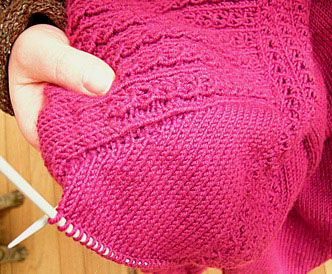
shortrowprob.jpg

While continuing my research on short rows I found that Priscilla Gibson-Roberts describes two methods for knitting shaped-cap sleeves in Knitting in the Old Way. One method is what I’m doing now, except she doesn’t do a wrapped stitch at the end of every row. The other method involves picking up stitches as you go along and not wrapping the slipped stitch. Perhaps I should have done the latter method in order to snugged up the stitches as I work. Oh well, too late now. I’m not starting over one more time.

t_photo_op.jpg

Notice the little paws in the bottom left of the photo? Well, somebody was just dying to get in a snuggle and snag the stitches. Look at his back paw.
Researching Wrapped Short Rows

I was getting so tired of the never-ending bottom rib of the top-down pullover that I was really tempted to leave it for later and start the sleeves. They seemed so much more intriguing.

Despite the temptation to jump ahead, I finished the ribbing but left the bind off for later. I’m still not sure about the length so I’ll leave that decision for later.

For the past two days I started and ripped out the sleeve three times. So while the sleeve is definitely intriguing it has been a bit more challenging then anticipated.

These set-in sleeves use wrapped short rows to shape the sleeve cap. To start off, a row of stitches are picked up around the whole armhole from the bottom front. Next, markers are place at the top of the cap to mark off where the short rows will be worked (one on the left top and another on the right top). The short rows are then worked between the markers, back and forth from the top of the cap to the bottom

of the armhole. Once at the armhole the sleeve continues to be knit in the round until the cuff.

This all seems easy enough, except that the wrapped short rows on the front are looking pretty sloppy and large. There are a combination of demons that are causing me grief. At this point the sweater is starting to get heavy to move around, the stitches seem to get stretched out by the long tips of the circular needles, and the yarn has a tendency to stretch if worked too many times.

So for the past few days I’ve been researching wrapped short rows and search my grandmother’s needle collection for a circular with smaller tips. I’ll make another attempt tomorrow.

I think the best reference for short rows is in “Knitter’s Book of Finishing Techniques” by Nancie Wiseman. I found the following online references, which are ok but not quite so detailed.

DnT, Inc.

Sweaterscapes

By the way, I’m glad to see that Krista Jo of KnitWit is blogging again.

Try On

tryon.jpg I’ve been diligently working on the bottom rib but keep making the same decrease mistake, argh! Definitely time to put the needles down and do something else.

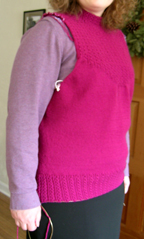
Here’s a quick snap shot of me trying it on. It seems a little tight at the hips even though I did do four extra increases just before starting the rib. I’m hoping that the tension will relax a bit (as noted in the pattern) once I wash it.

girl_knitting.jpg Knitting the torso of the top-down pullover seems to take so long now that I’m working the bottom rib. I just spent 15 minutes ripping out a row because I forgot to do a decrease. This is definitely one of the biggest disadvantages of knitting in the round.

This picture is from the Library of Congress, Prints and Photographs Division [reproduction number LC-USZ62-126794]. I came across this web site after doing a google image search on knitting.

Round or Flat ?

I’ve picked up the top down pullover project this week. I placed it on hold while I considered whether the bottom part of the body was going to be wide enough. circular.jpg I finally came up with a silly idea on how to test the width. Since this sweater has a slight hourglass body (width is same at the under arm and lower torso), I tried on the sweater upside down. I did feel quite silly doing this but, … oh well.


When I first started this sweater I suspected that I might prefer to knit sweaters in the round. At this point, I find that each method has advantages and disadvantages, the decision of which to use depends on the pattern.

Flat Round
can hide yarn ends in seams yarn ends might be more obvious
easier for intarsia easier for Fair Isle
easily match stripes around body stripes and patterns can jog
less area to rip out when errors more area to rip out when errors
seams might add bulk no or few bulky seams
must take care that rows match between pieces might involve steeks or some flat knitting
many seams to sew few seams to sews
harder to fit during construction can try on during construction
more armhole shaping possibilities limited armhole shaping possibilities

Seattle Yarn Stores

Not only does Seattle have the Space Needle, it also has six yarn stores within its city limits. Truly a yarn paradise compared to London or Paris.

weavingworks.jpg I spend most of my yarn shopping time and money at The Weaving Works since I’m usually drawn to their excellent selection of textile books, which almost always includes the very latest knitting titles. They have a good selection of all types of yarns, from traditional Shetland to trendy eyelash and it’s the only place in town that carries Koigu. If you are looking for spinning supplies, then this is the place to go. I plan on taking their beginning wheel spinning class in March.

hilltop.jpg My other favorite yarn store is Hilltop Yarn. Although, they have a much smaller selection of yarn and books, the staff is very friendly and helpful. Just beware that it is a very popular place in a very trendy neighborhood so it can get quite busy on the weekends. It’s a very cozy, but comfortable place to take classes.

If I can’t find what I’m looking for at these two stores then I visit the following stores.

Acorn Street Shop

Yarn Gallery

Full Circle

More on La Droguerie in Paris

tweed.jpg

Here’s a photo of the tweed that I bought while shopping at La Droguerie. A beautiful swatch was displayed along with the hanks, which showed how this yarn looks when knitted with two strands in graduating shades. I would have loved to buy more to make a sweater based on the swatch but didn’t have time to contemplate yardage since I was feeling a little guilty about making my husband wait while I browsed.

alpaca.jpg
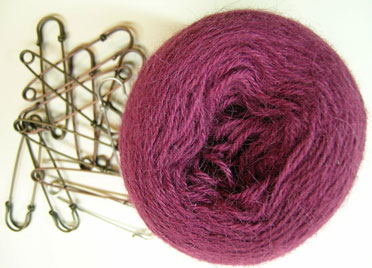
I also purchased this alpaca and some funky pins. Hopefully there is enough to knit gloves or a scarf. Too bad I didn’t buy more. Just this weekend I found the perfect sweater for this alpaca. It’s in a new book called A Garden Stroll by Lori Ihnen (she’s wearing it in the photo on the publisher’s website). If you like Poetry in Stitches by Solveig Hisdal then you might like this book. Don’t judge it by the sweaters on the publisher’s web site, they aren’t the best ones in the book.

To tell you the truth, I’m not a good yarn stash shopper. I usually find yarn perplexing when I don’t have a specific pattern in mind and I didn’t bring any sweater ideas with me to Paris. Actually I do find it much easier to buy yarn then actually knitting a sweater. Lately I’ve been stalling on my current sweater project since I still need to calculate additional increases around the waist.

More Future Prospects

Thursday during my lunch break I dropped by a bookstore to check out the latest issue of Piecework and noticed that the winter issue of Vogue Knitting is out. While flipping through VK, I came across a sweater called Frosty Flakes that features the same stranded pattern as the Latvian mittens that I just completed. I like how a portion of the bottom part of the body and sleeves has the stranded pattern with a dark background then switches to a light background.

While browsing the internet this afternoon I came across yet another sweater to put in my Future Prospects file. It’s called Gilet Lace by Beregere de France I love how the lace pattern on the sleeves is also on the shoulder.

V&A Stocking

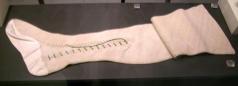
My first sight seeing stop in London was the Victoria & Albert Museum . While strolling around the British Galleries, I came across these stockings with an interesting description.
mans_sock

Man’s Linen Stocking 1660 – 1670

Stockings made from wool or linen, cut on the bias

(diagonally to the weave) to allow stretch were known

as ‘cut hose’. Lacing at the ankle gave a tight fit.

Plain hose like this could be worn under a more expensive

silk stocking to create a smooth line over hairy legs.

Shepherd’s Lace Sock

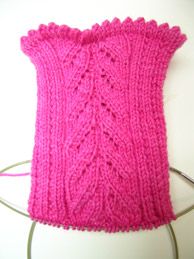
sl_front.jpg Although I like to work socks toe-up, this time I started from the top to get a neatly finished picot cuff. This cuff was started by doing an provisional cast on with a crochet chain. When it was the correct length, I folded it over and secured the top edge by knitting each stitch from the provisional cast on edge with a stitch from the bottom edge, forming a small tube. I then continued knitting the leg. The ribbing is just a K2, P1 rib except odd rows are all knit stitches (row 1: K2, P1 – row 2: knit all stitches).

Yarn Stores in Paris & London

letour.jpg

My remedy for jet lag is four shots of espresso in the morning and then a good night’s sleep.

I was so busy sight seeing that I only managed to knit during the three-hour train ride from London to Paris. I’m still a little peeved at British Airways for not allowing knitting needles in the cabin of their aircraft. I could have finished a pair of socks during each nine hour flight. It’s odd that the TSA allows them but not BA. Although I could have attempted to bring them on in my carry on bag, I decide it wasn’t worth the potential hassle.

While in London I stopped into John Lewis and Liberty department stores to check out their yarn stock. Liberty has a small stock of Rowan yarns and patterns. Not really worth the trip since I can get Rowan yarn here. John Lewis has a better selection of various brands but still very unsatisfying compared to any one of my five local yarn stores.

While in Paris I quickly popped into La Samaritaine, Le Bon Marche and La Droguerie. La Samaritaine has a small yarn section (about the same size as Liberty’s) tucked into a corner on the top floor that only includes Phildar yarn. Le Bon Marche’s yarn section (also tucked into a corner on the top floor) is three times bigger than La Samaritaine’s. They carry Rowan, Phildar and Bouton D’ Or.

I was most impressed with La Droguerie. They have a small selection of yarn but I love how it is displayed. Hanks are hung on the wall by yarn type in a rainbow fashion. The picture below gives you a small hint of the display. There is more yarn hanging on the opposite wall to the left.

ladroguerie.jpgI don’t know who makes their yarn but it appears to be of good quality natural fibers such as wool, alpaca, cotton, silk and etc. I purchased several hanks of tweed wool and a ball of alpaca.

Besides yarn, they also carry a dizzying array of buttons, ribbons and beads. Most shoppers seemed to be more interested in these items. I picked up some cool old looking safety pins that can be used as a closure for a shawl or wrap type sweater.