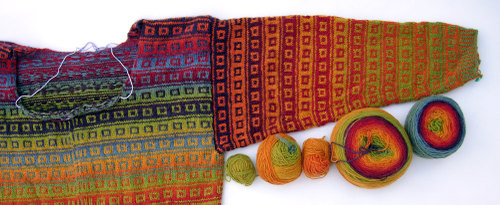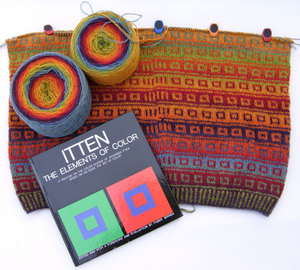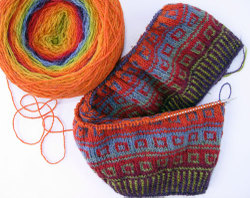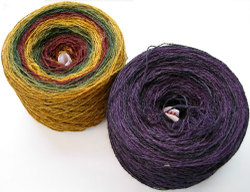
Cuffs are done

Cuffs_2

Thanks for all the encouragement and kind words.

The sleeves will stay as they are.

This week I took a short break to give myself time to think about the sleeves.  At this point I don’t have time to redo anything especially since Jean Wong’s class will be starting in two weeks. Besides, I really do like how it looks.

Collar_startNow it’s onto the collar.

As you can see I’ve only cut the front and back neck steeks and not the one down the center front. There’s a good reason for this.

The other day I was flipping through Feitelson’s book and started reading the Hillswick Lumber pattern because like the Kauni cardigan it has a round neck. This pattern describes how to knit the collar in the round by leaving the center front steek stitches on the needle. What a great idea!

So before I could start knitting the collar (in the round) I had to carefully undo the previously bound off steek stitches and put them on the needle with the other stitches that were on hold.

I started picking up stitches yesterday but then had doubts about the total number of stitches mentioned in the pattern. To get a total of 119 stitches I would have to pick up a stitch every other row on each side of the neck (between the front and back). I seem to remember hearing that stitches picked up along rows should be done at a rate of 3 stitches out of every four rows. PGR’s book (Knitting in the Old Way) says to pick up 2 stitches out of every 3 rounds (rows) for ribbing. If I followed PGR, then I would need a total of ~142 stitches. I’m once again at a point where I need to mull over the situation before proceeding. Not sure what I’ll do.

AngelDuring my short break from the cardigan I started working on Evelyn Clark’s Angel Lace Shawl. It looks like a big blob now but wait until it’s finished. It’s so easy to work away on this that I almost forget that I need to finish the cardigan. For me, Evelyn’s patterns are worry free. At least there are no concerns about fit.

Right arm doesn’t match the left

Right arm & almost done

The right arm  is almost finished despite not knitting for a few days while recovering from an awful cold.

I don’t get very many unsolicited comments about items in progress from my husband but yesterday he asked if the arms of this sweater are suppose to be so different. Befuddled and not sure how to respond, I think I answered, “Why does it look odd?” He responded, “One of the sleeves has more orange than the other.”

Unlike the body, I didn’t think much about how the colors combinations on the sleeves would turn out. I just started the left sleeve with yarn from where I left off with the shoulders. Of course his comment started to haunt me and I soon started jotting down possible color combinations with the yarn left after doing the body (assuming I hadn’t started the sleeves).

The follow questions and responses came to mind.

  • Can I knit both the sleeves with the same color combos?
    Nope, there’s not enough yarn with those colors.
  • Should I start with new color combos, like purple and yellow?
    Maybe, but I don’t think I want to take that route.
  • Is there a way to either lessen the orange or balance each sleeve with a bit of orange?
    This could be possible.

So as I consider my options I’m finishing the right sleeve and will possibly reknitting the left one so that there will be less orange in that one.

Responses to questions

Karen asked about teaching my niece to knit and her reaction to the yarn/toy store.

Teaching her went quite well considering she’s six years old. Her mother and father were amazed to see her sit and concentrate on one thing for a couple of hours. I casted on the stitches, showed her the movements a few times and then gave her the needles. At first I guided her hands but it wasn’t long before she was knitting by herself. I don’t think this was the first time she had done this because she mentioned that her friend has knitted with her before.

I’m not sure whether she’ll keep it up because the next day she didn’t ask about doing it again. I think six might be a little young to start.

I also forgot to mention that we drove to the Frio in a different car so she wasn’t with me when I bought the yarn and needles. That’s probably a good thing. Not sure what would have happened if we took the two children into that shop. Actually it was lunch time and Grandpa was really hungry so it was a very quick stop. The guy ringing up my purchases suggested a great BBQ joint a few blocks down at the junction of highway 46 and 87. It’s a combo meat market, BBQ restaurant and Shell gas station called Riverside Supermarket! We ate our lunch at one of the tables between the produce and meat case and enjoyed watching the locals line up to place orders. The sliced beef sandwich was so excellent taht we stopped by again on the way back to Austin.

Deborah asked, “How would you compare the length of color change in Kauni with, say, Noro Kureyon or Silk Garden?”

Kauni color changes are much longer than Kureyon or Silk Garden. I don’t know how much longer because I haven’t yet attempted to measure one of the colors in my skein. I’d guess at the length but I don’t think I’d be very accurate. Since the colors gradually change from one to the next, it would be hard figure out where one colors begins and ends.

Frio river outing

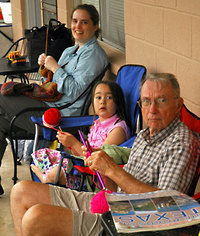
Knitting by the Frio riverLast weekend was the family outing to the Frio river. The weather was mostly overcast with light rain. That’s OK because even though the sun wasn’t out, it was about 10 – 15 degrees warmer than the previous week back home. With the weather being a bit cooler than anticipated I was able to continue working on the cardigan and even finished the left arm.
Just as I arrived I found out that my niece was ready to try knitting and wanted me to teach her. On the way from Austin to the Frio we kept an eye out for a yarn store and were lucky to find Ewe & Eye along the way. It’s a nice little store that’s also has a rather large toy section.

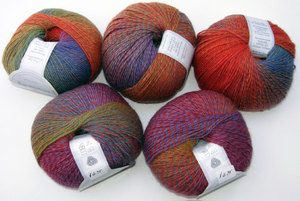
Jojoland Melody

While I was there to quickly grab some needles and yarn for a beginner I couldn’t help but take a quick look at all the yarn. This Jojoland Melody popped out at me. It’s a variegated yarn in rainbow colors similar to Kauni. While the colors are similar, I’m not sure how long the color changes are. Also this yarn is plied with three different colored strands that  form a noticeable barber pool affect. Not sure how it would look knitted up or if it would work as a replacement for Kauni.

Left arm

So, here’s what I got done. Please ignore the wrinkles. It was rolled and stuffed into my carry on bag.

I’m not so sure I like all that orange and green towards the bottom half of the sleeve but I’ll leave it for now.

I wasn’t sure about the sleeve length so I cut the extra stitches on the front and back neck to make it easier to try on the cardigan.

As you can see I lined up all the yarn that’s left – 240 grams worth. That’s what’s left of the 520 grams I had when I started. Not sure if I mentioned this but I’m making the medium sized one with the body shortened a few centimeters. Should be plenty to finish the other sleeve and the rest of the ribbing.

knitting with jean

Knittin g with Jean

A couple of weeks ago I was asked about Jean’s DVD and was embarrassed to admitted I hadn’t watched it even though I’ve had it since January. I finally finished watching it this past Saturday.

I first became aware of this 2 DVD set (and Jean) when she spoke at the
Seattle Knitter’s Guild meeting in February 2006. After her talk we were treated to a short preview of the first cast on segments. My initial reaction was that while I thought it was well maded, I didn’t particularly need to purchase a copy. I suspected that I was already familar with most of these techniques through various books I’ve accumulated, especially a couple of ones put out by Ondori (a Japanese publisher of knitting booklets). It was only after taking Jean’s class and hearing her mention that she has as a better way of doing a three-needle bind off that I decided to purchase it.

The each DVD starts with a menu that lists each category of techniques. You just select which one you’d like to view and all the techniques for that category are played. Some only show one specific technique while others show several similar methods. I immediately put in the second DVD and selected “joining shoulder seams”.

Just as Jean had mentioned, she does have a “new-to-me” method of joining shoulder seams with three needles that, unlike the old familiar three-needle bind off, doesn’t leave a noticeable ridge. Although I haven’t tried it yet, it looks like the perfect way to join shoulder seams that have been knitted in the same color. One thing to note is that it probably wouldn’t work for seams knitted with two colors on the same row. I’d love to describe the technique but I’ll leave that for Jean to teach you.

I continued to viewed some of the other techniques but soon found that I lost interest; not because the DVD wasn’t good but because it was a beautiful afternoon and there were other things I needed to get done. So, I guess I’m trying to say that while these DVDs will come in handy when I find myself in the midst of casting on a sweater, sewing seams or casting off  a sock cuff I won’t be popping them into the DVD player as something I watch when there’s nothing good on TV.

While I think many of the techniques can be found in books (if you search), these DVDs would be especially useful for knitters that learn better through watching rather than reading. Each segment shows clear close-ups of the knitter’s hands as she steps through each technique. Some are narrated by a woman with a native Canadian or American accent while others only have classical music playing in the background. A small booklet is included that summarized each technique, gives very brief suggestions on usage of the technique, includes a diagram on joining yarns mid row and a picture illustrating pick up spots around the neck.

What’s missing is a discussion on the merits of one technique over another and any explanation of why these techniques work better than others. But with that being said, I wouldn’t let these be the only reasons for passing up these DVDs. I would recommend them for picky knitters that learn better through watching another knitter.

You can find a list of all the techniques that are included in the DVD on her website, www.knittingwithjean.com.

Mystery yarn & picking up stitches

One of the next steps after finishing the body of the cardigan is to use a sewing machine to sew two lines zig-zag stitches on either side of the middle stitch of each steek.

Use my sewing machine?

Can’t remember the last time it’s been used. Considering the pile of stuff that’s accumulated around it, I’m sure it hasn’t been used for a couple of years – maybe even since I took up knitting in earnest. Instead of clearing my sewing area, I started spinning and got so caught up that I didn’t stop until I filled two bobbins.

Woolgatherings - Corriedale

It’s that roving I pulled out of storage last month. It was purchased from Woolgatherings at the Black Sheep Gathering a few years ago. I love the colors but have been too intimidated  to dive right in. Handling the colorful Kuani yarn has inspired me to give it a try. I’m hoping that splitting the roving lengthwise – one piece for each bobbin – will work out OK.

Zig zag stitchesMid-week my sewing machine emerged from the clutter and I managed to sew the zig-zag stitches as the pattern mentions. I’m not sure if this is necessary. My past two FI patterns didn’t mention doing this, but I though I’d give it a try. Kauni doesn’t seem to be as “sticky” as the VY wool I used for the Firebirds cardigan and the Roscalie vest so it’s probably a good idea.

After sewing the zig-zag stitches on each section of extra stitches (front, back and armholes), I grafted the shoulders together with a piece of orange yarn.

Begin left arm

Next, I cut the extra stitches (steek) on the upper left side before picking up stitches for the left sleeve.

This time I came up with a quirky calculation to figure out how to pick up the stitches evenly.

1. Measure the row gauge from the start of the armhole to the shoulder. Turns out I’m getting 8.5 rounds per inch.

2. Since 8.5 is a fraction I doubled it to get 17. That is, 17 rows for every two inches.

3. The stitch gauge is 6 stitches to the inch so I doubled that to get 12 stitches for every two inches.

4. From the last two steps I now know my pick up rate – 12 stitches within every 17 rows.

5. After sifting through several number combinations to find a pattern that will match my rate of 12 stitches in 17 rows, I settled on the following.

Following the rows on the body, *pick up 2 sts in every row, skip 1 row, pick up 3 sts in every row, skip 1 row, pick up 2 sts in every row, skip 1 row, pick up 3 sts in every row, skip 1 row, pick up 2 sts in every row, skip 1 row*. Repeat from * to * until 114 stitches have been picked up around the armhole

By the way, there’s another online shop that will ship Kauni to North America. It’s Astrid’s Dutch Obessions and the website is in English. I haven’t ordered from her before so I can’t vouch for the service but I have seen her postings on Knitter’s Review under “Sales and Shop News”. I’m glad that there’s one more source out there for us on the other side of the pond.

Sorry that I have no review of Jean’s DVD. I finished watching it this weekend and started a post but couldn’t get back to the computer tonight to finish it. I should have it ready Wednesday.


Answers to comments:

Frances, I don’t consider myself a fast knitter, especially since I’m quick to rip out anything I don’t like. I might seem fast because I tend to work on one thing at a time and try to fit it into my schedule whenever possible.

KarenJo, I haven’t taken Peg McNair’s class but it sounds interesting. I’ll have to check into that. Thanks.

Working front neckline

body done

Confused about how to work the decreases and extra stitches near the front neckline? Here’s what I did.

Work until knitting measures one row short of 44-48-52 cm.

First Round: Assuming that the beginning of the round starts at the middle of the extra stitches (steeks) on the front; bind off the left half of the extra stitches on the front and continue following the pattern as set until the last half of the extra stitches. Bind off those stitches. Once this round is finished all extra stitches at the front have been bound off. Break working yarns.

Second Round: Place first 15-17-17 stitches on holder. Cast on six extra stitches (first half of extra stitches) alternating colors as needed. Now following the pattern as set continue knitting until 15-17-17 pattern stitches remain in this round. Place these stitches on a holder. Cast on seven extra stitches (remaining extra stitches) alternating colors as needed. There are now seven extra stitches on the right needle and six on the left.

Next Round: Knit the first six extra stitches as set. Next, knit the first two pattern stitches together  (k2tog). Continue knitting the round, following the pattern as set until two pattern stitches remain. With these two stitches work a SSK decrease. Now knit the last seven extra stitches as set.

Following rounds: Continue working decreases every other round, until a total of 7 stitches have been decreased on each side of the extra stitches.

Neckline

Sorry I didn’t have time to finish watching Jean’s DVD this week so, no review as promised. Maybe I’ll find time to work on it this coming week.

Squares

Kauni body

I kept thinking I’ve seen these squares before. It finally hit me. They’re on the  cover of a book about color theory. It’s been a while since I’ve looked at the book so I can’t quite remember what it’s all about – probably color relationships.

It’s been a quick knit once I stopped trying to control the colors. Just started the extra stitches for the armholes.

Good thing it’s going quickly because I need to move on to Anne-Evilla so I can finish that by the end of May. Looks like the certificate course with Jean Wong is a go. It starts the first weekend in June and from then until next year it promises to keep me quite busy. I look forward to meeting up with knitter’s I know from Madrona’s winter retreat.

Color combinations

Start againI did start over again.

I tried to get the green/purple to stop at the end of the ribbing but didn’t quite make it. The purple spills over into the red section. That’s the charm of this sweater; seeing the colors morph from one to the next.

Doesn’t it look much darker this time?

Yet again I started fretting about the color combinations. To satisfy my curiosity I did a sketch with several starting points.

Color combos

Each of these sets of blocks represents three different color combinations with two yarns at different starting points. Right now I’m knitting the one on the far right and the one in the middle was my previous start. Notice that the middle one makes three unique color combinations while the one on the right has six. Of course, this is assuming that the color sequences are all the same lengths.

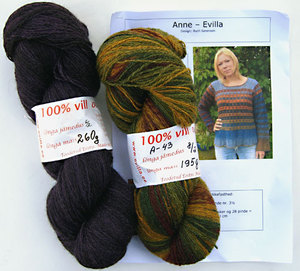
Here’s Evilla all wound up.

Evilla_wound

Nice colors but I think the yarn is even more rough than Kauni.

More yarn from Denmark

Anne-Evilla

The long awaited yarn came yesterday!

It’s for another design by Ruth Sørensen and available from BendixGarn. This pattern is in Danish.

Included in my package was a skein
of varigated green single strand lace-weight Evilla yarn. It was part of a trade in exchange for Socks that Rock yarn. Thanks Vivian.

Natalja asked how I like the Kauni yarn.

Well, not only do I like the colors, I even like the feel of the knitted fabric. It’s a light and soft fabric the suits my taste, but that’s my opinion. I’m not quite so particular about how soft my wool is, especially if it’s used to make a cardigan or pullover that will be worn over a shirt.

One thing that I’ve noticed about Kauni is that it can get very thin in spots. I do wish it was more consistent in thickness.

Natalja, I’m sorry to hear that it’s hard to get some North American yarns over there. This last fall I was in Barcelona and stopped by Persones Llanas. They had Lorna’s Laces.

Evilla yarn doesn’t seem quite as soft as Kauni but maybe it will get softer once it’s been washed.

June mentioned Nancy Roberts’ dye technique. I saw her article in Spin Off and immediately though of Kauni. Now that I’ve had a chance to look more closely at Kauni, I’m not sure how well Nancy’s technique would work as a way to duplicate Kauni.  She paints a knitted piece of fabric with dye. Wouldn’t that leave white spots if the the dye didn’t soak in well? Kauni, on the other hand, is probably spun from dyed wool. It’s as if the the subtle transitions from one color to the next flows so smoothly because of how the yarn is spun. These transition spots are like a marled/heathered yarn, similar to some Shetland yarns I’ve used. That’s why I mentioned that duplicating this yarn would be a good dye + spin + knit project.

A Kauni craze ?

KauniGosh, when I first saw this yarn on Anni’s blog, Hyldemor Knits, I knew I had to have some.

I’m pleasantly surprised at the response it’s gotten from other knitters in North America. Many are just as intrigued with this yarn and Ruth‘s pattern as I am.

It took me several months to get the gumption to order it from wollsucht.de, as I don’t speak or read German. I’ve heard through the grapevine that they’re no longer shipping it to the US but I haven’t confirmed that. I had no trouble ordering it from them, although shipping from Germany seems to be quite expensive compared to other European countries.

I’ve also heard that garnbutik.dk is selling kits for the cardigan and will ship to the US. I’ve never purchased anything from this website so I can’t vouch for the service.

The colorway is EQ. They have many others.

Now, won’t somebody in the US please carry this yarn?

Or hey, this would make a great dye + spin + knit project for all you that do all three.

Update:
There’s another online shop that will ship Kauni to North America. It’s Astrid’s Dutch Obessions
and the website is in English. I haven’t ordered from her before so I
can’t vouch for the service but I have seen her postings on Knitter’s
Review under “Sales and Shop News”. I’m glad that there’s one more
source out there for us on the other side of the pond.