 I started swatching for Irish Moss the other day and could not get anywhere near the tension (gauge) mentioned on in the pattern. It calls for 22 stitches and 28 rows in moss stitch (aka double moss stitch) to create a 4-inch square using 4.5mm needles. After three attempts and two needles sizes later, I’m starting to wonder if this Soft Shetland yarn will actually work for me. I can try again with 3.25mm needles but that just doesn’t seem right. I’ll try one more time with 4mm needles and if the swatch doesn’t match the required tension, I’ll rethink my yarn selection. I keep lusting over Jo Sharp Silkroad DK Tweed, so this afternoon I picked up a ball and will give it a try if the Soft Shetland proves to be too difficult.
Author: knitter
Cat burglar
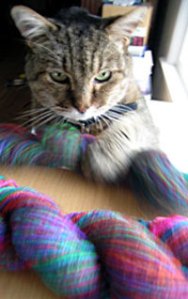 Yes, this blog is about knitting and not my cat.
I try to keep cat pictures to a minimum but no matter how hard I try to keep Toby out of shooting range he continually finds ways to make it into my pictures. I guess it’s revenge for all the times he has decided not to crawl onto my lap because I was holding knitting needles. We’ve tried mixing lap sitting and knitting but he’s decided the two can’t be mixed.
 We got in a little tussle while I tried taking pictures of the yarn I plied last night. I purchased the fiber earlier this summer at the Black Sheep Gathering in Oregon.
The first batch (bottom) was randomly plied with two strands. I didn’t like the muddled affect so I did the second batch using Navajo plying. This technique allows each color segment to be plied together so that the colors don’t get mixed.
Ramblings
Recent Observation
Yesterday afternoon I was checking out Classic Elite Yarns website and found this Wide Rib Cardigan . Looks familiar doesn’t it. Here’s Debbie Bliss’ Lara.
Cables
 Last weekend I made a trip to Weaving Works to pick up a new smaller sized cable needle (the red thing in the picture) and came across Cable Needle Freedom by Carole Wulster. It promises to teach knitters how to knit without a cable needle. I was intrigued and on a whim purchased it along with the cable needle.
This 44-page book describes how to read cable charts; work cables without a cable needle through three exercises; and includes three patterns. The highlighted technique, working cables without a cable needle, is so simple that it is described and illustrated in only 4 pages of the book. Essentially, it shows how to stratigically drop the first half of the cable stitches and pick them up after they have been crossed with the other half of the cable stitches.
While this booklet is cheaper then a class, I’m not quite convinced that I should have spent $15.00 on it. The techinque was easy to do with worsted weight yarn but wasn’t so easy when I tried it on the sport weight blend that I’m using for the Crossing Cables socks. Once the tiny dark stitches were dropped off the needle, it was difficult to find them again. Needless to say, I didn’t dare try this while knitting on the bus.
Although I won’t be throwing out my cable needles, I’ve got to admit this techique might come in handy in a pinch. Since the book starts from square one, it might be more useful for beginning knitters and others that are intimidated by cables. I applaud the author on emphisizing the usefulness of reading stitches. That’s what I do with all my knitting, including the Cable Crossing socks. When I’m working a long stretch of patterned stitches after having worked one repeat of the pattern, I rarely look at the chart. By reading the previous stitches, I can usually figure out what comes next with out looking at the chart.
Irish Moss
You all are so kind, thanks for all the Gilet Lace compliments.
Danny asked which Alice Starmore designs we were considering for the next sweater project.
 Although I didn’t ask my husband’s opinion, I limited my search to Aran type patterns since I haven’t yet attempted one. After searching through several books and pattern sources, I presented him with several designs, which included Irish Moss and Na Craga from Aran Knitting. When presented with the options once again this past weekend, he chose Irish Moss.
Yesterday evening I started my yarn search on the web. I knew it could prove to be interesting since Starmore is known not only for her beautiful designs but also for an odd distribution saga and attempts to thwart e-bay sellers. The Irish Moss pattern calls for Alice Starmore’s Scottish Heather, which is no longer available. My initial google search on Scottish Heather produced information which mentioned that Jamieson’s (who I believe was her previous distributor) Soft Shetland is the closest substitute. A second search for Soft Shetland produced a post on Knitter’s Review, which mentioned that Hilltop Yarns has it on sale for 30% off. Bingo! I had just enough time to jet up there. Lucky for me, they still had enough of it in Anthracite to make Irish Moss. Hopefully, I’ve made a good yarn choice.
Although the Irish Moss project is coming together quickly, I still intend to spend more time on spinning merino fiber and finishing the Crossing Cables socks. By the way, the Crossing Cables pattern is very well written. I would recommend it for any intermediate level sock knitting enthusiast. I should have the first sock done this weekend.
Done!
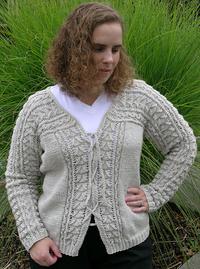 While I spent much of my time catching up at work after being on vacation for a week, I managed to complete Gilet Lace.
Unlike my last sweater project, I have no remorseful feelings about choosing this pattern. I found the pattern easy to follow and written with no mistakes. Well, actually there is one small mistake; I had to double the length of the crocheted cord. Bergereine yarn is easy to work as long as it isn’t ripped out too often. Best of all, the sweater fits well.
So what’s on the sweater project horizon? I’ll start to concentrate on spinning the fiber for the Spin-Off sweater but should also get more serious about making a sweater for my husband. I have a couple of Alice Starmore patterns that he’s approved and just need to choose one.
Lara?
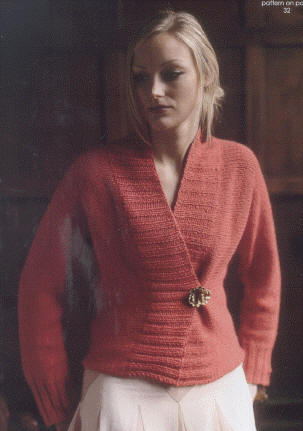
This week I came across Wendy’s post about Debbie Bliss’ Lara pattern and briefly toyed with the idea of making this sweater. It’s a simple but elegant design.
Tuesday night, I made a special trip to Hilltop to check out the pattern book, Silk Alpaca. After flipping through it, I began to realize that I shouldn’t waste $17 on this book since Lara is the only design that I liked. Besides, It’s such a simple design that it couldn’t be too difficult to knock off from the picture. Making my own version makes much more sense because I also wasn’t too thrilled with the thickness of Silk Alpaca ( 10 inches = 18 stitches). Despite only having one design that I liked, I might have purchased the book if it didn’t have one huge glaring problem – no schemas of the sweater pieces.
Mountain Colors

Last week I was as far away from a computer as I could get, soaking in the mountain colors of Glacier National Park in Montana (the home state of Mountain Colors Hand-Painted Yarns). Although I spent most of my time hiking, I did haul the Crossing Cables Socks around in my pack and found a few spare moments to knit. Here’s what I managed to get done (mostly during the long car trip).

After finishing half of the first foot on size 3mm needles, I decided to start over with size 2.5mm needles. The larger sized needles were producing a loose knit fabric that just didn’t look right. The sock should still fit the recipient since the fabric is essentially ribbing that stretches well.
I’m anxious to sew Gilet Lace together. I finished all the pieces just before leaving on vacation so it’s been laying on my project table waiting for my return. Hopefully I’ll find time to work on it tomorrow evening.
I’m sure all the knitting lists are talking about the case of the exploding knitting needle. I just heard about it on the local evening news. Don’t those needles look like Addi Turbos?
Japanese Short-rows
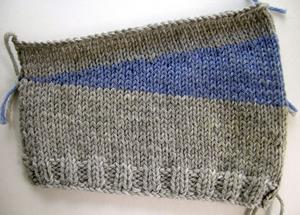
Several months ago, while reading Knitting in the Old Way, I came across Priscilla Gibson-Roberts’ description of how to work short-rows without wrapping the turning stitches.
It starts out in the usual fashion; every other row is worked a certain number of stitches shorter then the last. The usual short-row method requires the knitter to wrap the stitch at the turning point, but with this technique the first stitch after the turn is slipped and not wrapped. After all the short-rows have been worked, one last row is worked across all stitches, stopping at each of the row changes to close the gap by lifting the thread between the slipped stitch and it’s adjoining stitch onto the left needle to create a new stitch that will be knitted together with the next stitch.
Now doesn’t that sound complicated? It did to me, so at that time I filed it away in my mental knitting “to learn” list and didn’t give it much thought until I ran across Susanna Hansson’s Japanese short-row class offered at Acorn Street. I jumped at the chance to learn this from a skilled instructor.
Despite only having three registered students, Susanna went ahead and taught the class last night. I’m so glad that it wasn’t cancelled. Susanna is a wonderful instructor. She clearly communicates not only how to do the technique but why we should follow each step. Upon finishing the swatch she encouraged us to stop and analyze our knitting to figure out why this brilliant technique works so well. I’d encourage anyone to take one of her classes.
If you would like to learn more about how to do Japanese short-rows and can’t take one of her classes, there are a few references on the subject.
Knitting in the Old Way by Pricilla A. Gibson-Roberts mentions how to work these short-rows on the knit side while working in the round.
 Basic Crochet & Knit by Ondori has very clear diagrams that cover each step (page 36). I purchased this one to supplement the class handout.
Reader’s Digest Knitter’s Handbook by Montse Stanley briefly mentions how to do this technique with a couple of pictures.
My Biggest Swatch Ever
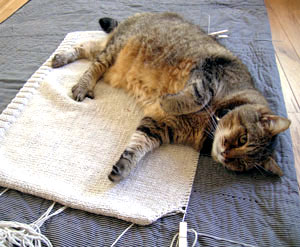
Although Toby does not have front claws, he sure knows how to dig his back claws into any knitted piece that happens to be lying within his reach. Other then this little annoying habit, he tends to respect the fact that my knitting tools and yarn are not his toys.
This piece was suppose to be the back to the Gilet Lace sweater but after I spread it out using blocking wires and shooed the cat away, I realized it turned out too big. I tried incorporating a small deviated from the pattern by replacing two repeats of the lace pattern on the center back with stockinette stitch. Well my calculations for this change were wrong so I’ve ripped out a week’s worth of work and started again with more accurate calculations. I also plan to monitor the width as I knit so I don’t make the same mistake again.
I have it!

Yahoo, I got the Crossing Cables Socks pattern from Danny Ouellette earlier this week.
After flipping through the pattern, it looks like it will be worth the wait. While I might have eventually done it on my own, I can now clearly see that it would have taken a while. I was on the right track but hadn’t yet figured out how to strategically place the cables between purl stitches.
The pattern is five pages long, includes several charts and has a very professional look. I don’t think Danny has spared any details.
Although I’m diligently working to finish Gilet Lace, I couldn’t resist working on a swatch of the Mountain Colors Bearfoot yarn that I’ll be using for the socks. This 3-ply yarn is a pleasure to knit. I’ve decided to follow the pattern and use 3mm needles, but I’m usually inclined to use a smaller sized needle to get tighter stitches when making socks. This time I’ll stick to the larger needles to avoid making socks that will be too small for the recipient.
Under the Mimosa Tree
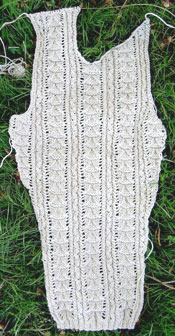 We have just enough green grass under our mimosa tree to spread out the left sleeve of gilet lace for a photograph. As usual, the rest of the grass is suffering through the summer waiting for rain.
This weekend I dropped by Full Circle to check out their current stock. I’m always amazed at the diverse range of yarns that this small traditional yarn store carries. While it’s not a trendy place, it’s certainly worth a trip if you’re looking for brands that you don’t see in other stores around Seattle. They even offer a couple of Phildar lines.
While examining each section of yarn in the shop, I came across Bomull by Marks & Kattens. It’s the long lost identical twin of Bergereine. This yarn would make a great substitute for Bergereine, especially since it comes in a slightly larger array of rich colors.
 Purlwise

You must be logged in to post a comment.